


A Wagging Tail Isn't 'Happy.' Scientists Found the Direction Is the Real Tell
The old rule that a wagging tail means a friendly dog gets people bitten. Researchers discovered something stranger and more useful: dogs wag harder to the right when they feel good and to the left when they're uneasy, and other dogs can read the difference.

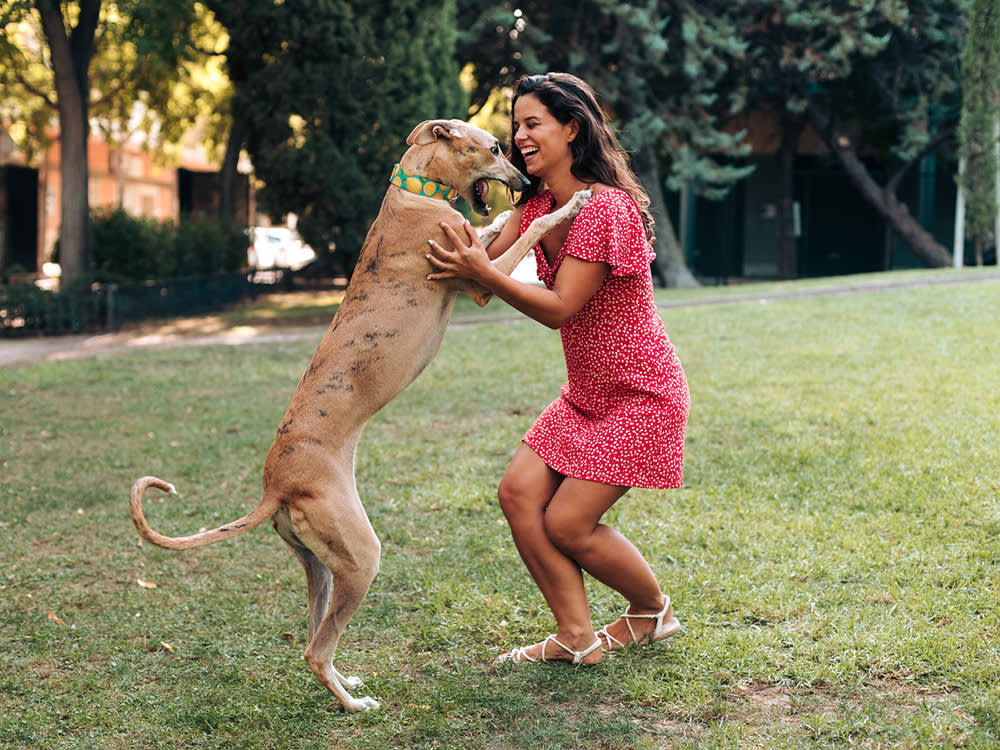
Here’s a piece of dog-body-language folklore that sends people to urgent care: “a wagging tail means a friendly dog.” It doesn’t. A wag means the dog is aroused, emotionally activated, and that arousal can be joy, or it can be the tightly wound tension right before a bite. Plenty of people have reached toward a wagging dog and been shocked to get snapped at, because they read the wag as a green light instead of what it actually is: raw data that needs interpreting.
What makes the tail genuinely fascinating is that science has found a hidden layer in it, one most people have never heard of. It’s not just whether the tail wags, or how high or fast. It’s which way it leans. Dogs wag harder to the right when they feel good, and harder to the left when they feel uneasy. That subtle asymmetry turns out to be a real window into a dog’s emotional state, and, as researchers later discovered, one that dogs themselves can read in each other.
People want the tail to be a simple on-off switch for ‘friendly,’ and it just isn’t. It’s a mood readout, and mood is complicated. Once you stop asking ‘is the tail wagging’ and start asking ‘how is it wagging, and what’s the rest of the body saying,’ you understand the dog in front of you far better, and you’re a lot less likely to misjudge a tense one.
The left brain, right brain of it
To make sense of the direction, start with the brain. In humans, the brain splits into two hemispheres that handle different jobs and each control the opposite side of the body. Most animals show a version of this left-brain, right-brain division. In animals, the left brain is thought to specialize in “approach” behaviors, the drive toward good things like food, while the right brain handles “withdrawal,” the pull to retreat from something frightening. Because a dog’s tail sits right along the body’s midline, researchers wondered whether it might reveal this emotional split, tipping left or right depending on which hemisphere was more active.
The experiment that found it
To test the idea, researchers studied 30 mixed-breed dogs. Each dog was placed in a kennel fitted with cameras precise enough to capture the exact angle of the tail’s movement, then shown four different things, one minute each: their own person, an unfamiliar human, a friendly cat, and a large, unknown, intimidating dog.
The pattern was striking. Seeing their person, all 30 dogs wagged more strongly to the right. Shown a stranger, the wag still favored the right, but less emphatically. The cat pulled the wag right too, more subtly still, curiosity with a positive tilt. And the large, unfamiliar dog flipped it: every dog wagged more to the left.
The conclusion followed cleanly from the brain wiring. Positive or curious feelings pushed the wag to the right, driven by the left hemisphere and its approach system. Unease or wariness pulled it to the left, driven by the right hemisphere and its withdrawal system. The right muscles of the tail broadcast the good feelings; the left muscles signal caution. It’s involuntary, an emotional fingerprint the dog isn’t choosing to show.
Reading the whole tail, not just the direction
The left-right bias is a fine-grained detail, and in real life you’ll rarely have the camera precision to measure it perfectly. That’s why it belongs on top of the basics, not instead of them. A tail speaks through its whole behavior: whether it’s held high or tucked low, stiff or loose, moving in a slow sweep or a fast blur or a full-body circular swish. A high, stiff, fast wag over a tense body is a very different message from a low, loose, wide wag on a wiggly dog, and neither is captured by “the tail is wagging.” Watch the tail alongside the ears, the eyes, the mouth, and the posture, whether you’re at the dog park or sitting in a vet waiting room, and the direction becomes one more useful clue in a fuller sentence.
What newer research adds
The 2007 study answered whether a dog’s own feelings leak into the direction of its wag. A second study, published in 2013, asked the more startling question: do other dogs notice? Researchers showed dogs video of fellow dogs wagging with a left or a right bias and measured their reactions. Dogs watching left-biased wags became more stressed, with elevated heart rates and more anxious behavior, than when they watched right-biased wags. In other words, the asymmetry isn’t just a signal we can decode from the outside; it’s information dogs are actually exchanging, a real channel of canine-to-canine communication.
Scientists have kept probing why dogs wag at all, and the honest answer is that it’s still not fully settled, tail-wagging likely serves several overlapping social and emotional functions rather than one. But the practical lesson for owners is clear and durable: a wag is an emotional broadcast, not a promise of friendliness. Learn to read its height, speed, stiffness, and, when you can catch it, its direction, and you’ll understand what your dog is really telling you, and be far better at spotting the dog who’d rather you kept your distance.
References
- Quaranta, A., Siniscalchi, M., and Vallortigara, G. “Asymmetric tail-wagging responses by dogs to different emotive stimuli.” Current Biology, vol. 17, no. 6, 2007, pp. R199–R201, doi.org/10.1016/j.cub.2007.02.008.
- Siniscalchi, M., et al. “Seeing left- or right-asymmetric tail wagging produces different emotional responses in dogs.” Current Biology, vol. 23, no. 22, 2013, pp. 2279–2282, doi.org/10.1016/j.cub.2013.09.027.
This article is for general education. If your dog shows signs of fear or aggression, consult a qualified trainer or veterinary behaviorist.
Common questions
Does a wagging tail always mean a dog is happy?
No, and believing it does can get you bitten. A wag signals arousal, not necessarily friendliness. You have to read the whole picture: the tail's height, stiffness, and speed, plus the dog's face and body. Research adds one more layer, the direction of the wag, with a rightward bias linked to positive feelings and a leftward bias to unease.
What does it mean when a dog wags more to the left?
In the original research, dogs wagged more strongly to the left when they saw something that made them apprehensive, like an unfamiliar, intimidating dog. Because the right hemisphere of the brain (which handles withdrawal and fear responses) controls the left side of the body, a left-biased wag reflects that the right brain is more active, a sign of caution rather than comfort.
Can dogs actually tell the difference between left and right wags?
Yes. A follow-up study showed dogs watching video of other dogs wagging left grew more stressed, with higher heart rates and more anxious behavior, than when they watched right-biased wags. So this asymmetry isn't just a readout for humans; it's meaningful information dogs pick up from each other.
Dr. Kohl is a board-certified veterinary dentist with a particular interest in preventive oral care. She reviews all dental health content at The Pet Times and contributes practical guides on home dental routines, professional cleaning, and oral disease prevention.
Meet our experts ↗Keep reading
 TrainingYour Dog Isn't 'Bad With Toys.' Nobody Taught Them the Game.Dr. Lena Park · 7 min
 TrainingDogs Don't Forgive After a Fight. What They Do Is SmarterDr. Ravi Mehta · 5 min
 TrainingYour Dog Is Reading Your Face Right Now. The Science Is Wild.Dr. Amara Solis · 6 min
 TrainingThat 'Guilty Look' Isn't Guilt. It's a Read on You.Dr. Nina Kohl · 7 min
 TrainingThe 'Guilty Dog' Face Is Real. Guilt Has Nothing to Do With ItDr. Ravi Mehta · 6 min
 TrainingYour Dog Isn't Peeing on His Friend. He's Peeing on the Message Underneath Him.Dr. Amara Solis · 8 min