


Competitive Dog Surfing Is Real, and the Dogs Are Better at It Than You'd Think
Once a year in Northern California, dogs in life vests drop into real waves and get judged on it. The surprise isn't that it exists. It's how un-competitive the vibe is, and why the dogs genuinely seem to love the ride.

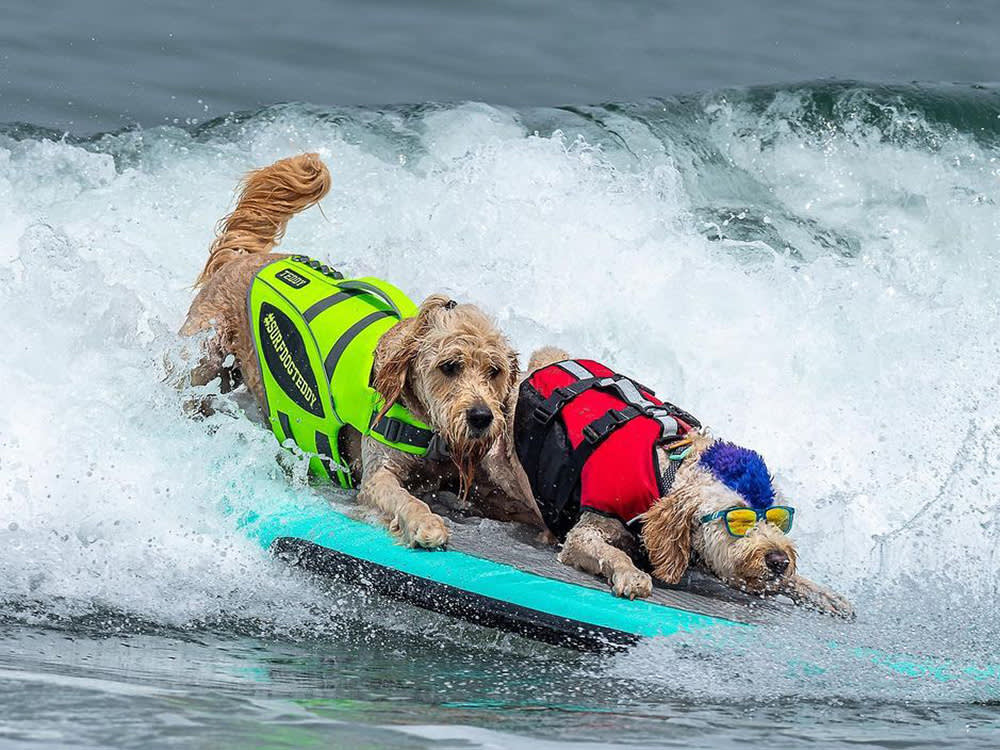
The first time you hear “World Dog Surfing Championships,” it sounds like a bit, a fake event from a sketch comedy show. It is not. Every summer on the coast of Northern California, dogs in bright life vests paddle out, drop into actual breaking waves, and get scored by judges on how they ride. And here’s the part that surprises people who show up expecting a novelty: the dogs are good. Some of them are genuinely, turn-carving, wave-reading good.
The point of this piece isn’t to gawk at the spectacle, though. It’s to answer the better question underneath it: why would a dog want to do this at all? The answer, from the people who do it, has almost nothing to do with competition and almost everything to do with the bond between a dog and their person.
Why the dogs are actually out there
Talk to the sport’s regulars and one reason keeps surfacing: the dogs love it, and the humans mostly consider themselves crew.
For some dogs, it’s about having a job. Stephen Drottar, a surfer of roughly four decades whose Labrador Rosie — “Rippin’ Rosie” on a heat sheet — is a championships regular, ties it to the breed’s boat-working ancestry: in his telling, Rosie comes out of a session with the settled satisfaction of a dog who clocked in, did her work, and did it with her person. For other dogs, it’s raw sensory joy. Alecia Nelson, whose Pug Gidget took the Top Dog Award in 2018, has described a dog who announces herself at the beach at full volume and makes straight for the waves — and who seems to get a bonus out of the ocean itself, since salt water appears to calm Gidget’s allergy-prone skin and ears.
And for at least one pair, surfing rebuilt a relationship. Dan Nykolayko has been candid that when he and his French Bulldog Cherie started, they weren’t especially bonded — her brother Ace was his dog, by his own admission. The ocean forced the two of them to study each other, and by his account the trust eventually ran both directions; Cherie went on to win Top Dog in 2019. That, more than any trophy, is the recurring theme: surfing is a bonding experience first and a sport second.
Can your dog be a surf dog?
The people who do this agree on the one real prerequisite, and it isn’t athleticism. It’s that the dog genuinely loves and is comfortable in the water. Beyond that, they stress a good life vest and patience during training. The origin stories all rhyme, too: dog hops on board, dog stays on board, human realizes the training was mostly a formality. Nykolayko’s summary of the entry requirements amounts to a wave-loving dog, full stop.
If your dog isn’t drawn to water, this isn’t the sport to force. But for the water-loving dog, few activities pack this much exercise, stimulation, and pure shared joy into one salty afternoon.
How the contest actually works
The event was dreamed up by Kevin Reed, author of a book on teaching dogs to surf, and organized by TasteTV, which held the first championship in 2016. Dogs compete in weight classes, small, medium, large, and extra-large, and judges score first, second, and third within each group. There are also tandem heats, two dogs on a board together, or a human and dog riding as a pair, plus a best-dressed beach-fashion award. The top honor across everything is the Top Dog Award, given to the highest-scoring surfer of the day.
The scoring is real, too. Nelson has laid out what the judges reward: distance ridden and the size of the wave both count, a clean ride on an open face beats a whitewater push, and flourishes — a dog steering the board through a turn, or riding it backward — earn extra credit. It is, in other words, a judged sport with actual criteria, performed by animals in flotation vests.
That said, dog surfing carries a chaos the human version doesn’t. Nelson has also explained the sport’s interference problem: send your dog onto a wave and a competitor who launches late can plow into them, and while convention gives the wave to whoever launched first, the judges miss plenty. It’s part of the charm.
The least competitive competition on the beach
You’d expect ego. Drottar describes the opposite. Human lineups, he has said, can turn territorial precisely because waves are a scarce resource — but a dog in the water rewires the whole mood. His experience paddling out with Rosie is that the tension around him simply dissolves; strangers brighten and paddle over to greet her. Whatever scarcity does to human surfers, it doesn’t survive a Labrador on a board.
That warmth is the whole texture of the event. Drottar has compared it favorably to a youth-sports sideline: nobody here is living through their dog, and everyone is rooting for everyone else’s.
Good waves, good cause
There’s a charitable engine under the fun, too. Each year the championships partner with animal-welfare organizations, raising funds and visibility — and organizers say past editions have produced a steady trickle of adoptions around the event itself, with attendees taking rescue dogs home. The do-gooder streak rubs off on the regulars: Nelson went on to found the Surf Gidget the Pug Healing Hearts Foundation, which rescues and trains abandoned dogs, then places them where they’re needed most — with children living with disabilities and with survivors of abuse. Nykolayko, for his part, says Cherie’s surfing career has raised thousands for two rescue groups, the Helen Woodward Animal Center and the French Bulldog Rescue Network.
What’s new since this was written
The championships have kept rolling, and the 2025 edition in Pacifica delivered a repeat champion: Cacau, a chocolate Labrador from Brazil, took Top Dog for the second year running, riding through famously foggy, choppy “washing machine” conditions. Division standouts included a 14-year-old Pit Bull named Faith winning the large-dog class and a French Bulldog taking the medium division, proof that surf-dog talent isn’t limited to the young or the classically athletic.
The bigger picture hasn’t changed, which is rather the point. Year after year, the event keeps pairing wave-riding dogs with rescue fundraising and adoptions, so the charitable side has become as much a fixture as the competition itself. The waves get judged; the dogs get homes.
References
Tom Hadley writes about training and behavior, helping owners understand what their pets are trying to tell them. His work covers everyday manners, decoding common behaviors, and the small changes at home that make dogs and cats easier to live with.
Meet our experts ↗Keep reading
 LivingSo You Want to Work With Animals. It's Harder Than the DreamClaire Sutton · 5 min
 Living12 Women-Owned Pet Brands Born From a Second CareerNina Vasquez · 7 min
 LivingA Former Ringling Clown Is Rewriting the Pit Bull's Reputation, One Hoop at a TimeMarcus Webb · 5 min
 LivingBritain Banned a Dog That Officially Doesn't ExistJames Okafor · 7 min
 LivingOne Sleepover Makes a Shelter Dog 14 Times More Likely to Get AdoptedLeila Torres · 5 min
 Living111 Dogs, One Drug Tip, and the Law That Makes Dogfighting a FelonyJames Okafor · 4 min