


Your Dog Won't Do Stairs? Rule Out Pain Before You Rule Out Courage
Stair refusal is information, not stubbornness. Check the body first, then the staircase itself, then rebuild confidence one literal step at a time.

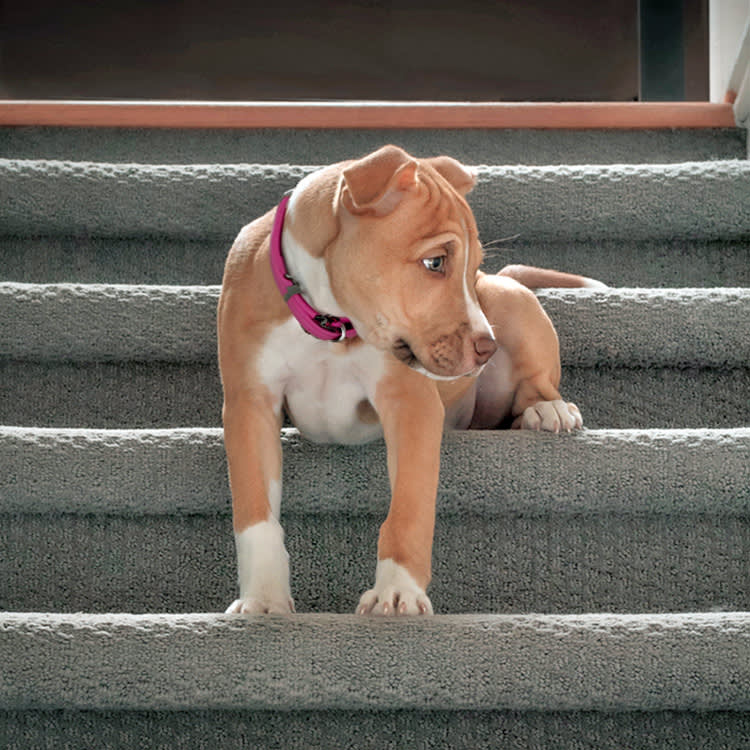
A dog who plants at the bottom of a staircase is not giving you attitude. They are giving you data. The trouble is that the data has several possible meanings, and the most popular interpretation, stubbornness, is the one that is essentially never correct. Before you coax, lure, or haul a 60-pound dog up a flight of steps, it pays to work through what the refusal is actually telling you, in the right order.
First suspect: the body
Trainers who work with stair-phobic dogs consistently make the same first move, and it is not a training move. It is a vet visit. A dog with sore hips, an inflamed knee, early arthritis, or fading eyesight experiences stairs as a genuinely punishing obstacle, and refusing them is a rational choice, not a fear to be trained away. Force that dog up the steps with cheese and cheerleading and you have taught them exactly one thing: the stairs hurt, and now so does the training.
Pain is underdiagnosed in dogs because they hide it well, and stair avoidance is one of its classic early tells, particularly in seniors and large breeds. A dog who used to take stairs happily and has gone reluctant deserves an orthopedic exam before a training plan.
“Sudden stair refusal in a middle-aged or older dog is a pain flag until proven otherwise. I would far rather examine a dog who turns out to be scared than train a dog who turns out to be hurting,” says Dr. Nina Kohl.
Second suspect: the staircase
If the body checks out, look hard at the stairs themselves, because some staircases are legitimately scary from a dog’s eye level. Fear of stairs is not especially common in adult dogs who grew up in homes that have them. It shows up in dogs who were never socialized to them: puppies raised in single-story settings, rescues who lived outdoors or in kennels, and dogs encountering a new home’s architecture for the first time.
Certain designs make it worse. Old houses tend toward steep, narrow flights that challenge depth perception. Slick hardwood or tile treads move under paws that evolved for dirt, and a dog who has slipped once has an excellent memory for it. Floating and open-backed stairs are the worst offenders, because from a dog’s low angle, the staircase reads as a series of ledges over a void. The fix can be as cheap as a runner, stick-on carpet treads, or a blanket draped to make open risers look solid.
Then, and only then: the training plan
The rebuild is the same for a nervous puppy and a reluctant adult, and the full sequence is in the how-to box above. The principles behind it are worth spelling out, because they are where most well-meaning owners go wrong.
Shrink the ask. One step is the unit of progress, not the flight. For many dogs, descending is easier than climbing, so start wherever the dog is more willing. Sit at their level, pay one paw on the tread, then two, then four, and resist the urge to celebrate a good rep by immediately demanding a bigger one.
Let the dog vote. After each rep, toss a treat away from the stairs and watch what happens. A dog who snaps it up and bounces back to the staircase for another round has told you to continue. A dog who drifts away has told you the session is over, and honoring that answer is what keeps tomorrow’s session possible. This consent check is the single best overwhelm detector available, because it requires no skill at reading subtle body language.
Know the stress tells anyway. Weight shifted back onto the hind end while the front paws touch the step means the dog is not ready to commit. Stress panting, looking away from the stairs, or looking up at you mid-attempt are all signs to drop back to an easier version. General stress signals like stiffness, darting eyes, and lip-licking apply here as everywhere.
Never force. No dragging by the leash, no carrying a dog to the middle of a flight to make them finish, no sink-or-swim. Forcing does not teach stairs. It teaches that you are unpredictable near stairs, which is a worse problem than the one you started with.
For puppies, capitalize on their flexibility but respect their construction. Young joints, especially in large breeds, should not be doing repetitive full flights during rapid growth. Carry the puppy when you are in a hurry, train when you are not, and pad slick steps while coordination catches up. No stairs at home? Build the skill on curbs, low platforms, and sturdy boxes so the movement pattern exists before the first real staircase appears.
If progress stalls, a certified fear-free or veterinary-behavior professional can compress months of frustration into weeks, which matters enormously for anyone whose apartment is four floors up with no elevator.
What’s new since this was written
The pain side of this story has changed materially. In 2023 the FDA approved the first monoclonal antibody for dogs, bedinvetmab, sold as Librela, a monthly injection that blocks nerve growth factor to control osteoarthritis pain. More than a million U.S. dogs have received it since launch, and for some stiff seniors, owners report the return of exactly the behaviors this article is about: stairs, couches, and car jumps.
It has not been without controversy. In 2025, following post-approval adverse event reports, the FDA and Zoetis updated the U.S. label to add neurologic signs like ataxia and, notably, worsening mobility in some dogs, and veterinary journals continue to debate case reports of rapidly progressing joint disease in treated dogs. The practical takeaway is narrower than either the hype or the backlash: if your dog’s stair refusal turns out to be arthritis, you now have more options than ever, and a conversation about benefits and risks with your vet, rather than a training plan, is the right next step.
References
Dr. Nair is a veterinarian focused on diet and feeding. She covers everyday nutrition, treats, and the many "can they eat this?" questions owners ask, grounding each answer in what is actually safe and sensible for dogs and cats.
Meet our experts ↗Keep reading
 TrainingYour Dog Doesn't Need a Muzzle. Train Them for One Anyway.Dr. Mara Chen · 7 min
 TrainingThat Creepy 'Shark Tank' Doll Won't Cure Your Dog's Separation AnxietyDr. Amara Solis · 5 min
 Health & WellnessCatnip Won't Mellow Your Dog. What It Actually Does Is StrangerDr. Lena Park · 8 min
 TrainingYour Dog Is Dreading Halloween. 8 Reasons Why (and How to Help)Dr. Amara Solis · 8 min
 TrainingYes, Dogs Wake Up Grumpy. The Morning Growl Is Information, Not Attitude.Dr. Ravi Mehta · 6 min
 TrainingYour Shy Dog Isn't Antisocial. You're Fighting Two Hidden Deadlines.Dr. Mara Chen · 9 min