


Yes, Dogs Wake Up Grumpy. The Morning Growl Is Information, Not Attitude.
Dogs really can wake up on the wrong side of the bed, and a cranky pup isn't being difficult, it's telling you something. Here's how to read the signs and when a bad mood means a vet visit.

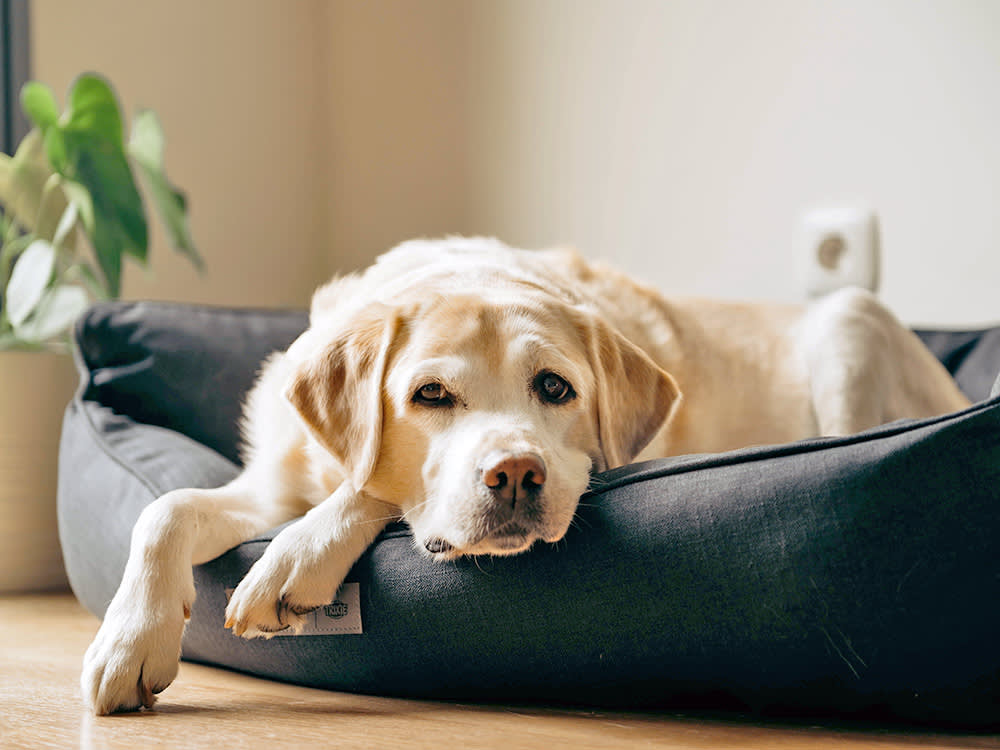
You know the feeling. Twenty minutes awake, stubbed toe, spilled coffee, and no amount of money could pry a smile out of you. We call it waking up on the wrong side of the bed, and we grant ourselves the grace of a bad morning. We’re often far less generous with our dogs. When a normally sweet dog is short-tempered before breakfast, we call it stubborn, or naughty, or “in a mood,” as if it’s a character flaw.
Here’s the shift worth making: a dog’s bad mood isn’t attitude to correct, it’s a signal to read. Dogs can absolutely wake up cranky, and when they do, the pinned ears and the morning growl are the closest thing your dog has to saying “not right now.” Learning to hear that, rather than override it, is one of the kindest things you can do as a pet parent, and occasionally it’s the thing that catches a real problem early.
Dogs have moods, and the biology backs it up
This isn’t sentimental projection. Veterinary behaviorists are clear that dogs feel a genuine range of emotions, and that a dog can wake up feeling off, particularly after a rough night’s sleep. Their emotional palette is simpler than ours, but the hardware is comparable: the hormones that steer a dog’s emotions are much like the ones that steer ours, so a dog’s brain can run through the same kinds of chemical shifts when its mood turns.
Some trainers prefer to skip the word “mood” entirely and talk about a change in a dog’s emotional state, precisely because “bad mood” is such a human frame. Whatever you call it, the practical reality is the same: your dog can get up grumpy, just like you.
A grumpy morning dog isn’t misbehaving, it’s communicating with the limited toolkit it has. The trap is taking it personally and pushing through. When you read the crankiness as information and give the dog room, you’re not spoiling it, you’re often preventing the growl from ever needing to become a snap.
What a bad mood actually looks like
Because a dog can’t announce its funk, you have to read behavior, and every dog does it a little differently. A pup that’s woken up stressed, agitated, or simply out of sorts might show it through pacing, whining, barking, repeated yawning, ears pinned back, panting, digging, a tucked tail, or just retreating to hide.
The most important variable is your own dog’s baseline. You know your dog’s normal better than any checklist, so the tell is the departure from it, the usually-bouncy dog that won’t get off the bed, the cuddle-seeker that wants to be left alone. Learn the individual, and the mood becomes legible.
The trigger you can’t ignore: pain
Here’s the line where a grumpy morning stops being a mood and becomes a medical flag. Pain is one of the most common reasons a dog suddenly turns irritable, and it often surfaces exactly when you touch or handle the dog.
The clearest warning sign is an out-of-character reaction to being petted. A dog that has always leaned into a good ear scratch or a paw massage, and now flinches, avoids it, or warns you off, may be telling you something hurts. That’s not defiance to train out. That’s a symptom to investigate. If a normally affectionate dog starts guarding a body part or reacting to contact it used to love, put pain at the top of your list.
What actually causes a canine off day
Beyond pain, plenty of ordinary things can sour a dog’s morning, the same grab bag that ruins ours. A bad night’s sleep, a bad dream, or a break in routine can all do it. A stressful event the day before, a vet visit, a chaotic afternoon, can carry over into the next morning. Some dogs are sensitive to weather and barometric shifts and get visibly antsier before a storm rolls in.
And it’s not only bad experiences that stir things up. A great, busy day can leave a dog cranky too, in the plain way that being overtired makes anyone short-fused. One trainer described her dog, fresh off a packed week of day camps and a stimulating scent class, growling when she went to massage its paws, a two-year ritual the dog usually adored. The message wasn’t defiance. It was “I’m exhausted, please let me be,” and reading it that way is what kept a tired evening from becoming a conflict.
How to help a grumpy dog
The fixes are mostly about lowering pressure, not applying it.
- Keep the routine steady. Predictability is grounding. Sticking to the normal rhythm of the day helps a dog reset. If the day has to go sideways, say you’ve got guests, give your dog a retreat where it can opt out.
- Offer a decompression spot. A cozy crate or a tent-style bed the dog can enter and leave freely gives it somewhere to reset. The freedom to come and go matters as much as the bed itself.
- Respect the growl. If your dog growls or pulls away from touch, stop. A growl is communication, and punishing it just teaches a dog to skip the warning next time. Let the dog have its space, then offer a low-key outlet on its terms, a sniffy walk, a chew, an easy game of tug.
When it’s time to call the vet
Loop in your veterinarian when a bad mood stops looking like a one-off. If the crankiness is consistent, keeps recurring, or spills into behavior that could be dangerous, like a dog digging under the fence to bolt, it’s worth a check. Your vet’s first job is to rule out a medical cause, because a dog that’s acting different is sometimes a dog that’s hurting.
It helps your vet enormously to arrive with evidence. Jot the out-of-character moments in your phone, or film them, and bring that record along. Once a medical issue is ruled out, the next step is usually a certified trainer, a behavior consultant, or a veterinary behaviorist, who can help you find the root of the pattern. Get the whole team on it, and you and your dog can get back to the good mornings, the ones that end in a walk or a long, happy sprawl on the couch.
References
- Bradshaw, J. W. S. “The evolutionary basis for the feeding behavior of domestic dogs and cats.” Journal of Nutrition, 2006. https://doi.org/10.1093/jn/136.7.1927S
- American College of Veterinary Behaviorists. “What is a Veterinary Behaviorist?” https://www.dacvb.org/
- Mills, D. S., et al. “Pain and Problem Behavior in Cats and Dogs.” Animals, 2020, 10(2), 318. https://doi.org/10.3390/ani10020318
- American Veterinary Medical Association. “Recognizing signs of pain in pets.” https://www.avma.org/resources-tools/pet-owners
Common questions
How can I tell my dog is grumpy versus in pain?
Pain often shows up as an out-of-character reaction, a dog that normally loves being petted suddenly avoiding it or growling when touched. If the mood change is sudden, persistent, or tied to being handled in a specific spot, treat it as possible pain and call your vet.
What should I do when my dog wakes up cranky?
Keep the day's routine steady, give your dog space and a cozy spot to decompress, and respect a growl instead of pushing. If crankiness keeps recurring or turns risky, rule out a medical cause with your vet.
Dr. Mehta is a board-certified veterinary nutritionist who evaluates pet food formulations, ingredient quality, and the science behind dietary trends. He writes and reviews all nutrition content at The Pet Times, including our food rankings and feeding guides.
Meet our experts ↗Keep reading
 TrainingThat Hug You Love? Your Dog Is Probably Just Enduring It.Dr. Nina Kohl · 5 min
 TrainingYour Dog Isn't Aggressive at the Door. He's Scared, and the Door Makes It Worse.Dr. Mara Chen · 4 min
 TrainingThe Algorithm Rewards Bad Dog Training. Here Are 10 Tells.Dr. Mara Chen · 7 min
 TrainingYour New TV Is Half the Reason Your Dog Won't Stop Barking at ItDr. Nina Kohl · 8 min
 TrainingYour 'Stubborn' Dog Is Actually Terrified. Here's What to Do.Dr. Nina Kohl · 10 min
 TrainingYour Dog Isn't Being Difficult. They're Begging for a Schedule.Dr. Lena Park · 8 min