


That Hug You Love? Your Dog Is Probably Just Enduring It.
Two studies, one of photos and one of videos, found most dogs show stress signals when we hug them. The good news: once you know what those signals look like, you can trade the squeeze for affection your dog actually enjoys.

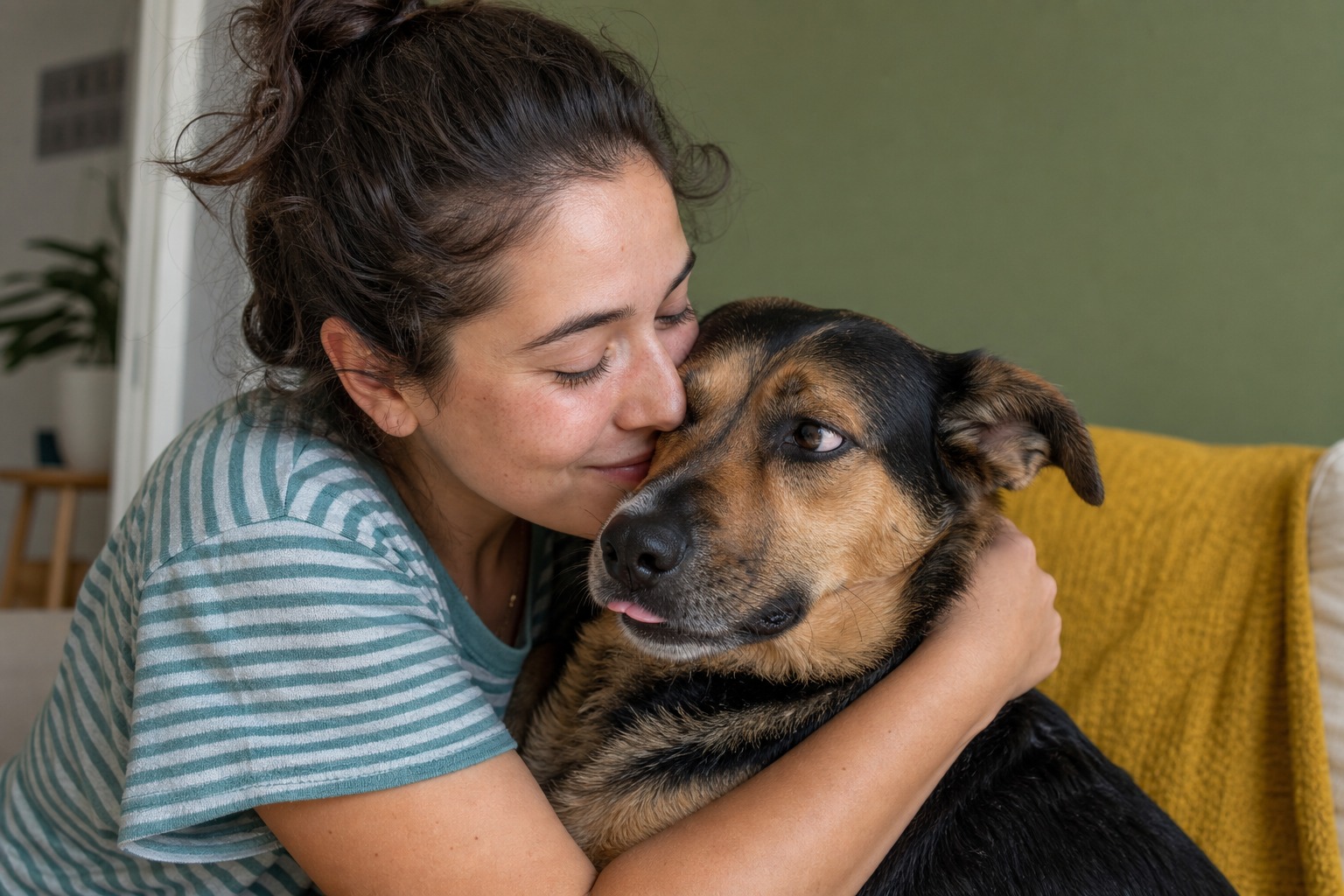
A hug is one of the warmest things one human can do for another, so it feels obvious that our dogs must love it too. Here’s the uncomfortable version of the truth: for most dogs, a full-body squeeze isn’t a message of love, it’s a loss of an exit. And when researchers actually looked closely, first at photos and later at video, the dogs told on us.
This isn’t a reason to feel guilty or to stop being physically affectionate. It’s an invitation to swap one gesture your dog tolerates for several your dog genuinely enjoys. But first, the evidence, because it’s more convincing than a single grumpy study.
Two studies, one consistent answer
The first data point goes back to 2016, when psychologist Stanley Coren ran a search for the phrase “hug dog,” pulled the first 250 photos it returned across Google Images and Flickr, and scored the dogs’ body language. The split was stark: roughly 81.6 percent of the dogs showed at least one sign of discomfort, about 10.8 percent looked neutral, and only around 7.6 percent looked genuinely at ease. Photos, though, freeze a single instant, and critics reasonably wondered whether a snapshot could misjudge a fleeting moment.
A 2024 study published in Applied Animal Behaviour Science answered that objection by using video instead of stills. Moving footage let the researchers catch the fast, easy-to-miss behaviors that a photo can’t, such as a quick nip, a yawn, or a blink. They analyzed the 80 most-watched clips of people hugging dogs on social media, and the numbers echoed Coren’s. In that footage, 81 percent blinked, 68 percent broke eye contact and turned their heads away, 60 percent narrowed their eyes, 44 percent licked their lips or noses, and 43 percent panted. Most striking, in 68 percent of the clips the dog nipped or mouthed at the person. Individually, any one of these can be nothing. Stacked together during a hug, they’re a dog quietly asking for space.
Why a hug lands so differently for a dog
The gap comes down to what an embrace does to an animal built to flee. Dogs are cursorial, meaning their bodies are engineered to run, and running is their first line of defense when something feels threatening. Wrap your arms around a dog and you’ve removed that option. Even a beloved, well-meant hug can register as being pinned, and a pinned animal that can’t create distance has to fall back on other coping behaviors, which is exactly what those lip-licks and head-turns are.
Here’s the catch that makes this so easy to get wrong: the calming signals dogs use, like yawning and lip-smacking, are the same behaviors we find adorable. So we read stress as cuteness and lean in harder. Misreading it isn’t harmless. A dog whose polite “please stop” gets ignored may escalate, and a bite that seems to come “out of nowhere” is often the last line in a paragraph the dog had been writing for several seconds.
The dogs that worry me most are the tolerant ones. A dog who freezes and endures a hug looks calm to the person giving it, but freezing is a stress response, not consent. If you learn to spot the whale-eye and the lip-lick, you’ll catch the conversation long before it ever gets to a growl or a snap.
Signs worth learning, from both studies, include tongue flicks, ears pinned back, the head or whole face turned away, the whites of the eyes showing in half-moons (often called “whale eye”), a tightly shut mouth, tense facial muscles, and a furrowed brow. A relaxed dog, by contrast, tends to have a loose open mouth, soft face, and none of that tension.
What to do instead
Your own dog might truly be one of the rare few who leans into a hug, and body language will tell you: soft eyes, relaxed mouth, a body that melts toward you rather than stiffening or angling away. If the signals say otherwise, you have plenty of better options. Most dogs would trade a hug in a heartbeat for a slow ear scratch, a chest or shoulder rub, a shared spot on the couch, or a calm hand resting on their side. These deliver the closeness you’re after without taking away their sense of escape.
The broader fix is literacy. The researchers behind the video study argued for exactly this, more education for adults and kids alike in reading canine communication, because the misunderstanding runs both ways and the stakes include both your dog’s comfort and everyone’s safety. Learn the signals once, and you’ll spend the rest of your dog’s life giving affection they actually want, which is the whole point of a hug in the first place.
References
Dr. Kohl is a board-certified veterinary dentist with a particular interest in preventive oral care. She reviews all dental health content at The Pet Times and contributes practical guides on home dental routines, professional cleaning, and oral disease prevention.
Meet our experts ↗Keep reading
 TrainingYour Dog Nibbles You Like Corn on the Cob. Two Experts Disagree About What to Do.Dr. Nina Kohl · 8 min
 TrainingThat Dog in a Yellow Bandana Is Politely Asking You to Back OffJordan Ellis · 5 min
 TrainingYour Dog Isn't Lonely. Point a Camera at Them and Find Out.Dr. Nina Kohl · 8 min
 TrainingYelling at Your Dog Lands in Their Body, Not Just Their EarsDr. Mara Chen · 5 min
 TrainingYou Don't Win Over a Scared Dog. You Become Safe and Boring.Dr. Lena Park · 9 min
 TrainingIt's Not the Job Stressing Your Dog Out. It's the Replay.Dr. Lena Park · 6 min