


Your Dog Is Dreading Halloween. 8 Reasons Why (and How to Help)
To a dog with no concept of Halloween, the whole night is a sensory ambush. Here are the eight things that spook them most, and how to defuse each one.

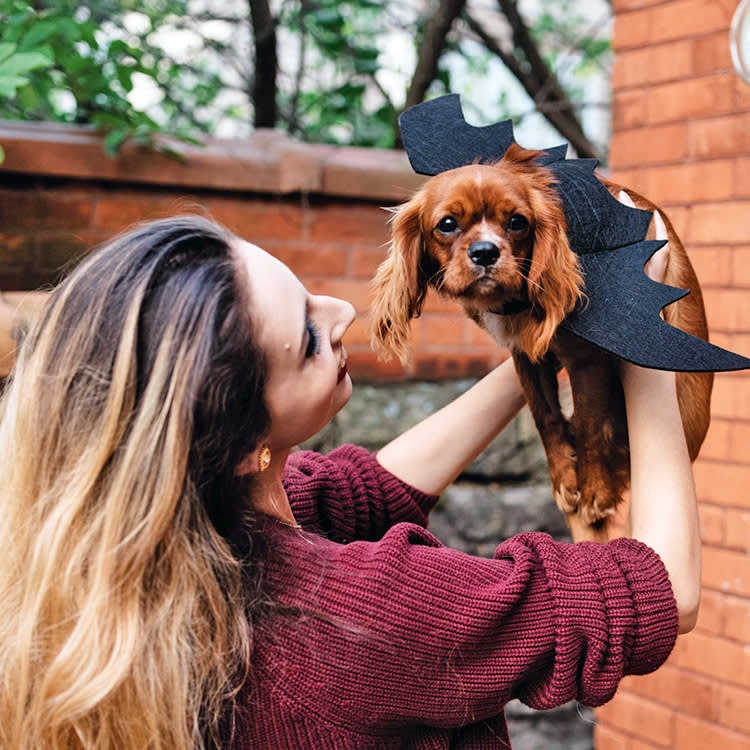
Imagine heading out for your normal evening walk and finding a 30-foot inflatable cat looming over a yard that was empty yesterday, with no way to understand why. That is Halloween from your dog’s point of view: a night where the rules of the world quietly break, all at once. No wonder so many dogs spend it on edge.
The good news is that “my dog hates Halloween” is really eight smaller problems wearing one scary mask. Once you figure out which specific triggers are hitting your dog, you can defuse them one at a time. Below are the eight most common ones, and a fix for each. You will not need all of them. You will need the two or three that match your particular dog.
The triggers cluster into three kinds: the social crush at your front door, the sensory assault in the air, and the confusion of costumes. We’ll take them roughly in order of how much trouble they cause a typical dog, starting with the doorway, which is both the scariest spot and the most dangerous.
1. Strangers at the door, and the doorbell that announces them
To many dogs, a steady stream of strangers walking up to the house feels like a territorial invasion, which can flip even a friendly dog into fearful or protective behavior. And the doorbell becomes its own separate torment, ringing over and over to signal each new wave.
Work on this before the big night. In the days ahead, have a friend ring the bell repeatedly while you pay your dog for staying relaxed or trotting off to a designated calm spot. On Halloween itself, set up a cozy retreat, a room with familiar bedding and favorite toys, and leave a TV or radio on to blur the outside sounds. Then take the doorbell out of the equation entirely: sit outside to greet trick-or-treaters, or watch for approaching kids so you can open the door before anyone rings. Every ring you prevent is one your dog doesn’t have to weather.
The night an anxious dog is most likely to bolt is the same night your neighborhood is full of strangers and open doors. Fifteen seconds spent double-checking a tag and a microchip is the cheapest insurance you’ll ever buy.
2. The trick-or-treater parade
A street full of pint-sized ghouls is a lot for a dog who prefers quiet walks and gets uneasy around kids. Walk or play hard with your dog earlier in the day, before the costumed crowds come out. A dog that has already burned energy is usually a calmer dog at 7 p.m.
This is also a safety issue, not just a comfort one. Halloween is the second-biggest day of the year for lost pets, behind only the Fourth of July. Even microchipped dogs can slip out an open door and vanish into the chaos. Keep a collar and ID tag on your dog all night. If your dog isn’t wearing one, a strip of painters tape with your name and number written on it works in a pinch. Make sure the contact info on both the tag and the microchip is current, and keep a recent photo on hand. A photo of a shaggy dog is not much help if your dog just came back from the groomer.
3. Unusual noises
The doorbell is not the only culprit. Fireworks, electronic decorations, and nearby parties all throw off sounds that can rattle a nervous dog. The same comfy, insulated retreat that helps with the doorbell helps here too.
One rule matters more than any other on a loud night: never leave your dog alone outside or off the leash, fenced yard or not. A sudden bang can send a panicked dog scrambling over or digging under a fence, and a loose dog on Halloween is a genuinely dangerous situation. There is also the uglier reality that some people treat the holiday as license for pranks, and you do not want your dog to become a target.
4. Bright or flashing lights
We love the glow of string lights, glow sticks, and flashlights. Your dog may not. Flashing and strobing lights can unnerve a sensitive dog, and the only real fix takes time. Desensitization works, but it works slowly, ideally introduced over weeks, not the afternoon of the 31st. Bring the light source out gradually, keep it low-key, and pair it with treats and praise for any calm or neutral reaction. Rushed exposure the day of tends to sensitize a dog further rather than help.
5. Unfamiliar decorations
Objects that light up, move, or make noise are unsettling precisely because your dog can’t file them under anything familiar. The fix starts at home: let your dog watch you set up your own decorations so nothing appears out of nowhere. If you have motion-activated decor, switch the motion sensor off when you are not actively using it, so your dog isn’t ambushed every time it heads to the water bowl.
Out on walks, resist the urge to march your dog up to the neighbor’s giant skeleton to “show” them it’s fine. Instead, let curious dogs investigate new sights on their own terms where it’s safe. Give them five to 10 seconds to look. If a dog is still rooted in place and staring after that, it may have locked up the way a deer freezes in headlights, and coaxing it away with a treat beats forcing it to keep staring.
6. Seeing you in a costume
Your Morticia Addams look may be flawless, but your dog does not get the reference. A person they love suddenly wearing a long wig and strange clothes can be genuinely disorienting, even frightening. The fix is a “getting ready” session your dog can watch. Put the costume on in stages rather than popping out fully transformed, and reward your dog for calmly checking out your weird new outfit. Try not to take it personally if the review is lukewarm.
7. Your dog in a costume
If you in a costume can rattle your dog, a costume on your dog can be worse. Plenty of dogs are simply uncomfortable in clothing. If you want the photo anyway, choose a costume that does not restrict movement or breathing and has no pieces small enough to be chewed off and swallowed. Introduce it slowly over several days, paired with lots of treats, so the outfit predicts good things. A best-in-show ribbon is not worth a miserable dog, so if your pup clearly hates it, let the costume go.
8. Changes in routine
Dogs are creatures of habit, and Halloween scrambles the schedule: dinner runs late, the evening walk gets weird, the house fills with commotion. Keep as much of the day ordinary as you can. Feed and walk at the usual times where possible, and minimize the disruptions you can control.
When your dog does get stressed, lean on activities that actually lower stress hormones: licking, chewing, and sniffing. A long-lasting chew or a stuffed, frozen puzzle toy can help a dog decompress after a jarring moment. Keep your own reaction calm and matter-of-fact. Fussing over an anxious dog with a flood of “it’s okay, it’s okay” can accidentally signal that there really is something to fear. If your dog is visibly stressed outside, don’t coddle, just calmly walk it back to a quieter place.
Should you consider medication?
Most dogs get through Halloween without medication, but every dog is different. If yours has a real terror of nights like this, talk to your vet well in advance, not the day of. Anti-anxiety medication needs time to trial so you can see whether it helps and adjust the dose with your vet’s guidance before the actual event. If prescription medication feels like more than you need, ask about calming supplements or pheromone diffusers, which are gentler options for milder cases.
“The most common Halloween mistake I see is families waiting until the doorbell is already ringing to think about a fearful dog,” says Dr. Solis. “Whether it’s a training plan, a chew, or a medication, everything works better when you start it a week or two out.”
Halloween is a logistics-heavy holiday for a lot of us. But match the fix to your dog’s actual triggers, start early, and there is a real chance you will both make it to the “Monster Mash” in one relaxed piece.
What’s new since this was written
Veterinary behavior guidance has increasingly moved toward planning ahead rather than reacting in the moment, and prescription anti-anxiety options for situational fear have expanded, so a conversation with your vet in early October now opens more doors than it used to. The consistent message from behavior specialists is that calming supplements and pheromone products can take the edge off mild anxiety, but genuinely fearful dogs do best with a plan set up in advance.
The candy warning has also gotten sharper. Xylitol, the sugar substitute that is dangerous to dogs, now frequently appears on ingredient labels as “birch sugar,” which can hide it from parents scanning for the more familiar name. If your dog gets into sugar-free candy or gum, treat it as an emergency and call your vet or the ASPCA Animal Poison Control Center right away.
This piece covers anxiety and safety around a stressful holiday. If your dog struggles with severe fear or panic, please loop in your veterinarian, who can tailor a plan to your specific dog.
References
Common questions
Is Halloween candy dangerous for dogs?
Yes. Chocolate is toxic to dogs, and sugar-free candy and gum often contain xylitol (also labeled 'birch sugar'), which is highly poisonous even in small amounts. Keep all candy out of reach and watch for dropped pieces on walks.
Should I put my dog in a costume?
Only if your dog is genuinely comfortable in one. Many dogs dislike wearing clothes. If you do dress them up, make sure nothing restricts movement or breathing, skip pieces they could chew off, and introduce the costume gradually with treats.
Dr. Solis is a board-certified veterinary dermatologist with over twelve years of clinical experience. She advises on skin conditions, allergies, and grooming practices that affect coat and skin health. All dermatology and allergy content at The Pet Times is reviewed by her team before publication.
Meet our experts ↗Keep reading
 Health & WellnessThe Hot Car Isn't What Gets Most Dogs. The Walk Is.Dr. Priya Nair · 9 min
 TrainingYour Dog Isn't Being Dramatic About Storms. Four Fears Are Hitting at Once.Dr. Nina Kohl · 6 min
 TrainingYour Dog Doesn't Need a Muzzle. Train Them for One Anyway.Dr. Mara Chen · 7 min
 TrainingComforting Your Storm-Scared Dog Won't 'Reward' the FearDr. Amara Solis · 6 min
 TrainingYour Dog Doesn't Need a Bad Memory to Be Terrified of the VacuumDr. Priya Nair · 9 min
 Health & WellnessThe 'Vagus Nerve Reset' for Anxious Dogs Is a Myth. The Nerve Is Not.Dr. Lena Park · 6 min