


That Creepy 'Shark Tank' Doll Won't Cure Your Dog's Separation Anxiety
A human-shaped dummy in your old T-shirt is having a viral moment as a separation-anxiety fix. Trainers say it misreads the whole problem. Here's why panic isn't loneliness, and what actually helps a dog left alone.

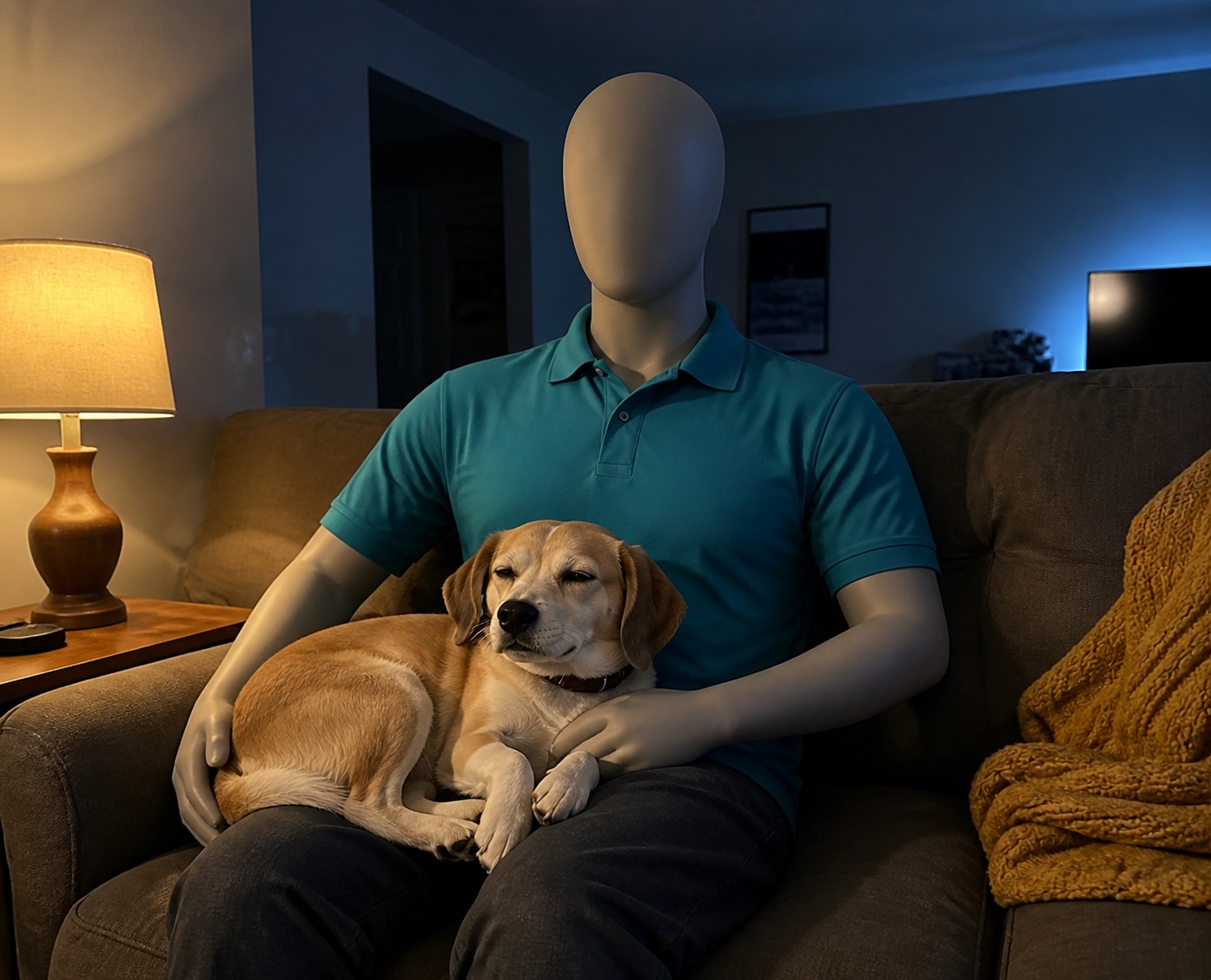
There is a certain kind of pet product the internet cannot resist: the one weird trick that promises to fix a hard, expensive, emotionally draining problem in one purchase. The latest is a human-shaped doll you dress in your worn clothes and prop on the couch so your dog thinks someone stayed home. It got its biggest boost in October 2025, when an inventor named Todd Schram brought one, a seated inflatable dummy called Gerty, onto Shark Tank. Robert Herjavec called it scary and weird. Kevin O’Leary saw a viral hit and put in $50,000 for 30 percent of the company. The clip did numbers. The dolls sold.
And the whole premise is built on a misunderstanding of what separation anxiety actually is.
Panic is not the same as loneliness
This is the crux, so it is worth being blunt about. A dog with real separation anxiety is not lonely in the way a bored dog is lonely. They are in a state of panic, triggered by losing access to the one person they are bonded to. Company, in the abstract, is not what they are missing. Proximity to their person is. A dummy on the sofa does not touch that, because the problem was never an empty seat.
When people describe the doll, they usually say something like, ‘so he won’t feel alone.’ But a dog in a genuine separation panic isn’t lonely, they’re terrified that the person they rely on has vanished. A stand-in body doesn’t answer the fear the dog actually has. At best it’s a novelty. At worst it convinces an owner they’ve solved something they haven’t even started on.
And no, your dog is not fooled. However pungent the T-shirt you drape over it, a dog does not mistake a mannequin for a human being. When a dog does seem more settled near one, it usually comes down to something ordinary: the object’s size, the trace of your scent on it, or simply the mild interest of a new thing in the room. That is closer to how a fan’s white noise or a body pillow works, a familiar, steady presence in the background, than to anything that resolves distress.
The concept, for what it’s worth, predates the Shark Tank version by years. Back in 2019, a Bulldog named Shorty who fell apart whenever her owner Marc traveled was given a mannequin from Vintage Pet Rescue, nicknamed Farc, short for Fake Marc. Shorty adored it, and after she passed, other dogs at the rescue took to curling up in Farc’s lap. The videos are genuinely sweet. Sweetness, though, is not the same as a cure.
Where the doll can quietly backfire
The real risk is not the doll itself. It is what an owner stops doing because they bought one. Trainers worry most about false reassurance: a dog who is soothed just enough that their person delays the actual, proven help while the underlying panic goes untreated. There is also the temptation to lean on the prop as a babysitter. A comfort object, if your dog happens to like one, is not permission to leave them alone longer. It is not a substitute for a person, and it does not do the work.
What actually helps a dog who can’t be left alone
Here is the part the miracle-cure framing skips: treating separation anxiety is a slow project, and it works. The methods are unglamorous and well-supported.
Build a predictable routine. Dogs settle when the day is legible. Even for an anxious dog, being consistent about how and when you leave gives them a dependable structure to lean on.
Make the crate a refuge, not a punishment. A cozy, positively introduced crate can become a safe den a dog retreats to by choice. What reads as confining to us can read as secure to them, and starting this early, ideally in puppyhood, helps.
Practice leaving in tiny doses. This is the engine of the whole thing. Step out for seconds, then minutes, and stretch the absences only as fast as your dog stays calm. Keep departures and returns low-key, resisting the urge to stage a tearful goodbye, so the coming and going stops feeling like an event.
Ask your vet about calming support. When training alone isn’t enough, a vet may suggest a calming supplement, ingredients like chamomile or CBD help some dogs take the edge off, or, in more severe cases, prescribe an anti-anxiety medication. That is a conversation to have with your veterinarian, not a shelf you self-shop.
Bring in a pro for the hard cases. For dogs whose panic is severe, a certified trainer or veterinary behaviorist can build a plan matched to that specific dog. This is where the biggest, most stubborn cases actually turn around.
What’s new since the doll went viral
Gerty didn’t fade after its television moment. The company is still selling in 2026, and the product line has grown: alongside the standard doll, you can now buy a personalized version with a photo of your own face printed on the head. The standard doll runs about $50, sometimes discounted to $40, and the custom one about $65.
None of which changes the underlying picture. If you like the idea of your dog cuddling a soft, scent-carrying object while you’re out, and you are already doing the real work, a doll is probably harmless, and, fine, kind of endearing. Just don’t buy it expecting it to do a trainer’s job. There is no single product that keeps an anxious dog calm. Consistent, gradual training does, and nothing replaces actual time with an actual person.
References
- Sherman, Barbara L., and Mills, Daniel S. “Canine Anxieties and Phobias: An Update on Separation Anxiety and Noise Aversions.” Veterinary Clinics of North America: Small Animal Practice, 2008. https://pubmed.ncbi.nlm.nih.gov/18657769/
- de Assis, Luciana S., et al. “Developing Diagnostic Frameworks in Canine Separation-Related Problems.” Frontiers in Veterinary Science, 2020. https://www.frontiersin.org/articles/10.3389/fvets.2019.00499/full
- American Veterinary Medical Association. “Separation Anxiety in Dogs.” https://www.avma.org/resources-tools/pet-owners/petcare/separation-anxiety-dogs
Common questions
Do dolls or mannequins actually help dogs with separation anxiety?
For most dogs with true separation anxiety, no. The condition is panic at losing access to a specific person, not simple loneliness, so a stand-in body doesn't address it. Some dogs enjoy a doll as a comfort object, but experts do not consider it a treatment.
Does my dog think the doll is a real person?
No. Dogs are not fooled into thinking a dummy is human, no matter how much of your scent is on it. If a dog seems calmer near one, it's usually the size, the familiar smell, or just the novelty of something new in the room.
What actually works for separation anxiety?
A consistent routine, positive crate training, gradual desertion practice that builds from very short absences, vet-guided calming supplements or medication when needed, and, for severe cases, a certified trainer or veterinary behaviorist.
Dr. Solis is a board-certified veterinary dermatologist with over twelve years of clinical experience. She advises on skin conditions, allergies, and grooming practices that affect coat and skin health. All dermatology and allergy content at The Pet Times is reviewed by her team before publication.
Meet our experts ↗Keep reading
 TrainingYou Didn't Make Your Puppy Shy. Biology Did, Before They Were Born.Dr. Amara Solis · 5 min
 TrainingThe 'Velcro Dog' Is Sweet Until It Isn't. Know the Difference.Dr. Ravi Mehta · 7 min
 TrainingWhen Your Dog Turns to Stone on a Walk, Don't Pull. Read It.Dr. Amara Solis · 6 min
 TrainingYour Dog's DNA Isn't the Whole Story. The Part You Can Actually Change Is.Dr. Mara Chen · 5 min
 TrainingYour Dog Doesn't Need a Bad Memory to Be Terrified of the VacuumDr. Priya Nair · 9 min
 TrainingYour Dog Isn't Lonely. Point a Camera at Them and Find Out.Dr. Nina Kohl · 8 min