


How Often to Groom Your Dog Comes Down to One Word: Coat
There's no universal grooming schedule, and the biggest mistake owners make, shaving a double coat, can actually harm your dog. A coat-by-coat guide to bathing and trimming, plus the nails, teeth, and ears most people forget.

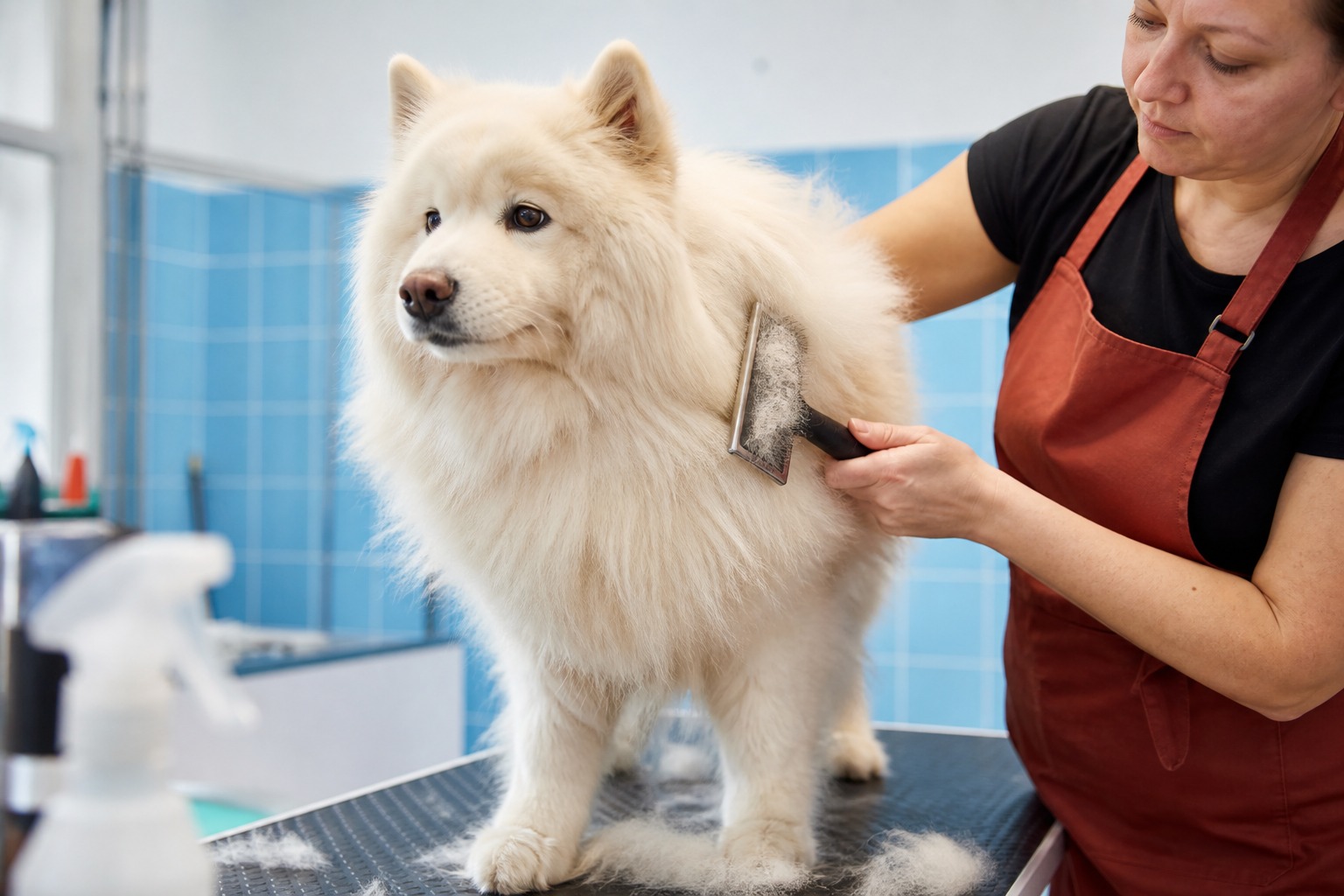
There is no single right answer to how often your dog needs grooming, and anyone who gives you one number is guessing. How often you groom hinges on your dog’s coat, how long you like the fur, the hours they spend rolling around outdoors, and even their age. Get the coat part right and everything else falls into place, including the single most common grooming mistake, which can actually hurt your dog. Let’s start with why any of this matters, then break it down by coat.
Grooming is a health routine, not a spa day
Your dog may love a good roll in the mud, but they also feel better clean, and the benefits go well past a shiny coat. A regular routine keeps skin and coat healthy, which feeds directly into overall health: it helps prevent fleas and ear mites, clears out dead hair and skin, and keeps skin from getting irritated. Regular handling also makes your dog more comfortable being touched, which pays off at every vet visit. And a groomer, professional or you, gets close enough to spot problems hiding under the fur, like skin conditions, lumps and cysts, and early ear infections, before they turn serious.
As a baseline, most dogs are fine bathing somewhere in the six-to-12-week range, plus the odd nail trim. Watch your dog: visible dirt or odor means it is bath time regardless of the calendar. Beyond that baseline, your dog’s coat sets the schedule.
Know your dog’s coat type
Between purebreds and mixes, dog coats fall into a handful of categories, and each has its own needs.
- Short-haired coats are smooth and low-maintenance, often lower in dander. Think Pit Bulls, Pugs, Boston Terriers, Labrador Retrievers, and Bull Terriers.
- Long-haired coats are long and often silky and need more upkeep. Some Poodle mixes, Lhasa Apsos, Collies, and Shih Tzus qualify.
- Thick undercoats belong to cold-climate breeds like Siberian Huskies, Akitas, Old English Sheepdogs, and Alaskan Malamutes. This is the double coat, and it needs careful handling (more on that below).
- Silky coats appear on some long-haired breeds like Shih Tzus and Lhasa Apsos, and even medium-coated dogs like the Maltese, Yorkshire Terrier, and Samoyed.
- Curly and wire-haired coats cover Poodles and many Doodle mixes, Bichon Frises, and Cocker Spaniels (curly), plus coarser-coated dogs like the Airedale Terrier, Brussels Griffon, Jack Russell Terrier, and Dachshund (wire).
The trimming schedule, by coat
Not every dog needs a haircut. Many short-haired dogs do beautifully with just baths and nail trims. In fact, short-haired dogs should not be trimmed at all in most cases, because cutting happens so close to the skin that it can do harm; unless your vet recommends it for a medical reason, leave a short coat alone.
For the coats that do need trims:
- Long-haired dogs: a professional trim every eight to 12 weeks. Daily brushing stretches the time between cuts.
- Thick undercoats: groom and remove the loose undercoat about every eight to 12 weeks so the skin can breathe without losing the insulation the dog needs. If you trim at all, take off no more than half an inch, and lean on a professional, since this coat is more involved.
- Silky coats: these dogs usually lack an undercoat and have oilier skin, so a trim every four to eight weeks works, depending on how long you keep the fur.
- Curly-haired dogs like Poodles do best with a trim roughly every six to eight weeks so the coat doesn’t mat; wire-haired dogs land in the four-to-eight-week range.
The mistake that can actually hurt your dog
If you take one thing from this, make it this: do not shave a double coat. It is tempting in summer, out of a well-meaning belief that you are cooling your dog off. But a thick undercoat is not just insulation against cold; it also shields against heat and protects the skin, and shaving it can lead to patchy, improper regrowth that never fully recovers. Dogs with undercoats need de-shedding and light tidying, not a buzz cut. This is the difference between grooming that helps and grooming that backfires.
“The undercoat is doing a job, even in July,” says Dr. Mara Chen. “When people shave a Husky or a Golden down to the skin to ‘help’ with the heat, I often see the opposite, more sun exposure, more skin trouble, and a coat that grows back wrong. Brush it out, don’t shave it off.”
The parts people forget
Baths and haircuts get the attention, but a full routine includes a few smaller jobs on their own clocks:
- Nails: roughly every three to four weeks, or whenever you hear clicking on hard floors. Overgrown nails can actually change your dog’s posture and gait and become painful.
- Teeth: daily brushing with a dog-safe, often peanut-butter-flavored toothpaste is the gold standard; even a few times a week beats nothing. Dental disease is one of the most common and overlooked problems in dogs.
- Ears: check and gently clean floppy or hairy ears regularly, especially in breeds prone to ear infections and after swimming.
Senior dogs deserve a gentler, more frequent touch, too. Older skin is thinner and more sensitive, joints make long grooming sessions harder to tolerate, and regular handling helps you catch new lumps or sore spots early.
DIY or the pro?
Before you take scissors or clippers to your dog yourself, it is worth a quick check with your vet or a groomer, either of whom can point you to the right products and cadence for your specific dog. Short-coated dogs are very manageable at home. Double coats, elaborate breed cuts, and any dog who finds grooming stressful are usually better off with a professional who can keep the experience safe and low-stress.
References
- Skin and coat health in dogs — Merck Veterinary Manual
- Why you shouldn’t shave double-coated dogs — American Kennel Club
- Dental care for dogs — American Veterinary Medical Association
This article offers general grooming guidance. For skin, coat, or dental concerns, check with your veterinarian.
Common questions
Is it okay to shave my double-coated dog in summer?
Usually no. A double coat insulates against heat as well as cold and helps protect the skin, and shaving it can lead to patchy, improper regrowth. Dogs with thick undercoats should be de-shedded and lightly tidied, not shaved down. When in doubt, ask a groomer or your vet.
How often do dogs need their nails trimmed?
A good rule of thumb is roughly every three to four weeks, or whenever you hear nails clicking on hard floors. Overgrown nails can change how your dog stands and walks and become painful, so this is not just cosmetic.
Not a substitute for your vet. Our guidance is educational. For urgent symptoms, contact a vet or emergency clinic right away. Editorial standards
Sasha Ford is a certified cat behaviour consultant who has worked with shelters, catteries, and private clients across the country. They review all feline behaviour content at The Pet Times, with expertise in multi-cat households, indoor enrichment, and stress-related disorders.
Meet our experts ↗Keep reading
 Health & WellnessYou're Probably Washing Your Dog Too MuchSasha Ford · 6 min
 Product PicksWhy Your Dog Still Smells After a Bath, and the Shampoos That Fix ItDr. Lena Park · 8 min
 Health & WellnessBathing Your Dog More Won't Fix the Smell. Finding It Will.Dr. Priya Nair · 8 min
 Product PicksYour Dog Doesn't Want a Signature Scent. Here's When DedCool's Perfume Is Fine Anyway.Sasha Ford · 4 min
 LivingConan's Cohost Let Her Husband Cut the Dog's Hair. Once.Leila Torres · 8 min
 Health & WellnessNobody Licenses Your Dog's Groomer. Ask About the Dryer.Dr. Mara Chen · 7 min