


Every Dog Bone Fails in One of Two Ways. Learn Both and You'll Never Buy Wrong Again.
A veterinary dentist has pulled cracked teeth from thousands of dogs. The safe-chew question comes down to two failure points, the tooth and the gut, plus one fingernail test that settles most of it.

Affiliate disclosure. This article contains affiliate links. We may earn a small commission if you buy through a link, at no extra cost to you. How we handle recommendations.
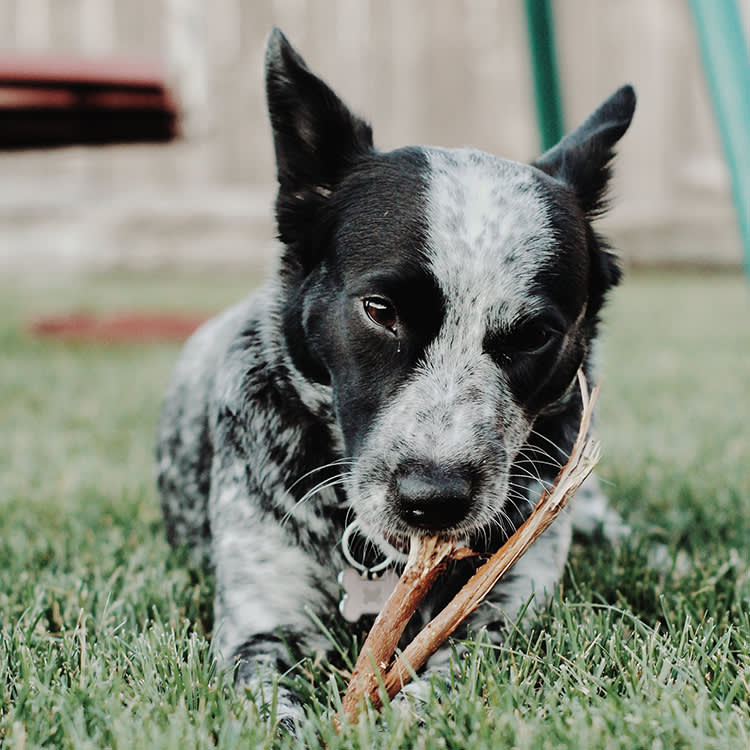
The bone aisle has become a trap. It keeps expanding, the packaging keeps making bigger promises, and it has gotten genuinely hard to tell a safe chew from one that will land your dog in surgery. But underneath the marketing, there are really only two ways a chew hurts a dog, and once you can name both, the whole aisle sorts itself out.
Failure one is the tooth. A chew that is too hard cracks teeth. Dog teeth, like ours, are hollow, so a fracture is not just painful, it exposes the root to bacteria and infection. Veterinary dentists see this constantly. Over a full career, one dentist can treat something on the order of ten thousand dogs for chewing-related dental fractures. That is not a fluke risk. That is the main event.
Failure two is the gut. A chew that breaks into large, swallowable pieces becomes a choking or obstruction hazard. A chunk can lodge in the esophagus and interfere with breathing, or move into the digestive tract and trigger inflammation, vomiting, appetite loss, and real pain. Sometimes surgery is the only way out.
A safe chew threads both needles: hard enough to scrape teeth clean through gnawing, soft enough not to fracture them, and structured so it wears down rather than shattering into gulpable chunks. Here is how the popular options score on those two axes, plus the single rule that catches most bad choices before you buy.
The fingernail-and-kneecap rule
Before any specific product, memorize the test veterinary dentists actually use: if you cannot make a dent in it with your fingernail, or it would genuinely hurt to rap it against your own kneecap, it is too hard for your dog’s teeth. That one check rules out most of the tooth-crackers on the shelf, no lab required. And one habit backs it up: only give a chew when you are home to watch. Supervision teaches you your dog’s chewing style and means you are there if something goes wrong.
The safer bets
Bully sticks
Bully sticks score well on both axes, which is why they are a go-to. They soften as a dog works them, so they are gentle on teeth, and the curled ones resist snapping in half, so they are less apt to go down in one big chunk. They are digestible, unlike a lot of chews, and reasonably long-lasting.
One caveat is calories. Bully sticks are not a diet food: a typical six-inch stick runs around 88 calories, roughly nine percent of the daily intake for a 50-pound dog, so factor them into the day if your dog is watching their weight. For most dogs, though, a real bully stick is one of the better choices on the shelf. Look for single-ingredient sticks with no additives; there are plenty of well-reviewed bully sticks on Amazon.
Pig ears
Pig ears do well in both departments too. Because they are relatively thin compared with most bones, there is little risk of a cracked tooth, and internists rarely see gut emergencies from them. The rule is simply size: give one your dog can properly chew rather than inhale, match it to your dog, and you generally do not have to worry.
Proceed with caution
Dental chews
Dental chews are designed to fight plaque and tartar, and the good ones work, largely because the act of chewing does the cleaning. The organization to trust here is the Veterinary Oral Health Council, which vets dental products against real standards. Check their accepted-products list before you buy; a widely recommended, VOHC-accepted option is Greenies. Research in the Journal of Animal Science has found that dental chews given after meals can help slow periodontal disease, though brands vary and much of the benefit comes from the chewing itself rather than any special chemistry.
Why the caution flag? Some dogs bolt them whole, because the smaller size and softer feel read as treat rather than chew. If you have seen your dog genuinely chew them rather than gulp, you are likely fine.
Yak cheese chews
Yak cheese chews, a hardened Himalayan cheese, have gotten popular. There is early support for the milk having a decent fatty-acid profile, most of the lactose is removed in processing so they tend to sit well even with sensitive stomachs, and they last a long time for determined chewers. The problem is on the tooth axis: they are hard and block-like, and the American Animal Hospital Association warns they can crack teeth for exactly that reason. If you use one, buy a simple-ingredient version (typically yak milk, lime, and salt), apply the fingernail test, and when it is gnawed down to a couple of inches, microwave the wet nub for about 60 seconds to puff it into a soft, crumbly piece so it does not become a choking hazard.
The ones to skip
Rawhide
Rawhide is the most controversial chew for good reason. It has a recall history, including a major 2017 recall tied to possible salmonella or chemical contamination in manufacturing. Beyond contamination, there are countless reports of dogs suffering dangerous abdominal blockages, because rawhide can balloon to as much as four times its original size once swallowed and become impossible to pass, plus choking cases. And the labels do not always help: a 2020 study found that two of ten chews marketed as “rawhide-free” actually contained rawhide components. Even “natural” and “easily digestible” claims can be misleading, since any chew that tears into smaller pieces can cause trouble.
Plastic bones
Durable, inedible bones look like a clever fix for a heavy chewer, but they are a dentist’s nightmare. A dog can bite down with force many times harder than you would guess, and a rigid plastic bone has no give at all, so a fractured tooth, especially a back molar, is very likely. They are rarely swallowed, but not never.
Raw bones
Femur bones, marrow bones, and the like are a double failure. There is some evidence that raw bones can reduce dental plaque, but both the tooth and gut risks are real and, in practice, vets report more problems from these than from any other chew. Real animal bone is much too hard to gnaw regularly without eventually damaging a tooth. And a dog can grind bone into a powder that turns to paste in the gut, then dries out in the colon like cement and blocks the dog up. Sharp fragments can be swallowed too.
Antlers
Deer, elk, and other antlers get marketed as clean, natural, long-lasting chews. They are also among the hardest things you can hand a dog, and they fail the fingernail test badly. The likely result is a cracked tooth.
The bottom line
Owners ask me which bone is safe, and the honest answer is that the category matters less than two questions. Can my dog dent it, so it won’t crack a tooth, and does it wear down instead of breaking into a chunk they can swallow. Run any chew through those two filters, watch your dog use it, and you’ll avoid almost every emergency I treat.
Most dogs will happily destroy whatever you give them, so the responsibility is on us to choose well. Favor chews that pass the fingernail test and wear down safely, supervise every session, and you will spare your dog a cracked tooth or a blocked gut, and yourself a very expensive night at the emergency clinic.
References
- Veterinary Oral Health Council. Accepted Products for Dogs. https://vohc.org/accepted-products/
- Freeman, L. M., et al. Nutritional and Microbial Analysis of Bully Sticks and Survey of Opinions About Pet Treats. Canadian Veterinary Journal. https://pmc.ncbi.nlm.nih.gov/articles/PMC3949439/
- Clarke, D. E. Effect of a Dental Chew on Dental Substrates and Gingivitis in Dogs. Journal of Veterinary Dentistry. https://journals.sagepub.com/home/jov
- Marx, F. R., et al. Raw Beef Bones as Chewing Items to Reduce Dental Calculus in Beagle Dogs. Australian Veterinary Journal. https://onlinelibrary.wiley.com/doi/10.1111/avj.12308
Not a substitute for your vet. Our guidance is educational. For urgent symptoms, contact a vet or emergency clinic right away. Editorial standards
Dr. Mehta is a board-certified veterinary nutritionist who evaluates pet food formulations, ingredient quality, and the science behind dietary trends. He writes and reviews all nutrition content at The Pet Times, including our food rankings and feeding guides.
Meet our experts ↗Keep reading
 Food"Dogs Are Basically Wolves" Is How Raw Chicken Gets Fed. Here's the Catch.Dr. Lena Park · 7 min
 FoodSalmon Is Great for Your Dog. Raw Salmon Can Kill Them.Dr. Ravi Mehta · 7 min
 FoodBaked Sourdough Is a Fine Dog Snack. Raw Dough Is a 911 Call.Dr. Amara Solis · 6 min
 FoodYour Meatloaf Could Hospitalize Your Dog. This One Won't.Dr. Lena Park · 7 min
 Health & WellnessSalmonella Got Into These Dog Biscuits. Here's How to Check Your Bag.Dr. Priya Nair · 4 min
 FoodOne Slim Jim Has as Much Saturated Fat as a Whole Serving of FriesDr. Priya Nair · 6 min