


Your Dog Is Always Hungry. The Scale Tells You If It's Serious.
Every dog begs. The question is whether your dog is opportunistic or genuinely desperate, and one simple observation, whether they're gaining or losing weight, points your vet straight at the likely cause.

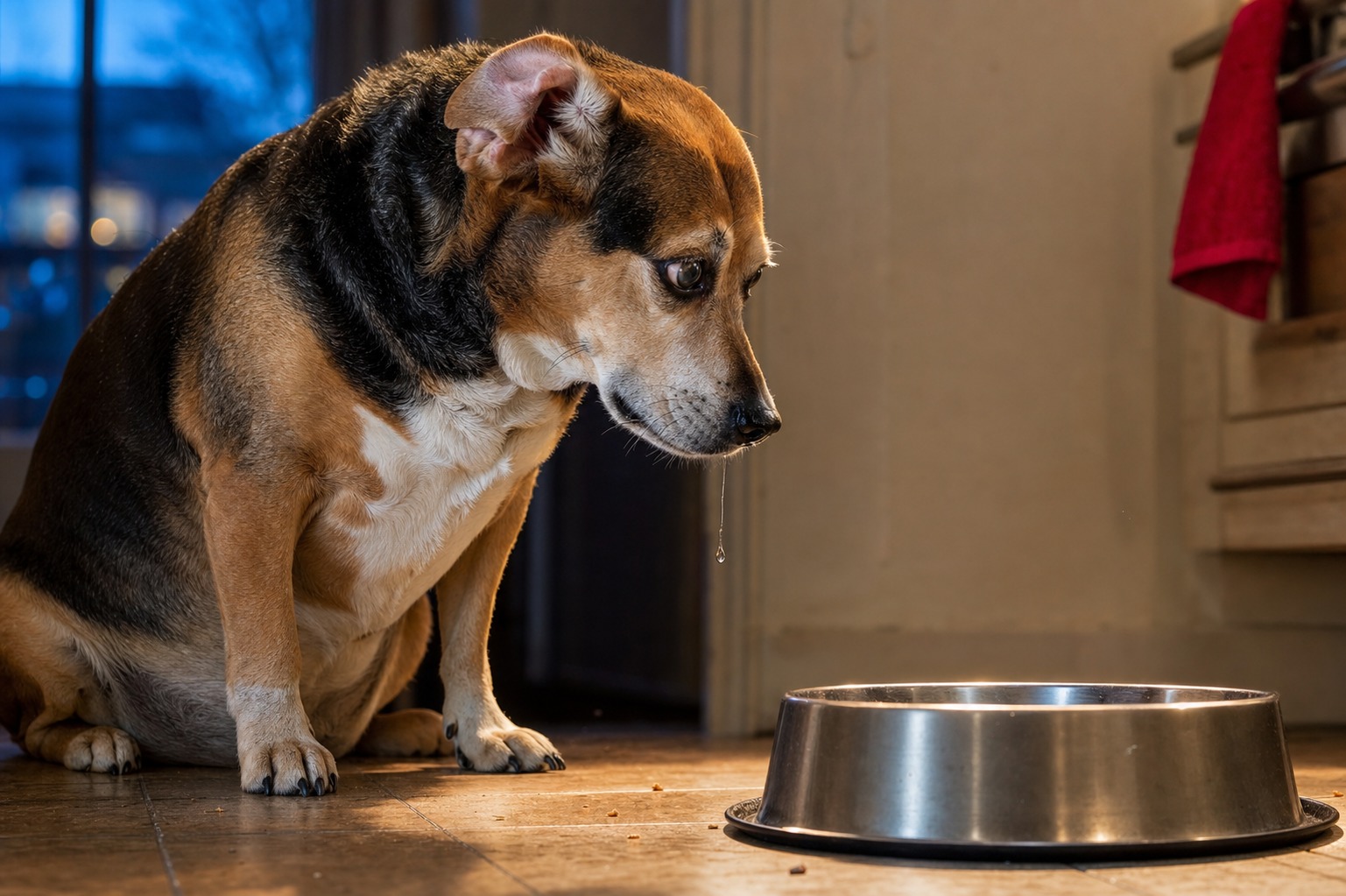
Anyone with a food-motivated dog knows the drill: the pleading eyes at dinner, the hopeful loitering by the counter. Usually that’s just a dog working the angles for a bonus snack, and it means nothing. But there’s a real difference between a dog hunting for extra and a dog acting desperate for anything remotely edible, and that difference is worth paying attention to. We tend to worry when a dog goes off their food, yet a sudden, ravenous, out-of-character hunger can be just as much of a red flag. The most useful move isn’t memorizing a list of diseases, it’s a single question that sorts the whole problem: is your dog gaining weight or losing it? Appetite plus the scale tells your vet where to look.
Hunger is a signal, not a personality trait
The sensation of hunger comes from a busy conversation between the pituitary gland, stomach, intestines, and fat tissue, all sending hormonal and nerve signals to the brain about fullness and what the body needs. A lot of medical conditions hijack part of that system and crank the hunger dial. So when a normally reasonable dog suddenly seems bottomless, especially if it came on fast, that’s a change to investigate, not just a quirk to feed. Nearly every serious illness lowers appetite, but a handful raise it, which is exactly why an unexplained spike deserves attention.
When hunger comes with weight gain
If your always-hungry dog is also putting on weight, these are the usual suspects:
Cushing’s disease. The adrenal glands overproduce cortisol, usually because of a tumor in the pituitary or an adrenal gland. The ramped-up appetite typically travels with increased thirst and urination, panting, and a pot-bellied look.
Sudden acquired retinal degeneration syndrome (SARDS). Dogs with this acute vision loss often get hungrier too. The cause isn’t well understood, but endocrine hormone imbalances seem involved, and those imbalances can leave a dog perpetually hungry.
Low blood sugar. Toy-breed puppies can struggle to hold their blood sugar between meals thanks to fast metabolisms and small energy reserves, so they need small, frequent, protein-rich meals. In older dogs, certain tumors secrete insulin and drive blood sugar down. Either way, low blood sugar sends the body into a panic to take in nutrients.
Stress. Dogs can be stress-eaters. Some stress hormones overlap with the ones involved in hunger signaling, so an anxious dog may get pushier about food.
Medications. A few drugs reliably crank up appetite. The big offenders are corticosteroids (like prednisone and dexamethasone) and anti-seizure medications (like phenobarbital and potassium bromide). At higher doses the hunger can get bad enough that a dog needs to switch medications.
When hunger comes with weight loss
Eating constantly and dropping weight is a more urgent pattern, because it usually means calories are going in but not getting where they belong.
Diabetes mellitus. In dogs, diabetes mainly comes from too little insulin. Insulin ferries glucose out of the bloodstream and into cells for energy or storage, so without enough of it, sugar piles up in the blood while the cells effectively starve. A diabetic dog has high blood sugar but can’t make energy from it, so the body thinks it’s starving. Insulin fixes the problem and lets the dog rebuild fat and muscle.
Gastrointestinal parasites. Worms and other parasites steal nutrients right out of the intestines and damage the gut lining so it absorbs less, a double hit that’s especially hard on puppies and can leave them constantly hungry.
Exocrine pancreatic insufficiency (EPI). The pancreas normally makes enzymes that break food into absorbable pieces. In EPI it doesn’t make enough, so food passes through largely undigested and the dog seems to be starving despite eating nonstop. Adding digestive enzymes to meals lets these dogs live normally.
Increased energy demand. A canine athlete and a lapdog have wildly different needs. Most dogs aren’t burning the 10,000 to 15,000 calories a day a sled dog does, but a real jump in activity, agility training, long runs, drives up appetite. Pregnant and nursing dogs get hungrier too, since their puppies are drawing on them.
Diet problems or underfeeding. Balanced canine nutrition is genuinely hard to hit, which is why a good-quality commercial diet is a safe default, homemade meals are easy to get wrong without a veterinary nutritionist, and incomplete nutrition can drive constant hunger or pica. And the simplest explanation of all: some dogs are underfed. It’s easy to overshoot on calorie-cutting, and different foods vary in calorie density, so recalculate portions whenever you switch diets, even within a brand, and use regular weigh-ins to catch changes early.
What newer research adds
There’s now a genuinely genetic answer for some always-hungry dogs, and it explains a lot about certain breeds. In a 2024 study from the University of Cambridge, published in Science Advances, researchers found that a mutation in a gene called POMC leaves affected dogs both hungrier and slower to burn calories. In the normal version, POMC helps produce hormones that tell the brain the body is full; in dogs with the mutation, that “I’m full” signal is truncated and never fully fires. The numbers are striking: about a quarter of Labrador Retrievers and roughly two-thirds of Flat-Coated Retrievers carry it, and affected dogs burn around 25 percent less energy at rest.
The practical upshot is twofold. If you have a Lab who acts like they’ve never been fed, that may not be gluttony or bad training, it can be hardwired biology, and it means portion discipline matters even more, because these dogs need fewer calories to stay lean, not more. It also underlines the main point of this whole piece: hunger is information. Sometimes that information is a disease, sometimes it’s a gene, but a sudden or extreme change is always worth a professional read.
When someone tells me their dog is suddenly starving all the time, my first two questions are ‘over what time frame’ and ‘what’s the scale doing.’ A slow, lifelong big appetite in a Lab is one conversation. A dog who flipped a switch last month and is either ballooning or wasting away is a completely different one, and it gets an exam that day. Appetite is one of the most honest signals a dog gives us, we just have to read it alongside their weight.
When to see the vet
Most dogs are food-obsessed and happy to sneak a snack, so the thing to watch for is a change, a sudden jump in how hungry your dog is, or unusually demanding behavior around food, especially alongside weight gain, weight loss, or other symptoms. Any real shift in your dog’s appetite is worth a vet visit. Hunger between meals is normal; a hunger that’s new, extreme, or paired with other signs is your dog handing you a clue.
References
- Dittmann, Marie T., et al. “A Deletion in the Canine POMC Gene Is Associated with Weight and Appetite in Obesity-Prone Labrador Retriever Dogs.” Follow-up in Science Advances, vol. 10, no. 10, 2024. University of Cambridge
- Raffan, Eleanor, et al. “A Deletion in the Canine POMC Gene Is Associated with Weight and Appetite in Obesity-Prone Labrador Retriever Dogs.” Cell Metabolism, vol. 23, no. 5, 2016, pp. 893–900. https://doi.org/10.1016/j.cmet.2016.04.012
- Cook, Audrey K. “The Physiology of Appetite Regulation.” Proceedings of the ACVIM Forum, 2016.
- Komáromy, András M., et al. “Sudden Acquired Retinal Degeneration Syndrome (SARDS): A Review.” Veterinary Ophthalmology, vol. 19, no. 4, 2016, pp. 319–331. https://doi.org/10.1111/vop.12291
Not a substitute for your vet. Our guidance is educational. For urgent symptoms, contact a vet or emergency clinic right away. Editorial standards
Dr. Park is a board-certified emergency and critical care specialist. She reviews our health and safety content for clinical accuracy and contributes guides on recognising urgent conditions. Her focus is helping owners act quickly and correctly when it matters most.
Meet our experts ↗Keep reading
 Health & WellnessYou Can't Eyeball a Healthy Dog. Owners Get the Most Important Sign Wrong.Dr. Mara Chen · 9 min
 FoodOnly 6% of Homemade Dog Diets Are Complete. Yours Is Probably in the Other 94%.Dr. Amara Solis · 12 min
 Health & WellnessOne Bowl, Two Dogs: The Feeding Habit That Breeds FightsDr. Amara Solis · 6 min
 FoodYour Dog Has No Idea When He's Full. That's Not a Flaw, It's the DesignDr. Ravi Mehta · 6 min
 FoodAsparagus Is the Rare Dog Treat That Fills Them Up for Almost No CaloriesDr. Lena Park · 6 min
 FoodHome-Cooked Dog Food Can Run $3 a Day. The Real Price Is Your Sundays.Dr. Amara Solis · 9 min