


Your Dog Probably Hates the Costume. Here's How to Dress Them Anyway
Pet costume spending just hit a record, but most dogs tolerate the outfit rather than enjoy it. The trick is reading your dog, not the cuteness, and knowing which costumes they'll actually put up with.

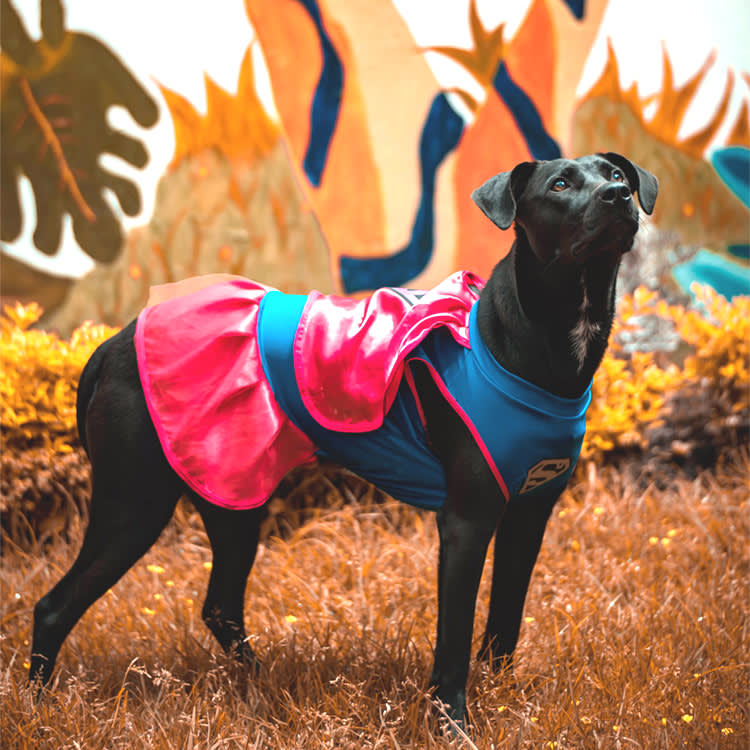
Here is an uncomfortable thing to sit with while you scroll photos of dogs dressed as tiny cowboys and hot dogs: most of those dogs are not having the good time you are. They are tolerating it. That doesn’t mean you can never put a costume on your dog. It means the goal shifts from “make my dog adorable” to “make my dog adorable without making my dog miserable,” and those are two different projects.
Why the outfit bothers them more than it bothers you
A costume does something to a dog’s body that a dog did not sign up for. It presses, it wraps, and it changes how they move. For a species that reads pressure and restriction as meaningful signals, a snug garment around the midsection or a hood over the head can feel less like a party hat and more like being pinned. That is why a dog who happily wears a harness every day can freeze the instant you add a cape and a headpiece. The harness earned its place through hundreds of low-stakes repetitions. The costume shows up once a year with none of that history.
The tell is in the body, and it’s easy to read once you know what you’re looking at.
People watch the face and miss the whole dog. A dog who’s uneasy in a costume goes still and low, tail tucked, mouth shut tight, weight shifted back like they’re bracing. A dog who’s genuinely fine stays loose, keeps a soft open mouth, and still wants to move toward you. If the outfit switches your dog off, that’s your answer, not the photo.
Signs your dog is not enjoying the getup include a stiff, frozen posture, a tightly closed mouth, ears pinned, and a general refusal to move. A comfortable dog keeps a relaxed body, a loose tail, and that easy, open-mouthed face you already recognize from good moments.
The rule that makes costumes tolerable: less is more
If you do want to dress your dog up, the single most useful principle is to keep the costume minimal and off the parts of the body that matter most. Dogs are already accustomed to something around the neck, so anything that lives there, a bandana, a bow tie, a small collar-based accessory, is the easiest sell. The full-body tuxedo is where you lose them.
A few guidelines that keep the experience closer to fun than to endurance:
- Choose something your dog barely registers, not something they have to carry.
- Go soft and lightweight over stiff and structured.
- Leave the face and head clear so they can see, pant, and use their whiskers.
- Make sure they can walk, sit, and turn without the costume fighting them.
For a dark-coated dog, you can skip fabric entirely: a stripe of pet-safe baby powder down the back turns them into a skunk, and a few more stripes make a passable skeleton. It’s the rare costume that adds nothing for the dog to notice.
Build tolerance the way you’d build any other
If costumes matter to you as an annual ritual, you can make your dog better at them, but not on the day of. Introduce the garment days ahead, let your dog sniff it, and pair the first brief wears with food they love, then take it off before they sour on it. You are trying to give the costume the same boring, positive history the harness already has. A dog who has practiced tends to tolerate the real event far better than one ambushed with a full outfit an hour before guests arrive.
What’s new: pet costumes are now a record business
The pressure to dress up your dog isn’t in your head, it’s a booming market. Americans spent an estimated $860 million on pet costumes for Halloween in 2025, a 22.9 percent jump over the prior year, according to the National Retail Federation. More than half of pet owners now buy their animals a costume, spending around $30 on average, with one in five going past $50. The most popular looks skew simple, pumpkins lead the pack, followed by hot dogs, bumblebees, ghosts, and superheroes.
The gentle irony is that the simplest, cheapest costumes on that list are also the ones dogs tolerate best. A pumpkin bandana or a lightweight ghost drape asks almost nothing of the dog, which is exactly the point. The record spending doesn’t have to mean record discomfort, as long as you let your dog’s body, not the trend, set the limit.
Dr. Chen is a small-animal veterinarian who leads health and safety coverage at The Pet Times. She writes and reviews the bulk of our illness, condition, and safety content, translating clinical guidance into clear, practical advice owners can act on at home.
Meet our experts ↗Keep reading
 TrainingNo, Your Cat Didn't Secretly Raise Your Dog. But Something Real Is Going On.Dr. Nina Kohl · 5 min
 TrainingYour Dog Isn't Reading Your Face. They're Reading Your Hand on the Leash.Dr. Lena Park · 8 min
 LivingThe ADA Has No Breed List. Your Landlord's Insurance Does.Dr. Priya Nair · 6 min
 LivingYour Dog Has a Love Language. You're Probably Speaking the Wrong One.Leila Torres · 7 min
 TrainingThat 'Guilty Look' Isn't Guilt. It's a Read on You.Dr. Nina Kohl · 7 min
 LivingYour 'Dog Type' Is a Mirror, Not a PreferenceDr. Nina Kohl · 6 min