


Dogs Chose an Empty Yellow Bowl Over a Bowl of Chicken. Here's What That Tells Us.
A study of free-ranging dogs found such a strong pull toward the color yellow that dogs picked an empty yellow bowl over food in a gray one. What it means for the toys and gear you buy, and why the finding may not be universal.

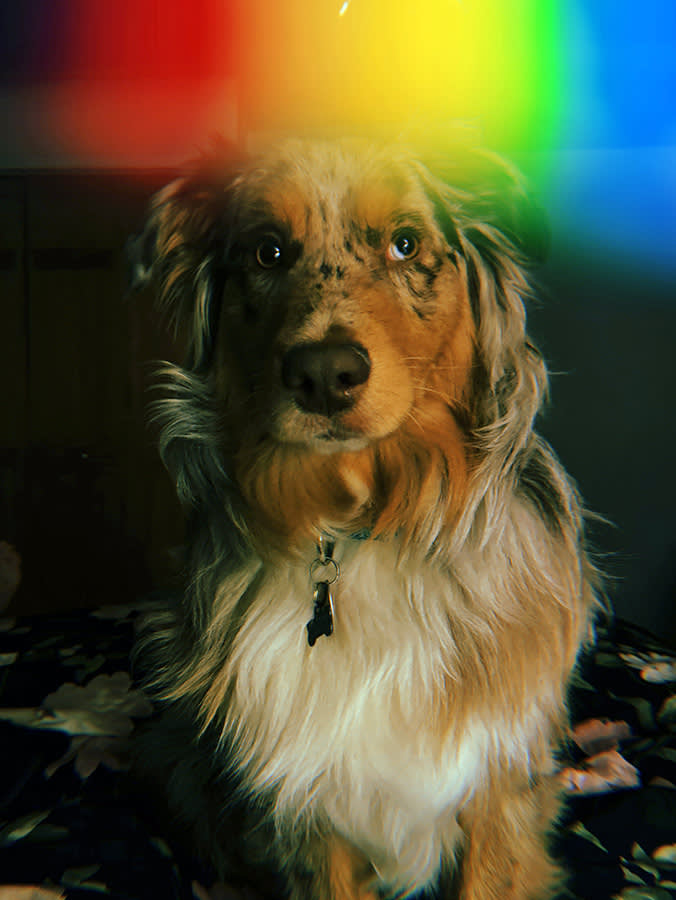
Here is a fact to file away the next time you are standing in a pet-store aisle choosing between a red toy and a yellow one: your dog cannot see the red one the way you can, and there is now research suggesting they may actively prefer the yellow. In one striking experiment, dogs were so drawn to yellow that they walked past food to get to it, choosing an empty yellow bowl over a gray bowl holding actual chicken.
That single result is the hook, but the useful story underneath it is about how dog vision really works and what it means for the stuff you buy. Dogs are not colorblind in the black-and-white sense of the old myth, but they do see a narrower slice of the rainbow than you do, and that slice has a favorite. Understanding the difference turns “pick a cute color” into a small, practical advantage for your dog.
What the researchers actually did
Scientists at the Indian Institute of Science Education and Research ran a series of choice tests on 134 adult free-ranging dogs across urban, semi-urban, and rural areas. The setup was simple. An experimenter placed three bowls, yellow, blue, and gray, in a random arrangement near a dog, then made a sound to get the dog’s attention and watched which bowl the dog approached first.
Across versions of the test, some with a biscuit under each bowl and some with nothing at all, one result kept surfacing: dogs went for the yellow bowl far more often than the other two. When the researchers narrowed it to just blue versus gray, the dogs showed no meaningful preference, which pins the effect specifically on yellow rather than on brightness or novelty.
The headline finding was the food test. When one gray bowl held a treat and an empty yellow bowl sat beside it, the dogs still made a beeline for yellow, picking it 41 times against 11 for the baited gray bowl. Swapping in chicken instead of a biscuit did not change the pattern; the empty yellow bowl won 47 to 14. As the study’s lead author put it, the preference for yellow was strong enough to override the dogs’ attraction to food itself.
Why yellow, and why it might not be universal
The honest answer is that nobody is certain why yellow lands so hard. The researchers floated a few possibilities. A scavenging dog may see something yellowish where we see meat and blood, and plenty of human leftovers tinted with turmeric or chili read yellow to a dog too, so the color could become linked, through experience, with food worth chasing. It is also possible the yellow bowls simply stood out with higher contrast against the test surroundings.
There is an important asterisk, too. A liking for a color might be something a dog is born with or something it picks up, which means a result from free-ranging dogs in one region may not carry over everywhere. Tellingly, a separate study of street dogs in Morocco found no color preference at all. So “dogs love yellow” is a real and well-documented finding for this population, not a proven law of dog nature.
What it means for the toys and gear you buy
This connects to a piece of settled science about dog vision. Humans have three types of color-detecting cones; dogs have two. That makes canine color vision roughly comparable to a person with red-green colorblindness. Dogs see the world mostly in blues and yellows, with reds and greens washing out into muddy, grayish, or brownish tones.
The practical takeaway writes itself. A bright red ball tossed onto green grass, a combination pet brands love, may nearly vanish for your dog, reading as a dull lump against a duller field. A blue or yellow toy, by contrast, pops. If your dog seems to “lose” fetch toys in the yard or ignore certain playthings, the color may be the reason as much as the toy. Choosing beds, toys, and training targets in blue or yellow is a cheap way to make your dog’s world more legible, and, if the yellow-preference research holds, maybe a little more appealing.
Owners tell me their dog is bad at fetch, and sometimes the dog just can’t see the toy well against the ground. Switch a red toy on green grass for a yellow or blue one and the ‘bad at fetch’ dog often turns out to be perfectly good at it. It costs nothing to pick a color your dog can actually track, and it can genuinely change how much they engage with play.
What newer research adds
Since the original free-ranging-dog study, researchers have started testing whether the yellow preference travels beyond India, and the picture is turning out to be more nuanced than the headline. A replication study looking at pet dogs found that younger dogs did tend to approach yellow bowls first, echoing the original result, but the statistical case was weaker than in the free-ranging population, with some analyses finding no significant difference across colors.
The reasonable way to hold all of this: dogs clearly see and respond to blue and yellow, that part is rock solid, and there is real evidence that yellow can be especially attractive, at least to some dogs in some settings. Whether every dog has a true favorite color is still an open question that scientists are actively working out. For your purposes, the low-stakes move is unchanged. Buy in the colors your dog can see, lean blue and yellow, and you have lost nothing even if the “favorite color” turns out to be less universal than the first study suggested.
References
- Roy, A., et al. (2025). “Ready, set, yellow! Color preference of Indian free-ranging dogs.” (PMC11794370.)
- Neitz, J., Geist, T., & Jacobs, G. H. (1989). Color vision in the dog. Visual Neuroscience, 3(2), 119-125.
- Kasparson, A. A., Badridze, J., & Maximov, V. V. (2013). Colour cues proved to be more informative for dogs than brightness. Proceedings of the Royal Society B, 280(1766).
- “Color preferences in dogs: A replication study.” (2025 preprint, OSF/PsyArXiv.)
- Comparative study of free-ranging dogs in Morocco (no color preference), Current Zoology.
Not a substitute for your vet. Our guidance is educational. For urgent symptoms, contact a vet or emergency clinic right away. Editorial standards
Sara Lim leads our Product Picks coverage, testing and comparing the things pets and their owners actually use. From everyday essentials to home-and-style finds, she focuses on honest, useful recommendations rather than hype.
Meet our experts ↗Keep reading
 LivingYour Senior Dog Isn't Slowing Down. He's Bored.Dr. Nina Kohl · 8 min
 Health & WellnessThe Real Threat to an Old Dog Isn't Age. It's a World That Keeps Getting Smaller.Dr. Ravi Mehta · 8 min
 Health & WellnessHer Dog Collapsed on the Sidewalk. What Looked Like a Stroke Usually Isn't.Dr. Ravi Mehta · 8 min
 LivingThe Doodle Was Sold to You on Three Promises. The Data Backs None of ThemDr. Mara Chen · 9 min
 Health & WellnessYour Old Dog Doesn't Want to Rest. Their Brain Wants a Puzzle.Dr. Nina Kohl · 6 min
 Health & WellnessMoney Doesn't Keep Your Dog Healthy. Company Does.Dr. Mara Chen · 6 min