


Your Puppy's Barking Isn't One Problem. It's Four.
Boredom, overstimulation, attention, and territory all sound identical at 7 a.m. Decode which bark you have, because each one has a different fix.

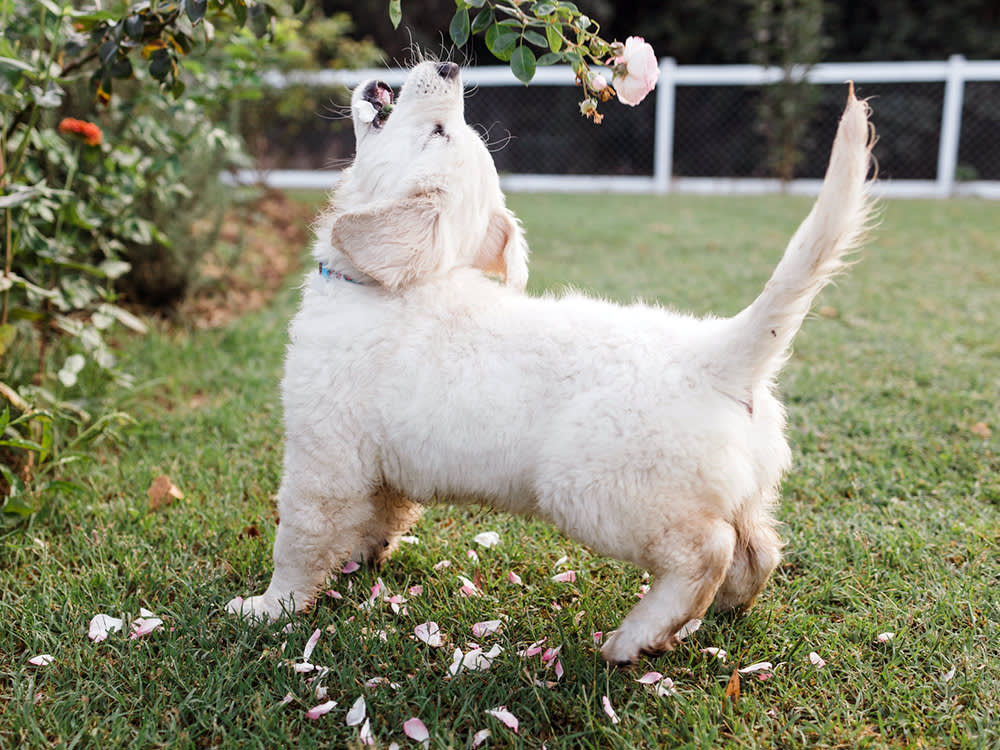
A puppy’s first few barks are adorable. Around week three of a barking habit, at 6:45 on a Saturday morning, the charm wears off, and most new puppy parents reach for a single question: how do I make it stop?
That question is the mistake. Barking is not one behavior with one off switch. It is a voice, and your puppy is using it to say at least four different things. Treat an attention bark like a territory bark and you will make both worse. So before you train anything, do the diagnostic work: figure out which bark you actually have. The good news is that each one telegraphs itself clearly once you know what to look for, and every one of them has a fix.
People ask me for a cure for barking the way they’d ask for a cough drop, but a bark is a symptom, not a disease. A bored bark, a scared bark, and a ‘someone’s at the door’ bark are three different conversations, and the treatment only works when you answer the right one.
Bark one: the bored bark
An under-occupied puppy is a loud puppy. If the barking happens when nothing is going on, that is usually the tell. The first fix is embarrassingly simple: audit your puppy’s day. Physical exercise, sniffing time, chewing projects, and puzzle feeders are not extras; they are the job a young dog needs. A puppy who has spent their energy has little left to announce, and a long walk or a stuffed food toy before your video call will buy more silence than any command.
Left unaddressed, boredom escalates beyond noise. Working-line and high-drive puppies especially will invent their own stimulation, and their inventions tend to involve teeth and your furniture. Barking is the cheap early warning; destruction is the invoice.
Bark two: the overstimulated bark
Some puppies do not bark because too little is happening but because too much is. Big feelings, small dog, loud output. These puppies need to learn that stillness pays. Practice calm on purpose: have your puppy settle beside you while you watch TV or work, and quietly reward them every time they choose to lie down and switch off. You are not training a trick; you are installing an off switch that adolescence will test later.
Bark three: the attention bark
This one is the pet parent’s fault, and almost everyone commits it. A puppy barks, you look over, laugh, coo, or even scold, and the puppy logs a win, because to a social animal, any attention is payment. Eye contact counts. Yelling definitely counts.
The most damaging version is the delayed surrender: you ignore the barking for two minutes, then crack and respond. That teaches your puppy a brutal lesson in persistence, that barking longer is what works, and every time you repeat the cycle, you build a more durable barker.
The fix has two halves. First, make the barking earn nothing: no eyes, no voice, no touch. Second, catch quiet moments and pay them generously. If ignoring truly is not working, a time-out flips the equation by removing the thing your puppy wants most, which is you. The moment barking starts, calmly leave the room and shut the door, or move the puppy to a quiet, safe space. Start with about 30 seconds, return only when there is silence, and reward the calm you find. Timing is everything: done inconsistently, time-outs just confuse a puppy, so commit to responding the same way every single time, even if that means a full Saturday of walking in and out of rooms like a sitcom character.
Bark four: the territory bark
Dogs come by this one honestly. Their ancestors vocalized to claim space and warn off intruders, and your puppy inherits both the instinct and, depending on breed, a hair trigger. Every dog has a “bubble” they consider theirs, and for some dogs, the bubble includes the sidewalk, the mail truck, and the school run passing your window. Smaller breeds bred for close quarters, like terriers, Chihuahuas, and Corgis, are often the most vocal.
Territory barking has a nasty feature: it is self-reinforcing. The puppy barks at the pedestrian, the pedestrian keeps walking, and from the puppy’s point of view, the barking worked. Every passerby “repelled” is a rep of training you did not choose.
That is why management beats willpower here. Close the curtains. Move the couch your puppy uses as a guard tower. Run background noise, like recordings of everyday sounds, so the world outside gets boring. Then layer the quiet cue on top, using the steps above, so you have a way to end the alert once it starts.
Which brings up a rule worth adopting: the three-bark rule. Barking is communication, and a puppy who alerts you to a knock at the door is doing honest work. Let them have their three barks. After that, cue quiet and pay the silence. You are not silencing the messenger, just capping the speech.
When to call in a professional
If your puppy is too fizzy to eat, respond, or think in the presence of their trigger, you are past DIY territory, and a good trainer can build impulse-control foundations before the habit sets. Aim for adolescence: barking that gets rehearsed for months becomes one of the hardest behaviors to unwind later. A trainer can also design a menu of games, obedience work, tricks, and agility that keeps a busy brain employed, which matters most for working breeds, where under-stimulation reliably graduates from barking to anxiety to demolition.
What newer research adds
Two findings from recent behavior science are worth folding into your plan. First, a large Finnish study of nearly 14,000 pet dogs found that problem behaviors travel in packs: dogs with noise sensitivity or fearfulness were far more likely to show other anxieties too, and prevalence varied sharply by breed. If your puppy’s barking looks fear-flavored, at fireworks, strangers, or sudden sounds, treat it as an anxiety question, not a discipline question, and loop in your vet early.
Second, researchers studying separation-related behavior have found the sound itself carries information: barking during alone-time tends to track frustration, while whining tracks fear and panic. A puppy who barks at the closed door is often demanding; a puppy who whines and paces may be genuinely scared. Same noise complaint from the neighbors, very different problems to solve.
References
- Salonen, M., et al. (2020). Prevalence, comorbidity, and breed differences in canine anxiety in 13,700 Finnish pet dogs. Scientific Reports.
- Pongrácz, P., et al. (2017). Should I whine or should I bark? Qualitative and quantitative differences between the vocalizations of dogs with and without separation-related symptoms. Applied Animal Behaviour Science.
- Cummings School of Veterinary Medicine at Tufts University. How to Stop Territorial Barking.
Dr. Park is a board-certified emergency and critical care specialist. She reviews our health and safety content for clinical accuracy and contributes guides on recognising urgent conditions. Her focus is helping owners act quickly and correctly when it matters most.
Meet our experts ↗Keep reading
 TrainingYour Dog Doesn't Out-Muscle You. They Out-Balance You.Marcus Webb · 7 min
 TrainingDog Anxiety Isn't One Thing. That's Why Treating It Like One FailsDr. Nina Kohl · 8 min
 TrainingYour Dog Is Never Barking at Nothing. You Just Can't Hear It.Dr. Ravi Mehta · 7 min
 TrainingYour Dog Nibbles You Like Corn on the Cob. Two Experts Disagree About What to Do.Dr. Nina Kohl · 8 min
 TrainingThe Frozen Stare Isn't the Fight. It's Your Last Few Seconds to Stop One.Dr. Amara Solis · 6 min
 TrainingStop Refereeing the Dog Park by Folklore. Read the Dogs InsteadSasha Ford · 10 min