


The Corn Cob Emergency: Why the First Hour Decides Everything
If your dog swallows a corn cob, what you do in the first hour often decides between an endoscopy and abdominal surgery. Here is the timeline, the risk math, and exactly when to call.

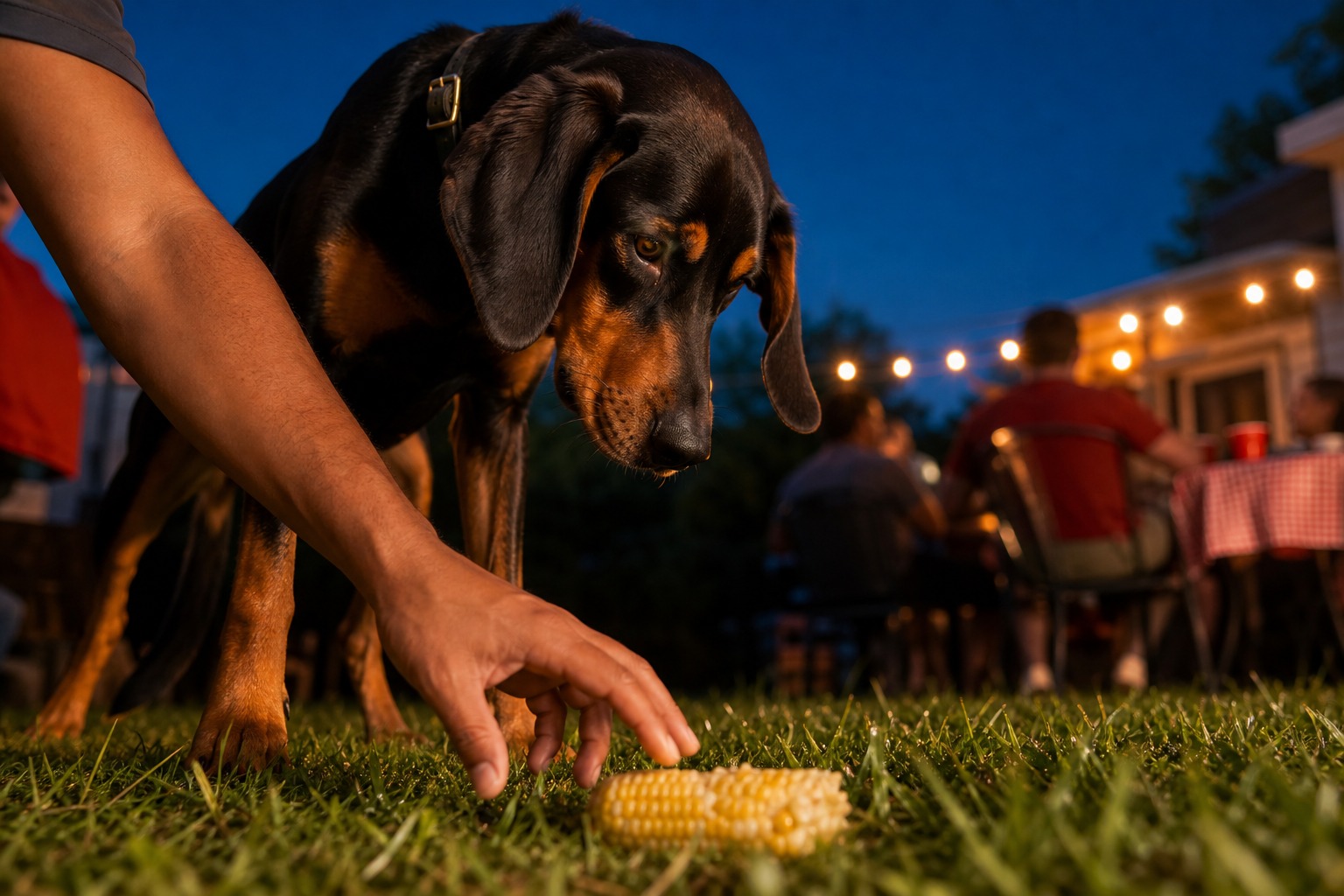
If you only remember one thing about corn cobs and dogs, make it this: the clock starts the instant your dog swallows one, and the first hour is worth more than any symptom you might see later. A cob that is still sitting in the stomach can often be fished out through the mouth. A cob that has moved into the intestine usually means abdominal surgery. That single difference is why this is one of the rare food hazards where you call before your dog looks sick, not after.
Corn itself is harmless. This article is not really about corn. It is about what to do in the window most owners waste watching and waiting.
The first hour: what actually happens inside your dog
A swallowed cob does not dissolve. It is built almost entirely from cellulose, a fibrous plant scaffold that a dog’s digestive enzymes cannot touch, so it travels through the gut intact and at the mercy of the plumbing.
For roughly the first few hours, a whole or half cob tends to sit in the stomach, which is a comparatively roomy, stretchy organ. While it is there, a veterinarian has good options. They may be able to induce vomiting, or pass an endoscope down the throat and grab the cob directly. Both spare your dog an incision.
Once the cob leaves the stomach and enters the small intestine, the geometry turns against you. The small intestine is a narrow tube, and a cob’s short, dense, barrel shape is almost purpose-built to jam in it. At that point, endoscopy can no longer reach the object, and surgery becomes the likely path. This is the crossover that makes timing everything, and it is invisible from the outside. Your dog will not act differently as the cob moves from stomach to intestine.
A swallowed cob is the one situation where waiting is exactly the wrong instinct. If you saw it happen, call before your dog looks sick. In the first few hours we often have a mouth-and-scope option. Once it is wedged in the intestine, we are talking about an operation.
The risk math, from the veterinary literature
It helps to know the actual stakes rather than a vague “it’s dangerous.” A retrospective analysis of 72 dogs and cats treated surgically for gastrointestinal foreign-body obstruction gives a useful picture of what a missed object leads to. Among those chronic obstruction cases, about a third (31 percent) needed a section of intestine surgically removed and rejoined because the trapped object had damaged the bowel wall. Roughly 15 percent developed a major post-operative complication. The reassuring number is that 94 percent survived to follow-up, which tells you the odds are good once a dog reaches a surgeon, but the road to get there is exactly the ordeal you want to avoid.
A separate look at gastrointestinal foreign bodies found the typical patient skews young, male, and large-breed, and that objects caught early in the stomach came out by endoscopy far more often than those that had migrated deeper. Translated to your kitchen: the adolescent Labrador who counter-surfs the cookout is the textbook patient, and the sooner the object is found, the gentler the fix.
What to do, in order
If you know or strongly suspect your dog swallowed a cob, work this list top to bottom without stopping to see how they seem.
- Call immediately. Phone your vet, or an emergency clinic if it is after hours, and say a corn cob was swallowed and roughly when. Ask whether to come in now. Do not schedule for tomorrow.
- Do not induce vomiting on your own unless a vet on the phone tells you to. A cob can lodge or tear on the way back up, and some at-home methods are unsafe.
- Note the timeline. When did it happen, how much cob, and what size is your dog. This helps the clinic decide between the scope and the operating room.
- Take away food and water until the clinic advises, in case sedation or anesthesia is needed.
- Bring the evidence. If you have the rest of the cob or the packaging, take it, so the team knows what and how much.
If symptoms have already started, treat it as a full emergency and go in. Watch for repeated vomiting, refusing food, a hunched or painful posture, low energy, drooling, and straining with little to show for it. The longer a foreign object sits wedged, the more it presses on the bowel wall and cuts off blood supply, which is what turns a retrievable object into the resection statistic above.
Why cobs specifically, and not other scraps
Plenty of dropped food at a barbecue is a non-event. Cobs are singled out for three converging reasons, and it is worth understanding them so you can judge other objects the same way.
The shape is the problem before anything else. A cob is a short cylinder with a diameter that happens to match the narrow stretches of a medium-to-large dog’s intestine. It is big enough to catch teeth on yet too dense to break down. The indigestibility means time will not save you the way it would with a chunk of bread. And the smell makes cobs magnetic: a stripped cob still carries the butter, salt, and char from dinner, so a dog will fish one out of the trash or off the lawn with real enthusiasm. That last point is why supervision at gatherings matters more than any rule you can teach.
Prevention that actually holds up at a party
The honest challenge is that cobs go wrong precisely when your attention is elsewhere. A few habits close the usual gaps: keep plates off low tables and the ground, bag cobs and seal the trash out of nose range rather than dropping them in an open kitchen bin, and give guests a heads-up not to slip the dog a “harmless” leftover. If you compost, keep the bin latched or elevated, because a cob in a compost pile is still a cob.
The kernels are fine, for the record
None of this is a knock on corn. Cooked, plain kernels show up in commercial dog food for good reason: they carry fiber that supports digestion, starch for energy, and a modest lineup of minerals and B vitamins. If you want to share, cut real corn off the cob, skip the butter and salt, and keep it to a small portion. The kernel was never the villain. The scaffold it grows on is.
The bottom line
A corn cob is not a “watch and see” situation. It is a race between you and your dog’s own plumbing, and you win it on the phone in the first hour, not by monitoring for symptoms that only appear once the cob is already stuck. Share plain kernels freely. Guard the cobs like they are what they are: one of the most common avoidable trips to a surgical suite that veterinary medicine sees.
References
- Grimes, J. A., et al. “Clinical Findings and Patient Outcomes Following Surgical Treatment of Chronic Gastrointestinal Foreign Body Obstructions in Dogs and Cats: 72 Cases (2010–2020).” PMC, https://pmc.ncbi.nlm.nih.gov/articles/PMC9536220/.
- “Endoscopic and Surgical Removal of Gastrointestinal Foreign Bodies in Dogs: An Analysis of 72 Cases.” PMC, https://pmc.ncbi.nlm.nih.gov/articles/PMC9179859/.
- Cornell University College of Veterinary Medicine, Riney Canine Health Center. “Gastrointestinal Foreign Body Obstruction in Dogs.” https://www.vet.cornell.edu/departments-centers-and-institutes/riney-canine-health-center/canine-health-topics/gastrointestinal-foreign-body-obstruction-dogs.
- Kansas State University College of Veterinary Medicine. “Aw, Shucks: K-State Vet Says Corn on the Cob Is No Treat for Dogs.” https://www.k-state.edu/media/newsreleases/.
- U.S. Department of Agriculture, FoodData Central. “Corn, Sweet, Yellow.” https://fdc.nal.usda.gov/.
Common questions
Can a corn cob pass on its own?
Rarely, and it is not worth gambling on. Cobs are made almost entirely of cellulose, which a dog cannot digest, and their barrel shape is nearly ideal for wedging in the small intestine. Some small cob fragments pass, but a whole or half cob usually does not.
Can dogs eat corn off the cob?
Yes. Plain cooked kernels with no butter, oil, salt, or seasoning are a safe occasional snack in small amounts. The kernel is not the hazard. The cob is.
What are the warning signs of a corn cob blockage?
Repeated vomiting, refusing food, a tense or painful belly, low energy, straining with little or no stool, and drooling. These often appear a day or more after the cob was eaten, which is why waiting for symptoms is the wrong move.
Not a substitute for your vet. Our guidance is educational. For urgent symptoms, contact a vet or emergency clinic right away. Editorial standards
Dr. Chen is a small-animal veterinarian who leads health and safety coverage at The Pet Times. She writes and reviews the bulk of our illness, condition, and safety content, translating clinical guidance into clear, practical advice owners can act on at home.
Meet our experts ↗Keep reading
 Health & WellnessThe Sweetener That Kills Dogs Often Isn't Labeled "Xylitol"Dr. Ravi Mehta · 8 min
 Health & WellnessYour Dog's Panting Isn't the Problem. Panting With No Job to Do Is.Dr. Ravi Mehta · 8 min
 Health & WellnessThe Underwear Isn't the Joke. The Surgery Is.Dr. Lena Park · 7 min
 Health & WellnessThe Sidewalk Salt Burning Your Dog's Paws Can Also Poison ThemDr. Amara Solis · 8 min
 Health & WellnessYou Can't Fix a Bleeding Dog at Home. You Can Win Them the Drive to the Vet.Dr. Ravi Mehta · 6 min
 Health & WellnessEvery Second You Spend on Snakebite First Aid Is a Second Your Dog Is DyingDr. Ravi Mehta · 8 min