


Every Second You Spend on Snakebite First Aid Is a Second Your Dog Is Dying
There is no field treatment for a venomous bite. No sucking, no ice, no tourniquet, no knife. There is only the drive to the vet, and a 95 percent survival rate waiting at the other end of it if you get there fast.

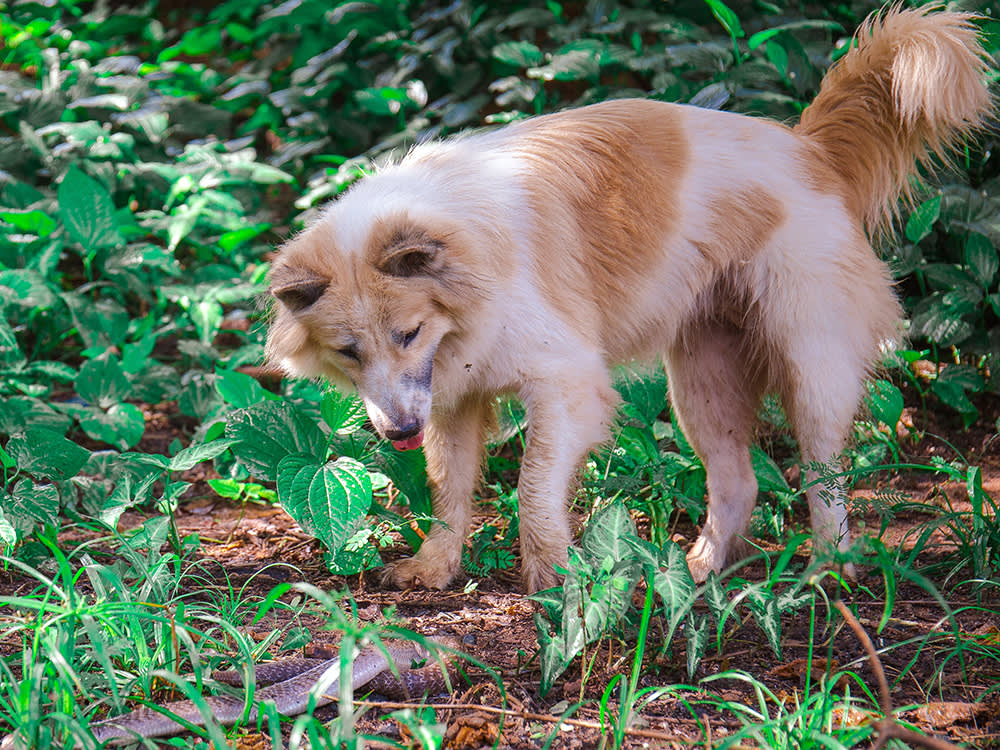
There is a version of this article that opens with a list of first-aid steps. That article gets dogs killed.
Here is what a venomous snakebite actually is: within seconds, enzymes and toxins are moving through your dog’s bloodstream, dismantling tissue. There is nothing you can apply, cut, suck, freeze, or tie that reaches them. The single treatment that works is antivenom, it exists only at a veterinary clinic, and the clock on how much damage it can prevent starts the instant the fangs go in.
So the entire field protocol is one sentence. Stop your dog moving, and drive.
Everything below is in service of that sentence.
Why it is so urgent, in plain terms
Snake venom is not a poison in the way people imagine. It is a chemical toolkit for taking an animal apart and starting to digest it.
Pit viper venom carries at least ten types of tissue-destroying enzymes, plus non-enzyme components called killing fractions that are roughly 50 times more toxic than the crude venom itself. As that venom breaks down tissue, fluid pours out of the bloodstream and into the damaged area. A dog can lose up to a third of their body fluid into the tissue spaces within a few hours, which crashes blood pressure and drops them into shock.
That is what you are racing. Not the pain, the fluid loss and the tissue destruction, both of which are happening right now while you look up what to do.
The forbidden list
Every item here has been tried, and every item makes the outcome worse. This is the section to remember, because it is where good intentions do the damage.
- Never put your mouth on the wound to draw the venom out. It works in old Westerns. It works nowhere else. The venom is in the bloodstream within moments.
- Do not cut an X over the fang marks. You have now added a wound to a dog whose blood has stopped clotting properly.
- Do not use a snakebite kit or extractor pump. They do not extract meaningful venom, and they cause additional local tissue damage.
- Do not apply ice. Cold constricts the local blood vessels and concentrates the venom exactly where it is doing the most harm, worsening muscle damage.
- Do not rub anything into the bite. Nothing applied to the skin reaches venom that has already entered the blood.
- Do not use a tourniquet. You will cause further tissue death and can turn a survivable bite into an amputation.
- Do not let your dog walk around. Activity circulates venom. Carry them if you can.
- Do not try to catch or kill the snake for identification. People do this. People then arrive at the emergency clinic with two patients.
Even a dead snake can envenomate on a reflex bite, so keep your dog away from any snake carcass you come across on the trail.
What you actually do
Assume the bite was venomous. That assumption costs you nothing and saves you the fatal minutes you would spend trying to identify a snake.
Keep them still and keep them quiet, and lift them into the car yourself if you can manage it. If the swelling has not reached the face, muzzle them: a snakebite is agonizing, and a dog who has never so much as growled at you may snap in that state. If the face is swelling, leave that area completely alone. Hold the bitten limb steady, positioned at or below the level of the heart.
Then drive, and call the clinic from the road so they can pull antivenom before you arrive.
What you might see, and when
A bite is not always obvious, particularly on a thick-coated dog where puncture wounds disappear into fur. Marked swelling is usually the first thing you notice, as tissue breaks down and fluid leaks into the area.
Watch for:
- Swelling around the bite, which typically keeps progressing for up to 36 hours
- Bruising and skin discoloration, often within hours, because the venom stops the blood from clotting
- Intense, immediate pain at the site (this is what distinguishes a snakebite from other causes of swelling)
- Sudden collapse
- Muscle tremors
- Shallow breathing
- Weakness, wobbliness, and lethargy
- Bleeding
- Vomiting or diarrhea
- Dilated pupils
Some signs are immediate and some arrive hours later, which is why a dog who “seems fine” after a bite still needs to be seen.
The treatment, and what it costs
Because signs can lag by hours, a bitten dog belongs in the hospital for a minimum of 12 hours, and a full 24 is better. Most need support and monitoring for up to a week. The number that matters: about 95 percent of dogs survive a snakebite with early, proper treatment. A large case series of 272 rattlesnake envenomations in dogs reported eight deaths, and the dogs who did worst were older, smaller, and slower to arrive.
Against pit viper envenomation, the one treatment with real proof behind it is antivenom, and its power decays with every minute it is delayed. The cost is the hard part. Vials commonly run in the range of several hundred dollars each, and while a single vial often controls the envenomation, several may be needed, particularly for a small dog or a cat. Total bills of $2,500 and up are ordinary. Many animals survive without it, but antivenom reduces the severity of signs, speeds recovery, and cuts complications.
Around that, expect blood work to track platelet counts and clotting times, IV fluids, serious pain management, antibiotics, and wound monitoring. Severe envenomations sometimes need blood or plasma transfusions.
Owners tell me they waited because they wanted to see if it got worse. It always gets worse. The dogs who do badly aren’t the ones who got a bad bite, they’re the ones who arrived two hours after a bad bite.
The severity dial
Several factors decide how bad a given bite is, and almost none of them are under your control. The two biggest are how much venom went in and how toxic that particular venom is. Beyond that:
- Regenerated venom. A snake that has not bitten in a while has a fuller, more concentrated reservoir.
- How threatened the snake felt. A more agitated snake delivers more concentrated venom.
- Offensive versus defensive strike. Offensive strikes are more severe.
- Your dog’s size. Small dogs and cats fare worse: less body mass to absorb and dilute the same dose.
- Where the bite landed. Legs and face are, counterintuitively, the “better” places, because local swelling and changes in blood supply can slow venom uptake. Bites to the body absorb faster. A bite to the tongue is the nightmare scenario, with signs that arrive fast and hit hard.
- Time to treatment. This one is yours.
- How much your dog moved afterward. Also yours.
About that vaccine
The rattlesnake toxoid gets sold as insurance, and the honest answer is that there is no published evidence it works in dogs.
The American Animal Hospital Association published a statement in 2022 highlighting the lack of efficacy data. UC Davis does not recommend routine vaccination of dogs for rattlesnake envenomation. A 2014 review of records from Southern California dogs treated for naturally occurring bites found no statistically significant difference in illness or death between vaccinated and unvaccinated dogs. Adverse reactions, including anaphylaxis, have been reported.
The dangerous part is not the shot, it is the belief. The most harmful myth about the rattlesnake vaccine is that a vaccinated dog does not need emergency treatment. A vaccinated dog who is bitten needs the exact same emergency care, on the exact same clock, as an unvaccinated one.
Prevention is where you actually have power
Stay on open trails. Keep your dog leashed and out of high grass, rock piles, and holes, which is where snakes rest.
If you see a snake, back away and leave. A snake can only strike about half its body length, and it does not want the encounter any more than you do, so give it room and time to leave. Do not investigate a dead one.
Snake-avoidance training classes are worth a look if you hike in rattlesnake country. They start as low as $65 in some areas, against a vet bill that regularly runs $3,000 or more, and against the thing you cannot price at all.
What’s new since this was written
The treatment picture has firmed up in a useful direction. F(ab’)2 antivenom, an equine-derived product, is now the workhorse in veterinary practice: in the 272-dog case series, 236 of the treated dogs received an F(ab’)2 product, and researchers reported it was well tolerated. Human data from the North American Snakebite Registry, published in 2025, found F(ab’)2 treatment produced substantially lower total costs than the older Fab product, which is part of why availability has improved.
The vaccine picture, meanwhile, has only hardened. Between the 2022 AAHA statement and the current UC Davis guidance, the veterinary consensus is now openly skeptical, and organizations like National Snakebite Support explicitly advise against it.
None of this changes the one thing that decides your dog’s outcome. It is still the drive.
References
- Witsil, A. J., et al. “272 cases of rattlesnake envenomation in dogs: Demographics and treatment including safety of F(ab′)2 antivenom use in 236 patients.” Toxicon, 2015. https://www.sciencedirect.com/science/article/abs/pii/S0041010115300581
- American Animal Hospital Association. “Key Vaccination: Rattlesnake Toxoid,” 2022 AAHA Canine Vaccination Guidelines. https://www.aaha.org/resources/2022-aaha-canine-vaccination-guidelines/rattlesnake-toxoid/
- UC Davis School of Veterinary Medicine. “Vaccination Guidelines for Dogs and Cats.” https://healthtopics.vetmed.ucdavis.edu/health-topics/feline/vaccination-guidelines-dogs-and-cats
- “The Cost of Antivenom: A Cost Minimization Study using the North American Snakebite Registry.” Journal of Medical Toxicology, 2025. https://pmc.ncbi.nlm.nih.gov/articles/PMC12205100/
- Washington State University Veterinary Teaching Hospital. “Rattlesnake bite treatment and prevention for dogs.” https://hospital.vetmed.wsu.edu/2026/06/28/rattlesnake-bite-treatment-and-prevention-for-dogs/
Common questions
Can I suck out the venom or use a snakebite kit?
No. Suction devices, extractor pumps, cutting the wound, ice, tourniquets, and topical substances all do harm and none of them remove meaningful venom. The venom is already in the bloodstream.
Will my dog survive a rattlesnake bite?
Most do. Roughly 95 percent of dogs survive when they get prompt, proper veterinary treatment, and one large case series of 272 envenomated dogs reported eight deaths. Delay is the variable you control.
Does the rattlesnake vaccine protect my dog?
There is no published evidence that it works. AAHA flagged the lack of efficacy data in 2022 and UC Davis does not recommend routine vaccination. A vaccinated dog who is bitten still needs emergency care immediately.
Not a substitute for your vet. Our guidance is educational. For urgent symptoms, contact a vet or emergency clinic right away. Editorial standards
Dr. Mehta is a board-certified veterinary nutritionist who evaluates pet food formulations, ingredient quality, and the science behind dietary trends. He writes and reviews all nutrition content at The Pet Times, including our food rankings and feeding guides.
Meet our experts ↗Keep reading
 Health & WellnessThere's No Cute Buzz for Dogs. Alcohol Goes Straight to Poisoning.Dr. Amara Solis · 6 min
 Health & WellnessCooked Salmon Is a Gift. Raw Fish From a Lake Can Kill Your Dog.Dr. Priya Nair · 5 min
 Health & WellnessYour Dog Broke Out in Hives. The Bumps Aren't the Scary PartDr. Ravi Mehta · 6 min
 Health & WellnessTwo Ounces of Gorilla Glue Can Put Your Dog in SurgeryDr. Ravi Mehta · 5 min
 Health & WellnessYour Dog Ate Your Weed. The THC Probably Won't Kill It. The Cover-Up Might.Dr. Amara Solis · 7 min
 Health & WellnessYour Dog Ate Chocolate: The Weight-and-Type Math That Tells You What to DoDr. Ravi Mehta · 7 min