


The Cat Is the Trojan Horse: How Cats of Brutalism Sells Concrete
Three grad students figured out that a cat on a roof gets people to look at the roof. Inside the strategy that turned an endangered architecture style into an internet darling, and a book.
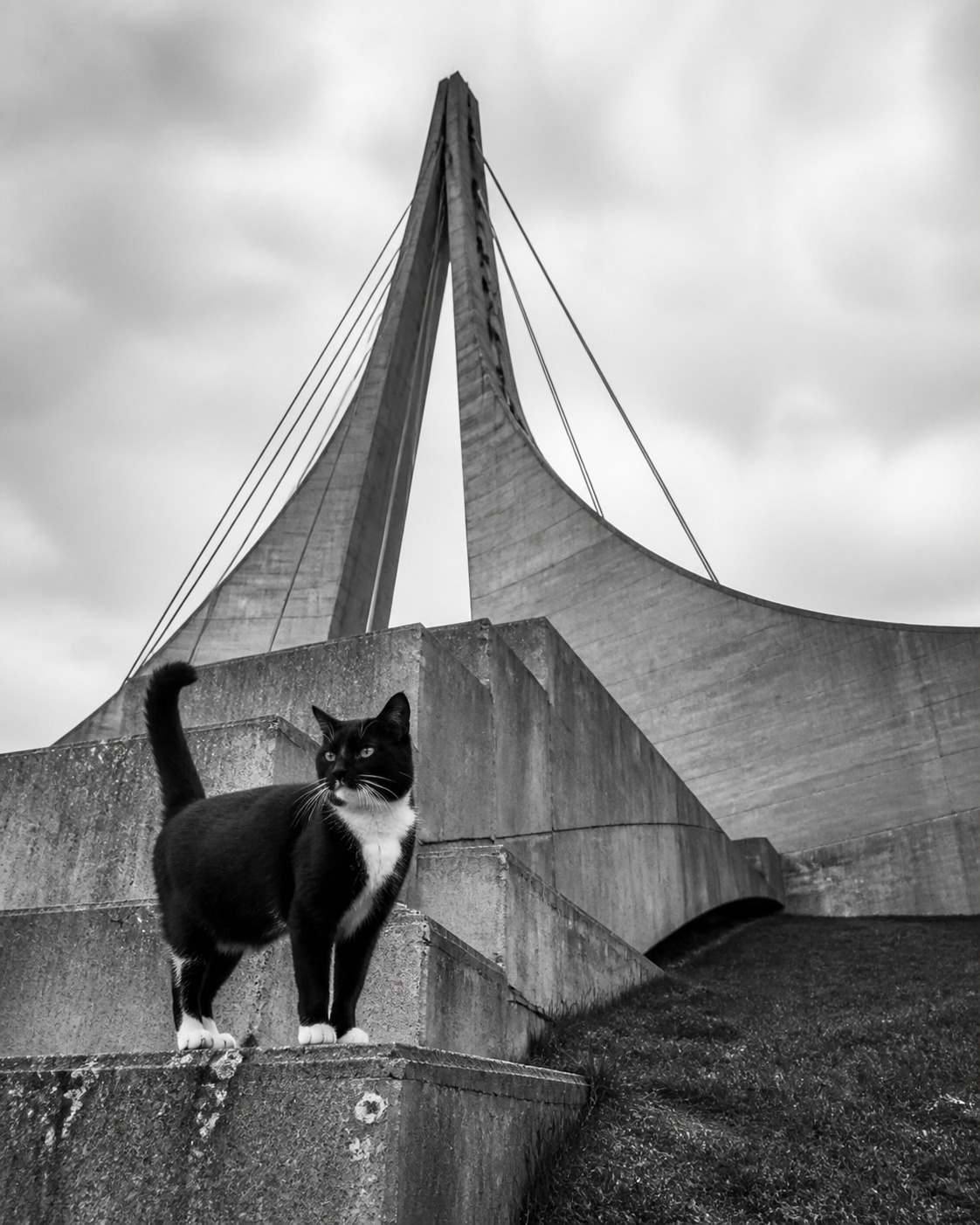
Here is the insight the whole thing runs on: nobody clicks on a photo of a concrete library, but everybody clicks on a cat sitting on one. Get someone to laugh at the cat, and you have tricked them into looking at the building. That is the entire strategy of Cats of Brutalism, and it is a small masterclass in how to smuggle an unpopular argument past people’s defenses.
The argument is preservation. A wave of heavy, post-war concrete buildings, the Brutalist style a lot of people love to hate, was aging into demolition range, and their defenders had a persuasion problem. Straight advocacy was not reaching anyone who did not already care. Three architecture grad students at the University at Buffalo solved it not with a better essay but with a better delivery vehicle. The cat is the Trojan horse. The concrete is the payload.
The trick, stated plainly
Emily Battaglia, Madelaine Ong, and Michaela Senay were brainstorming ways to promote a batch of threatened buildings, and they kept hitting the same wall: posting the architecture on its own went nowhere.
“In adding the cats, we were hoping to show the playful side of it, and to reach a community that might not have an architecture background,” Battaglia has said. That is the whole thesis in one sentence. The cat is not decoration. It is an audience-access strategy, engineered to reach people who would never otherwise stop on a photo of a 1969 library.
And it works because of contrast. A cat’s soft curves and casual slouch against brutal right angles and vast concrete slabs is genuinely funny, and the joke does something sneaky: it gets you to actually see the building’s form, which is the exact thing the students want you to reconsider. The humor and the argument are the same gesture.
Proof the payload lands
You can measure whether a Trojan horse worked by what gets through the gates, and here the evidence is concrete, so to speak. Within a couple of years of that first post, The New York Times named the project one of five art accounts worth following on Instagram. The account has since grown to roughly 112,000 followers, an audience for Brutalist preservation that no straight architecture campaign was ever going to assemble.
The clearest sign the argument outgrew the meme is that it left the internet entirely. In June 2024, Cats of Brutalism became a hardback book, published by the art-and-architecture house Hatje Cantz. A meme that ends up as a serious art-book from a serious art publisher is a meme that did its real job: it got concrete buildings taken seriously by people who arrived for the cats.
The origin was an accident, which is the point
None of this was a grand plan. The first cat to make the leap onto Paul Rudolph’s dramatic 1969 Earl W. Brydges Library was Bailey, one of Senay’s two rescues, both found, fittingly, on Bailey Road. (The other, Smith, is a black Domestic Shorthair who tends to appear and vanish against dark backgrounds like the Cheshire Cat.) It started on a lark, which is worth dwelling on, because the accidental origin is exactly why it feels authentic rather than like a marketing campaign. People can smell a manufactured hook. They forgive a genuine joke.
The buildings, meanwhile, needed the help. Brutalism was nearing its fiftieth birthday with much of its output on the chopping block and plenty of neighbors happy to see it go. The students saw past the reputation. “Brutalism isn’t just these giant concrete blocks,” Battaglia explained. “There’s actually a lot of different unique forms that I don’t think people realize are Brutalist buildings.” The cats made people slow down long enough to notice those forms.
The craft behind the joke
After thousands of posts, the founders have developed a real editorial eye, and their standards are stricter than the goofy premise suggests. Suggestions pour in, and many of the buildings people send simply are not Brutalist; those get politely set aside, because the whole project lives or dies on staying true to the style.
The visual rule they discovered is that motion beats stillness. “The more unique the pose is, the more attractive the post will be,” Battaglia has noted. A cat genuinely interacting with a structure, playing on it, claws out, biting it, lands far better than a cat merely sitting. The image has to feel alive, not pasted. Some of the best entries came from followers: a hairless White Russian scaling Dusan Dzamonja’s 1969 Spomenik Memorial in Bosnia and Herzegovina, and a three-legged rescue cat edited so seamlessly that commenters kept asking whether it truly had only three legs.
That rescue angle is not incidental. The team began featuring adoptable cats, pulling images from the Buffalo-area rescue Ten Lives Club and spots like the Buckminster Cat Café. A cat looking for a home, perched on a building looking for a champion, is a tidy piece of symmetry, and it quietly widens the payload from one cause to two.
The convert in the room
The detail that gives the project away as a labor of love is that only one of its three founders is even a cat person. Senay has her two at home. Ong stays diplomatically neutral. Battaglia has two dogs, and yet curating a feed of cats every day changed her. “This has actually made me more appreciative of cats,” she admitted. “It’s shown me that cats are more playful than I’d thought they were. A year ago, I wouldn’t have.”
Which is the whole account in miniature. Show up for one thing, leave caring about another. Even the rare pushback proved the point: one commenter declared a building “would be better without cats on it,” which, as the founders gleefully note, is the exact reason the account exists. The cat was never the message. The cat was how the message got in.
References
- Anderson, Sam. “5 Art Accounts to Follow on Instagram Now.” The New York Times.
- Cats of Brutalism. Hatje Cantz, 2024.
- Cats of Brutalism (@cats_of_brutalism). Instagram.
Nina Vasquez writes about life at home with pets and the relationships at the heart of it. Her work covers day-to-day living, people-and-pet stories, and the products that fit into a real household, with a warm, grounded take on everyday pet ownership.
Meet our experts ↗Keep reading
 LivingYour Cat Is a Sprinter and Your Dog Is a Marathoner. One Neck Tendon Explains Why.Sasha Ford · 4 min
 Living'Cat Lady' Was Always a Compliment. These 11 Women Are the Proof.Sasha Ford · 7 min
 LivingRosie Lived to 33. The Title She Held Was Never RealDr. Amara Solis · 6 min
 LivingNow Hiring: Job Listings for the Aspiring Bodega Cat (Benefits Pending)Sasha Ford · 3 min
 TrainingYour Cat Isn't Begging at Dinner. They're Waiting for You to Sit Still.Dr. Nina Kohl · 7 min
 Health & WellnessYour Cat Begs to Go Outside. The Honest Case for Keeping Them In.Dr. Priya Nair · 8 min