


'Cat Lady' Was Always a Compliment. These 11 Women Are the Proof.
Long before Taylor Swift posed with a Scottish Fold, empresses, nurses, novelists, and screen legends built their lives around cats. The insult never held up. Here's the roster that debunks it.
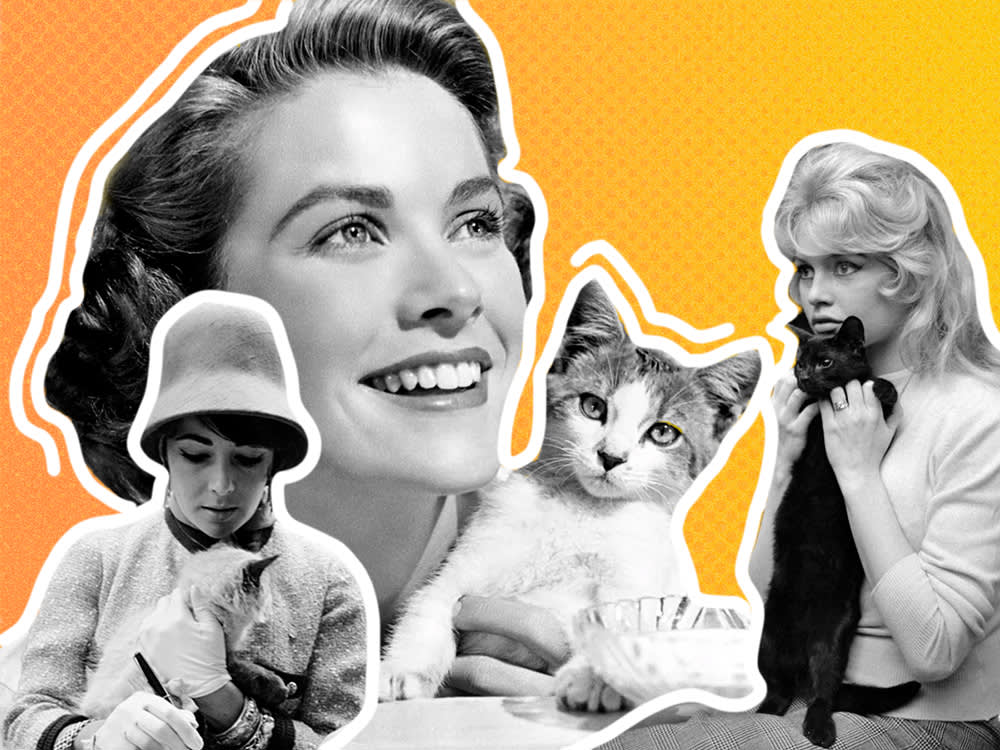
The phrase “cat lady” was built to be a warning. It conjured eccentricity, loneliness, a woman slightly off the rails, think of Grey Gardens’ Little Edie, or The Simpsons’ Eleanor Abernathy hurling cats at passing children. But the caricature only works if you ignore the actual women who lived it. Reach back through history and you find that some of the most powerful, brilliant, and stylish women who ever lived were, unmistakably, cat people.
The modern rehabilitation is real, brands now build entire aesthetics around chic cat ownership, and pop stars pose proudly with their cats, but the “cat lady as icon” story is not a recent invention. It is a very old truth we simply forgot to notice. Here are eleven women who make the case, arranged not by fame but by how far back this goes.
The rulers and reformers who started it
Catherine the Great. Russia’s longest-reigning woman leader was, frankly, obsessed. She let her prized Russian Blues wander the palace’s upper floors, while the ordinary mousers working the basement were handed official guard status, salary and all. After she once presented Prince Grigory Potemkin with a gift worth something like 40 million of today’s dollars, he answered with an Angora cat. She, in turn, shipped her Russian Blues abroad as diplomatic offerings to ambassadors and royal households, the British crown among them. Cat diplomacy, centuries before the internet.
Florence Nightingale. The founder of modern nursing kept more than 60 cats over her lifetime, sometimes with 17 in her care at once. This was not a quirk she hid. In her 1860 Notes on Nursing, she wrote that “a small pet is often an excellent companion for the sick,” especially in long, chronic cases, an early, clear-eyed nod to what we now call the human-animal bond. The woman who professionalized care also, in her way, prescribed cats.
The writers who put cats on the page
Colette. The French novelist behind Gigi was one of literature’s great cat devotees, and she did not keep it private. Her 1933 novella La Chatte (The Cat) centers on a young man whose bond with his Russian Blue, Saha, quietly overwhelms his marriage, a story only a genuine cat person could have written with that much tenderness and menace. Cats moved through her homes and her prose alike, treated always as full characters rather than décor.
Elinor Glyn. This novelist and screenwriter gave us “it” as shorthand for magnetism and confidence, as in, having it. She drew the idea straight from cats, writing that in the animal world “it” shows up in tigers and cats, both “fascinating and mysterious, and quite unbiddable.” She had two of her own to study, named Candid and Zadig.
Alice Walker. The writer and activist has long championed cat rescue, and favors the misfits. A cat named Tuscaloosa entered her life soon after her divorce and would curl on her feet or in her lap as she wrote. Another cat she named for Frida Kahlo, hoping that despite a rough kittenhood the cat would grow, like Kahlo, into “a being of courage, passion, and poise.” Of one snaggletoothed rescue she said a stranger might see imperfect teeth, but she saw the charming perfection of the cat’s imperfection.
The artist who became art
Dora Maar. The French photographer and painter was immortalized in Picasso’s Dora Maar au Chat, seated with a small cat perched on her shoulder, a painting that became one of the highest-selling Picassos of all time. She was far more than a muse, though. Her own cat-inspired work, the striking photograph Boy with a Cat, came out of her series documenting the working poor of Paris and London.
The screen legends who refused to hide it
Eartha Kitt. It is only fitting that Catwoman herself, the third actress to play the role, adored cats off screen too. Kitt brought her black cat Jinx nearly everywhere, backstage at performances and into green rooms alike.
Marlene Dietrich. Her cat found her. Blackie, a stray, wandered onto the grounds of Animal Land, a company that supplied trained animals to film productions, and appeared in the 1931 film Dishonored. He won Dietrich over with his on-camera charm and became her pet.
Brigitte Bardot. When the pressures of fame overwhelmed the actress, she turned to cats. She then spent her post-screen life paying it forward: the Brigitte Bardot Foundation, founded in 1986, is devoted to animal protection.
Jane Fonda. Fonda has shared her life with a string of cats, among them a black cat, Snickers, and a wild tuxedo named Shadow. The feminist and climate activist has never let age slow her down, continuing to lead and push for progress well into her eighties.
And the cook who said it best
Julia Child. The chef and her husband, Paul, brought home a cat named Minette after falling for the cat-loving culture of Paris. Minette became Child’s constant companion in the kitchen and at the table. Child put the whole philosophy into one line worth taping to your fridge: “A house without a cat is like a day without sunshine, a pie without fromage, a dinner without wine.”
The point, in case the caricature made you miss it
String these lives together and the “cat lady” stereotype collapses under its own weight. An empress running feline foreign policy. The mother of modern nursing writing cats into her medical philosophy. Novelists, photographers, chefs, and screen icons, none of them lonely, none of them off the rails, all of them devoted. If loving cats put you in this company, it was never an insult. It was a very good sign.
References
- Nightingale, Florence. Notes on Nursing: What It Is, and What It Is Not. 1860.
- Colette. La Chatte (The Cat). 1933.
- The Brigitte Bardot Foundation (Fondation Brigitte Bardot), founded 1986.
- The Metropolitan Museum coverage of Pablo Picasso’s Dora Maar au Chat (1941).
Sasha Ford is a certified cat behaviour consultant who has worked with shelters, catteries, and private clients across the country. They review all feline behaviour content at The Pet Times, with expertise in multi-cat households, indoor enrichment, and stress-related disorders.
Meet our experts ↗Keep reading
 LivingMy Cat's New Year's Resolutions, In Her Own WordsNina Vasquez · 3 min
 LivingThe Shoulder-Cat Photo Everyone Tried to Copy. Here's Why Yours Won't Work.Sara Lim · 6 min
 TrainingYour Cats Don't Hate Each Other. They Just Don't Smell Like a Family Yet.Dr. Amara Solis · 9 min
 LivingThe 'AI Cat Utopia' That Actually Ran on PeopleJordan Ellis · 6 min
 TrainingYour Couch Isn't Losing to Your Cat. It's Losing to Bad Real Estate.Dr. Nina Kohl · 9 min
 LivingYour Cat Isn't Judging You. It's Running a Threat Assessment.Dr. Nina Kohl · 7 min