


The 'AI Cat Utopia' That Actually Ran on People
A UK art-science project let three cats live with an AI robot for 12 days and got headlines about robots caring for cats. Look closer and the experiment proved the opposite: the autonomous utopia only worked because humans never left the room.

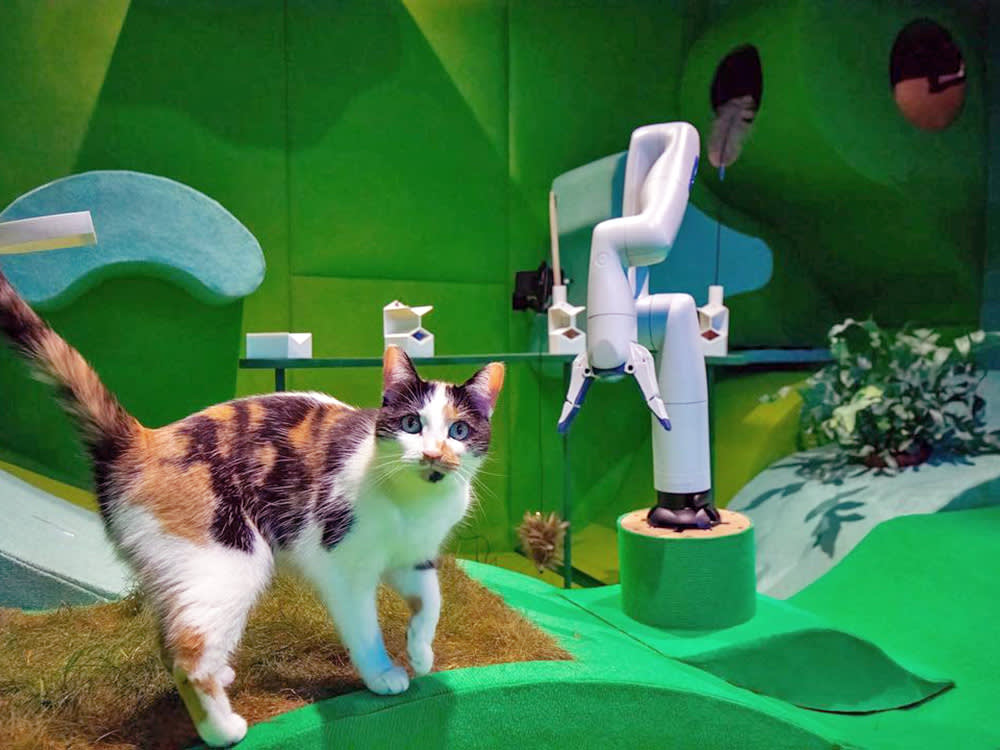
The tidy version of the Cat Royale story is the one that traveled: scientists built a robot that cared for three cats, and the cats were happy. It is a great headline. It is also almost backwards. The more you read about how the twelve-day experiment actually ran, the clearer it becomes that the “autonomous” cat utopia was propped up, minute by minute, by people. That is the part worth paying attention to, because it is exactly the part that gets airbrushed out of every ad for a self-cleaning litter box or an AI pet camera you will ever see.
So let’s start where the press releases ended: with the humans in the room.
The crew behind the “autonomous” robot
Cat Royale was a collaboration between computer scientists at the University of Nottingham and the artists at Blast Theory, built as part of the UK’s Trustworthy Autonomous Systems Hub, a research program studying what it actually takes for people to trust AI. Three cats, Ghostbuster, Pumpkin, and Clover, lived in a purpose-built enclosure for six hours a day over twelve days, sharing the space with a single robotic arm that offered games every ten minutes: tossing balls, dangling feathers, dragging a toy mouse, ringing a bell, presenting the eternal cardboard box.
The arm looked autonomous. It was not, or not entirely.
“People hear ‘AI robot’ and picture something running on its own,” says Dr. Amara Solis, DVM. “In practice these systems are almost always a partnership. The software makes suggestions, and humans stay in the loop to keep things safe and working. Cat Royale is honest about that in a way most consumer gadgets are not.”
Behind the scenes, a person was always ready to operate the arm, and they regularly had to. When a toy tangled or a cat played too hard and put the machine under strain, a human improvised a move to free it. Human observers scored every game and the cats’ reactions, and that scoring, not the AI alone, is what taught the system which cat liked what. Clover’s fondness for the orange bird toy, the detail everyone quotes, was learned because people watched Clover and told the machine what they saw. And senior staff from the RSPCA were present all twelve days to safeguard the animals.
Strip that crew out and the utopia collapses. That is not a flaw in the project. It is the finding.
What the cats actually got
None of this means the cats were miserable props. By the researchers’ accounts, the three genuinely seemed to enjoy the space, and the design is a small master class in what enrichment should look like, robot or no robot.
The enclosure was built for the cats first. Colors were chosen to relax them, and also to help them stand out to the AI’s cameras, a nice illustration of how the “wider world” had to be engineered before the robot could do anything useful.
“We quickly learned that it’s not just about getting a robot to pick up and move toys but rather you need to design the wider world in which both robot and cats live in order to enable them to interact safely and successfully,” Steve Benford, the Nottingham computer science professor who led the work, has said of the project.
Crucially, the cats could always opt out. High perches and walkways sat out of the arm’s reach, so a cat who wanted nothing to do with the robot could climb away and be left alone.
“The single best feature of that enclosure is the escape route,” Dr. Solis says. “Any enrichment, an automatic toy, a feeder, a laser, has to let the cat leave. A cat who cannot walk away from a device is not being entertained. They are being cornered.”
That is a design rule you can steal for your own living room today, and it costs nothing.
Why a robot arm isn’t coming to your apartment
It is fair to wonder whether household cat-tending robot arms are just around the corner. They are not, and the reason is instructive. The Cat Royale enclosure was tuned for the cats’ happiness and the AI’s cameras, not for human livability, with specific colors, textures, and terrains a person would never want in their home.
The team’s paper on the installation was presented at the 2024 Computer-Human Interaction (CHI) conference in Honolulu, where it won best paper, an unusually strong signal from the field. In it, the researchers spelled out the human roles the system depended on: breakdown recovery, animal-welfare oversight, and simply being an audience. In other words, the peer-reviewed conclusion is not “robots can raise cats.” It is closer to “robots can assist, if enough people stay involved.”
Benford has floated the more interesting question the project raises: could a robot teach us something about how our cats like to play, so we play with them better? That reframes the goal entirely. The point of the AI is not to replace your attention. It is to sharpen it.
The honest way to read your own pet tech
Here is where Cat Royale actually earns its keep, because the autonomous pet gadgets in the story are already in your house. Automatic feeders, self-cleaning litter boxes, treat-tossing cameras, and app-driven laser toys all market themselves on the same promise the robot arm made: your pet, cared for, without you. Cat Royale is a twelve-day argument that the promise is oversold. Use that lens when you shop.
- Ask what happens when it fails, not just when it works. The robot arm needed a human on standby for tangles and jams. Your automatic feeder needs a plan for a power outage, a jammed hopper, or an empty battery, ideally an alert to your phone and a backup bowl. A device that fails silently is worse than no device.
- Buy tools that keep you in the loop, not ones that cut you out. The best smart pet gear gives you data or presence, a camera that lets you talk to your cat, a feeder that logs whether they ate, a tracker that flags a change in routine. Treat “set it and forget it” as a warning label, not a feature.
- Never let a gadget be the only enrichment. Cat Royale worked because the robot was one option inside a rich, cat-designed world with escape routes. An automatic toy that runs in an otherwise bare room is not enrichment. Pair any device with perches, hiding spots, window views, and, most of all, time with you.
- Watch your specific cat, the way the crew watched theirs. The system only learned preferences because humans scored the cats’ reactions. You are that scorer at home. If the fancy toy sits untouched and your cat still wants the string on a stick, believe your cat.
The one thing the robot couldn’t do
For twelve days, three cats lived in an environment engineered to be a feline paradise, tended by an award-winning AI, and it still took a full-time human crew to keep the whole thing standing. That is the quiet, hopeful takeaway buried under the “robot cares for cats” headlines. The technology can genuinely help. It can watch, feed, clean, and even learn what your cat enjoys. What it cannot do, what it needed people for at every turn, is be present. That job is still, reassuringly, ours.
References
- Benford, Steve, et al. “Charting the Realities of Human-Robot Cohabitation with Cats (Cat Royale).” Proceedings of the 2024 CHI Conference on Human Factors in Computing Systems. https://dl.acm.org/doi/10.1145/3613904.3642115
- “Cat Royale.” Blast Theory. https://www.blasttheory.co.uk/projects/cat-royale/
- “Trustworthy Autonomous Systems Hub.” UK Research and Innovation. https://www.tas.ac.uk/
- “Environmental Needs Guidelines.” American Association of Feline Practitioners. https://catvets.com/guidelines/practice-guidelines/environmental-needs-guidelines
Jordan Ellis is a certified professional dog trainer with a decade of experience working with rescue organisations and private clients. They specialise in anxiety, reactivity, and positive reinforcement methods, and review all training and behaviour content at The Pet Times.
Meet our experts ↗Keep reading
 Product PicksThe Self-Cleaning Litter Box That Actually Wins Cats OverSasha Ford · 5 min
 Product PicksShould You Put a Camera on Your Cat? A Weight-First Buyer's GuideJames Okafor · 7 min
 Product PicksA Cat DNA Test Won't Tell You What Your Cat Is. That's Not the Reason to Buy One.Dr. Mara Chen · 7 min
 Product Picks9 Electronic Cat Toys That Beat Boredom While You're OutDr. Mara Chen · 6 min
 Product PicksI Doubted a $30 Plastic Box Could Beat Litter Smell. It Did.Tom Hadley · 4 min
 Health & WellnessAn App Says It Can Translate Your Cat's Meows. We're Not Sure That's the Point.Dr. Priya Nair · 4 min