


Your Cat Is a Sprinter and Your Dog Is a Marathoner. One Neck Tendon Explains Why.
Cats twist mid-air and land on their feet. Dogs jog for miles. The difference comes down to a flexible spine, a missing ligament, and two totally different ways of catching dinner.

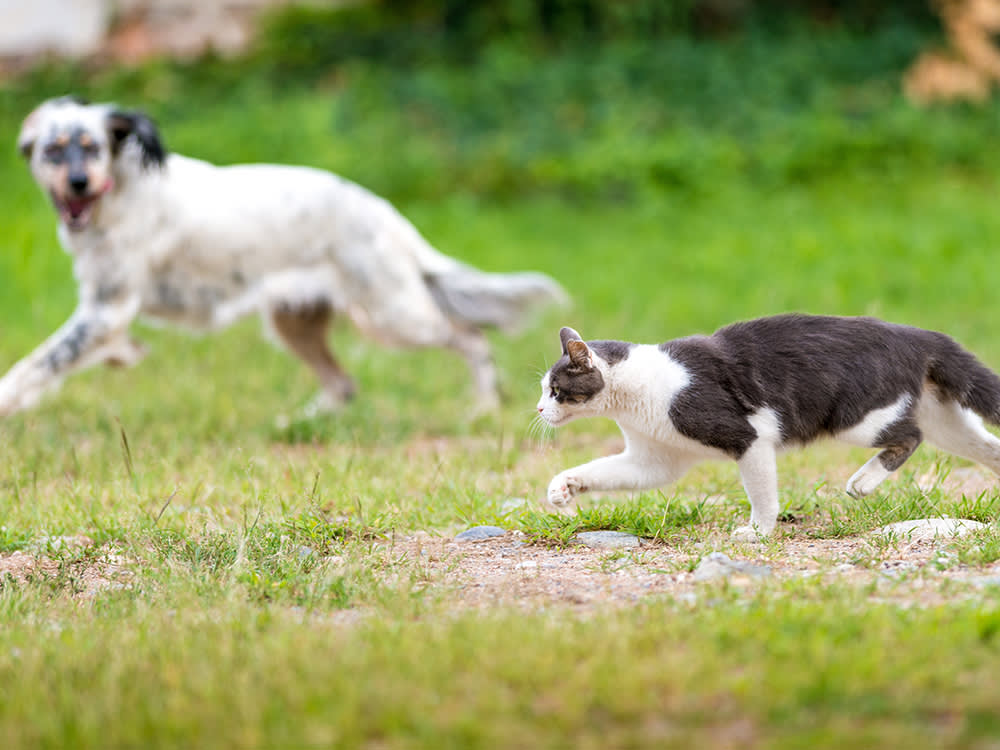
Watch a cat pour itself off a bookshelf, twist in the half-second of the fall, and touch down on all four feet like it planned the whole thing. Then watch a dog settle into a steady jog beside a bike, mile after mile, perfectly content. Both are athletes. They are just built for opposite sports, and the reason traces back to how each animal evolved to eat.
Two different hunters, two different bodies
A cat hunts alone. No pack, no chasing prey to exhaustion across open ground. A cat’s whole strategy is stealth, one explosive burst, and enough flexibility to correct in mid-leap if the target bolts. Everything about the feline body is tuned for that ambush.
A dog’s ancestors hunted the opposite way, working together to run prey down over long distances, nose to the ground on a scent trail. That job did not reward mid-air acrobatics. It rewarded endurance and an efficient, stable stride you could hold for miles. Once you see the two hunting styles, the anatomy stops being trivia and starts being obvious.
Why cats bend like that
A cat’s spine is genuinely more flexible than a dog’s, and it comes down to the hardware. The discs between a cat’s vertebrae have more give, and the vertebrae themselves are more loosely connected, which is also why cats largely dodge the back problems that plague a lot of dogs. On top of that, a cat’s shoulders and pelvis attach to the spine more loosely than a dog’s do. Add it up and you get an animal that can rotate its front and back halves almost independently, twist during a fall, and land upright.
That flexibility is what lets a cat leap up to nine times its own height from a crouch, change direction in an instant, and, yes, almost always land on its feet.
The tendon dogs have and cats don’t
Here is the piece most people have never heard of. Running along the back of the neck is a structure called the nuchal ligament, which connects the head to the spine. It is an energy-saving adaptation for animals built to run fast and far: it holds the head steady without the muscles having to do the work, saving energy over long distances.
Dogs have it. So do horses and humans, all of us long-distance movers. As early dogs evolved longer legs, longer noses, and longer necks to follow scent across open country, that ligament let them keep their heads down and their energy up over huge stretches of ground. They traded some front-limb dexterity and raw neck strength for teamwork and stamina.
And cats? Cats do not have a nuchal ligament at all. They never needed one. Nothing about ambush hunting asks you to hold your head level for ten miles.
So who is actually faster?
It depends entirely on the clock. A cat’s flexible spine, powerful muscles, and claws that grip like a runner’s spikes let it hit around 30 miles per hour, and its stretched-out stride can cover roughly three times its body length. But that is anaerobic sprinting, sustainable only for seconds. A cat is a phenomenal sprinter and a hopeless distance runner. There is a reason the cheetah, the fastest land animal alive, is a cat.
Dogs live at the other end. A few, like Greyhounds, can touch 45 miles per hour, but only in short bursts. Most dogs cruise closer to 15 to 20 miles per hour, and their real gift is holding a jog far longer than any cat would tolerate, or, being cats, even consider.
“The takeaway I want owners to hear is that these are two different athletes with two different needs,” says Dr. Mara Chen. “A dog does well with sustained, rhythmic exercise like a long walk or jog. A cat wants short, intense bursts, a few minutes of real chase-and-pounce play, not a marathon. Match the activity to the body and you get a healthier, happier animal.”
What this means for your floor at 2 a.m.
Next time your cat detonates into a lap of the living room and then flops down like nothing happened, or your dog looks genuinely puzzled that the walk is over, you are watching a hundred generations of hunting strategy play out. One was built to explode. One was built to keep going. Both, conveniently, are also very good at napping.
References
Sasha Ford is a certified cat behaviour consultant who has worked with shelters, catteries, and private clients across the country. They review all feline behaviour content at The Pet Times, with expertise in multi-cat households, indoor enrichment, and stress-related disorders.
Meet our experts ↗Keep reading
 LivingYour Cat's Fur Pattern Says Almost Nothing About Who They AreDr. Mara Chen · 7 min
 Health & WellnessA Blind, Paralyzed Cat Isn't a Tragedy. It's a Setup Problem.Dr. Nina Kohl · 7 min
 Health & WellnessYour Cat Doesn't Think You're Its Baby or Its Parent. The Truth Is Better.Dr. Mara Chen · 6 min
 Health & WellnessThis Cat Is 26. Her Secret Is 15 Boring Habits, Not One Magic Trick.Dr. Priya Nair · 9 min
 TrainingPaper Is the Best Cat Toy in Your House. It's Also a Trap.Dr. Ravi Mehta · 7 min
 LivingYou Can't Out-Spray Cat Pee. Here's the Only Thing That Actually Works.Dr. Mara Chen · 9 min