


You Can't Out-Spray Cat Pee. Here's the Only Thing That Actually Works.
Air fresheners lose to cat urine every time, and the chemistry explains why. What actually removes the smell, how to clean it off every surface, and when the pee is really a health warning.

Affiliate disclosure. This article contains affiliate links. We may earn a small commission if you buy through a link, at no extra cost to you. How we handle recommendations.
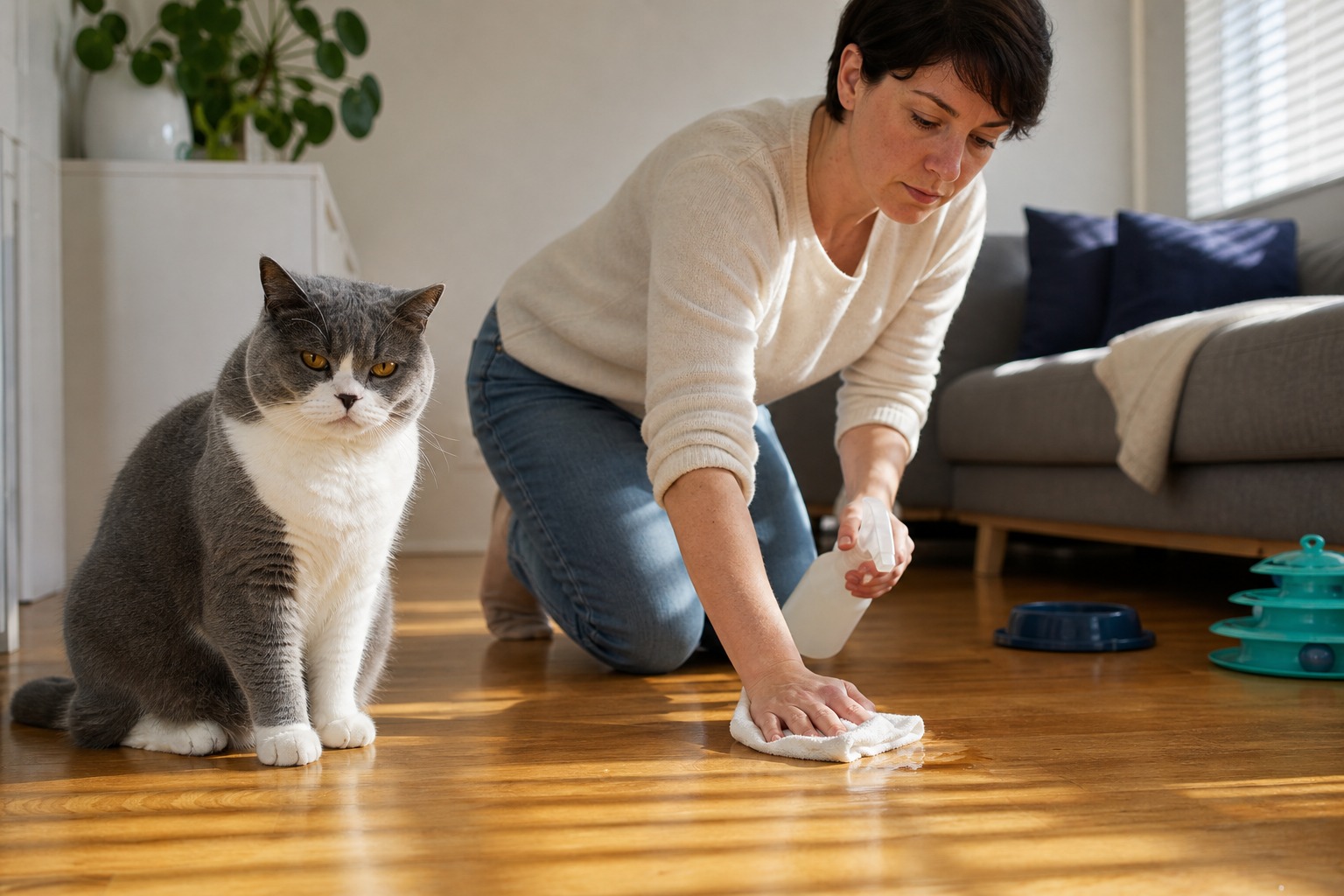
Here is the hard truth about cat pee: you cannot cover it up. People reach for the air freshener, the scented candle, the plug-in diffuser, and for about twenty minutes it seems to work. Then the pee wins, because masking a smell and removing a smell are two completely different jobs, and cat urine is chemically built to defeat the first one.
Once you understand why cat pee is so stubborn, the fix stops being a guessing game. This piece is about that chemistry, the products that genuinely beat it, how to clean it off every surface in your house, and the part most cleaning guides skip entirely: sometimes the smell is not a cleaning problem at all. It is your cat telling you something is wrong.
Why cat urine is in a league of its own
All urine smells, but cat urine is uniquely brutal, and that is by design rather than bad luck. Two things stack up.
First, concentration. Cats are obligate carnivores whose kidneys evolved to squeeze the maximum out of every drop of water, a holdover from desert-dwelling ancestors. That leaves their urine loaded with urea, which bacteria break down into ammonia, the sharp, eye-watering note you hit first.
Second, and this is the part the ammonia story leaves out, cat urine contains felinine, a sulfur-based amino acid that other animals don’t produce in the same way. As the urine ages, felinine degrades into volatile sulfur compounds, the same family of chemicals that make skunk spray and rotten eggs unbearable. That is the deep, clinging, back-of-the-throat funk that survives long after a normal cleaner would have handled ordinary ammonia. It is also why the smell can seem to get worse over days: the longer it sits, the more those compounds develop.
There is a social layer too. Cats use urine to communicate, leaving a scent-and-pheromone message that tells other cats who has been through the area, without anyone having to risk a face-to-face standoff. That is useful information for a cat and a nightmare for a human nose, and it is part of why a cat who smells an old spot is tempted to refresh it.
Why enzyme cleaners win and everything else loses
The reason ordinary cleaners fail comes down to one molecule. Cat urine leaves behind uric acid, which forms crystals that are not water-soluble. You can scrub with soap, mop with vinegar, and the surface will look and even smell clean, but those crystals stay locked in the fibers. Then a humid day rolls in, the crystals rehydrate, and the smell is back as if you never touched it.
Enzymatic cleaners are the answer because they do something no soap can: the enzymes actually break the uric acid and the odor compounds apart at a molecular level, so there is nothing left to reactivate. This is why vets and behavior folks treat them as the non-negotiable tool for cat urine. A few reliable options:
- Nature’s Miracle enzymatic cleaner — the widely available default, made specifically for pet urine.
- Rocco & Roxie Stain & Odor Eliminator — a well-reviewed enzyme formula that works on set-in stains.
- Angry Orange pet odor eliminator — citrus-based, useful when you also want to discourage a repeat visit to the spot.
If you can’t get an enzyme cleaner immediately, home remedies buy you time but don’t fully finish the job. White vinegar followed by baking soda neutralizes some of the odor. On surfaces that won’t be harmed, a mix of hydrogen peroxide and a little dish soap can lift both stain and smell (always spot-test first). Diluted essential oils get suggested a lot, lavender is said to help cut ammonia and peppermint to deter repeat marking, but go easy, because many essential oils are toxic to cats and are not worth the risk near your pet. None of these dissolve uric acid crystals the way an enzyme does, so treat them as a stopgap, not the cure.
One tool worth adding to your kit: a cheap UV blacklight. Dried urine fluoresces under UV, so in a dark room you can find the hidden spots your nose knows are there but your eyes can’t pinpoint. You cannot clean what you cannot find.
The four-step cleanup
Once you’ve located the mess, the method is the same everywhere:
- Find the source. Follow your nose, or use the blacklight, until you have the exact spot. Guessing wastes cleaner and leaves crystals behind.
- Blot, don’t rub. Press a dry cloth or paper towel into the area to pull up as much liquid as possible. Keep going until the towel comes away dry. Rubbing just spreads it.
- Soak it with enzyme cleaner. Saturate the spot, more than feels necessary, and let it sit for the full time on the label. The enzymes need contact time and wetness to work.
- Repeat until it’s truly gone. Blot, re-treat, and check again once it’s dry. Deep spots can take two or three rounds. Patience here is what separates “smells clean” from “is clean.”
How to handle each surface
Different materials need slightly different care.
Carpet. The classic problem, because urine sinks past the surface into the pad. Soak up everything you can, apply enzyme cleaner generously, wait the full dwell time, then blot dry. For a stubborn spot, wiping the area afterward with rubbing alcohol can help lift residue.
Cushions. Strip off any removable covers and treat both the cover and the foam. Anything machine-washable can go through a hot wash with a biological (enzyme-based) detergent to break the compounds down.
Mattress. Treat it like carpet, blot, saturate with enzyme cleaner, blot again, but accept that urine often soaks deep into a mattress, so you may need to repeat over a couple of days and it may never be perfect.
Clothing. The easy win. Get it into the washing machine promptly with a biological detergent and the smell usually comes right out.
Wood. The tricky one. If urine has soaked into untreated or unsealed wood, it can stain, warp, and hold odor permanently, and the board may need replacing. Move fast, use only a cleaner rated as safe for wood, avoid soaking, and test on a hidden patch first.
When the pee is a health message, not a mess
This is the section the cleaning-only guides leave out, and it is the most important one. A cat who suddenly starts urinating outside the box is often not being spiteful or lazy. They are telling you something.
The common triggers fall into two buckets. The first is the setup: a box that is not scooped enough, in a location the cat dislikes, or too few boxes for the household. The second, and the one you must not miss, is medical. Urinary tract infections, bladder stones, and kidney problems all make urinating painful, and a cat in pain quickly learns to blame the box and go elsewhere. Stress, from a move, a new pet, a new baby, or a change in routine, can do it too.
When a litter-trained cat suddenly starts going outside the box, I want them seen before we call it a behavior problem. Straining, going more often, blood in the urine, or crying in the box can point to an infection or stones, and in male cats a blockage is a true emergency. The accident on your rug is sometimes the first symptom you get.
If your cat is otherwise healthy and the vet has ruled out illness, then you work the environment. If anything about the pattern seems off, a vet visit comes first.
How to keep it from happening again
Prevention is mostly about removing the reasons a cat looks elsewhere.
Litter box maintenance is everything. Scoop daily, keep the box in a quiet, low-traffic spot away from noisy appliances, and follow the classic guideline of keeping one extra box beyond however many cats live with you. Cats are genuinely fussy about cleanliness, and a box that offends them is a box they will avoid.
Learn your cat’s preferences. Not every cat likes the same litter, box shape, or depth. If accidents keep happening, set out a couple of options side by side and let your cat vote with their paws.
Address stress at the root. If anxiety is driving the marking, give your cat more of what makes them feel secure, hiding spots, vertical space to retreat to, predictable routines, and regular play to burn off tension.
Skip the cover-up. Masking the smell with air fresheners or diffusers is the least effective thing you can do, and heavily scented products can bother a cat’s sensitive nose or even push them to re-mark. Fix the cause and remove the odor properly, and you won’t need to hide anything.
Cat pee feels like a war you’re losing because most people are fighting it with the wrong weapon. Switch to enzymes, clean it properly the first time, and pay attention to what the accidents are trying to tell you, and it becomes a problem you can actually win.
References
- Cornell Feline Health Center. “Feline Behavior Problems: House Soiling.” Cornell University College of Veterinary Medicine.
- Miyazaki, Masao, et al. “The biological function of cauxin, a major urinary protein of the domestic cat.” Chemical Senses / Journal of Chemical Ecology, on felinine metabolism in cat urine.
- International Cat Care. “Thinking outside the box: understanding feline house soiling.” icatcare.org.
- American Association of Feline Practitioners. “Feline inappropriate elimination guidelines.” catvets.com.
Common questions
Can cat pee actually be washed out of fabric?
Yes, most fabric can be saved if you act quickly. Washable items respond well to an enzymatic or biological laundover; soak up what you can, treat with an enzyme cleaner or biological detergent, then wash. Mattresses and untreated wood are the hardest because the urine soaks deep.
My cat isn't having accidents, so why does my house still smell like pee?
Usually the litter box. If the box is scooped too rarely, there are too few boxes for the number of cats, or the litter isn't controlling odor, the box itself becomes the smell. Scoop daily and keep an extra box beyond your number of cats.
Dr. Chen is a small-animal veterinarian who leads health and safety coverage at The Pet Times. She writes and reviews the bulk of our illness, condition, and safety content, translating clinical guidance into clear, practical advice owners can act on at home.
Meet our experts ↗Keep reading
 LivingHe Fostered Six Kittens. Two Died in His Hands. He Kept Fostering.Dr. Amara Solis · 8 min
 Health & WellnessThe Wobbly Cat Looks Like a Tragedy. It's One of the Easiest Special Needs There Is.Dr. Lena Park · 8 min
 LivingYour Party's Biggest Risk Isn't the Cat Getting Scared. It's the Front Door.Dr. Amara Solis · 7 min
 Health & WellnessFoxtails Aren't Just a Dog Problem. For Cats They Can Be Deadly.Dr. Amara Solis · 5 min
 Health & WellnessYour Cat Begs to Go Outside. The Honest Case for Keeping Them In.Dr. Priya Nair · 8 min
 TrainingToilet-Training Your Cat Means Throwing Away Their Health ChartDr. Ravi Mehta · 8 min