


The Wobbly Cat Looks Like a Tragedy. It's One of the Easiest Special Needs There Is.
Cerebellar hypoplasia is the most viral neurological condition on the internet and the most misunderstood. It doesn't get worse, it doesn't hurt, and it isn't catching. What it needs from you is mostly rugs.

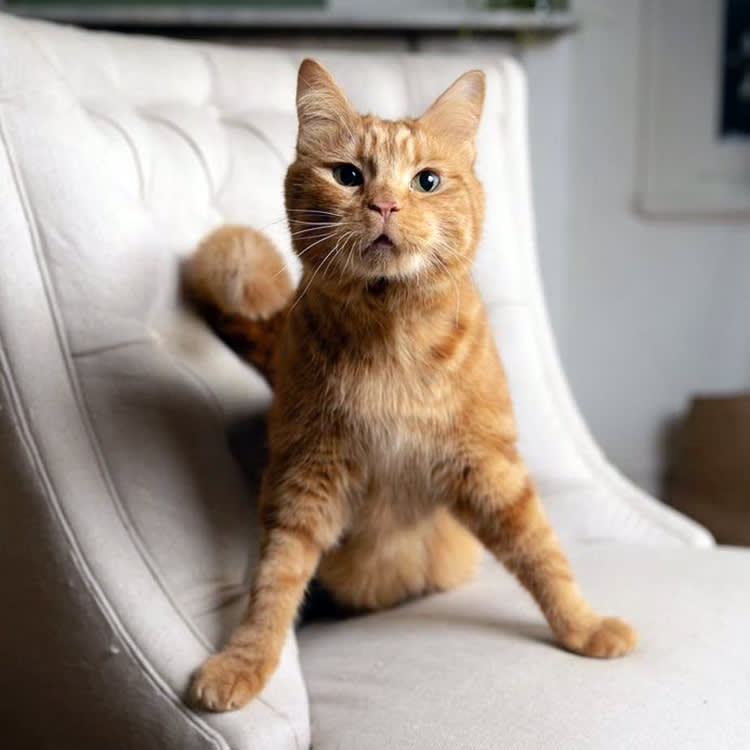
The first time you watch a cat with cerebellar hypoplasia try to cross a room, your stomach drops. The legs splay wide. The head bobs. The whole animal moves like a marionette operated by someone in a moving vehicle. Everything in you says this cat is suffering.
They are not. And once you understand what is actually broken, the entire condition reorganizes itself in your head from a tragedy into a home renovation project.
What the damage actually is
Cerebellar hypoplasia, “wobbly cat syndrome,” happens when the cerebellum, the part of the brain responsible for balance, coordination, and fine motor control, fails to develop properly. The usual cause is feline panleukopenia virus, the feline parvovirus, passing from an infected mother to her kittens either in the womb or during the first couple of weeks of nursing. The virus attacks rapidly dividing cells, and in a fetal or newborn kitten, the cerebellum is one of the fastest-growing structures there is. It gets caught in the crossfire.
Here is the part that changes everything. The cerebellum does not generate movement. It edits it. Think of it as the copy desk between the intention and the muscle. A cat with CH has full strength, full sensation, and a completely intact desire to jump on your counter. What they lack is the department that would have smoothed out the delivery.
That is why these cats look so much worse than they feel. They are not weak. Watch one sleeping or sitting still and you would never guess. The wobble only shows up in the doing.
And the damage happened once, in one window, and then stopped. It is not a degenerative disease. It does not spread. It does not creep.
Owners come in braced for a prognosis conversation and I get to tell them there isn’t one. The injury is finished. Your job now is furniture, not medicine.
How to spot it
CH cats are distinctive once you know the pattern:
- A wide-based stance, legs planted far apart like a sailor on a deck
- Swaying when standing or moving
- An exaggerated high-stepping gait, lifting the legs much higher than needed
- Head tremors and head bobbing, most obvious when they are concentrating, especially while eating
- A tendency to overshoot and undershoot, misjudging a jump or a step
- Frequent falls, taken with an apparent lack of concern
The tremor giveaway is the intent: it appears when they try to do something and fades when they relax. And crucially, a still or sleeping CH cat looks exactly like any other cat.
Diagnosis is usually straightforward. A vet can identify CH from history and physical exam findings in most cases, particularly with a kitten from an unvaccinated mother or a shelter litter. When the picture is unclear, a CT or MRI will show a smaller-than-normal cerebellum, which confirms it. Severity varies widely and tracks the extent of the cerebellar damage: some cats have a barely perceptible tremor, some cannot walk without a wall.
If your cat is wobbly and it started rather than always having been there, that is not CH. Sudden or worsening incoordination in an adult cat is an emergency, not a quirk. Toxins, inner-ear disease, spinal disease, and neurologic infections all present that way and all need a vet immediately.
The one thing that actually prevents it
Vaccination. Panleukopenia is entirely preventable, and the vaccine that prevents it, the FVRCP core vaccine, is one of the most effective tools in feline medicine.
Kittens should start their FVRCP series at six to eight weeks and continue every three to four weeks until at least sixteen weeks of age. An unvaccinated pregnant stray in a colony is the origin story for most CH litters in this country.
There is one more detail that almost nobody knows, and it is worth knowing if you work with cats: modified-live panleukopenia vaccines should not be given to pregnant queens, precisely because of the risk to the developing kittens. If a pregnant cat needs protecting, that is a conversation with your veterinarian about which product and which timing, not a walk-in shot.
Living with one is mostly a furniture problem
Ask people who actually have CH cats what the daily reality is and the answer is usually some version of “less work than you’d think.” The adaptations are small, cheap, and mostly about geometry.
Put down soft flooring. Rugs, runners, and mats give traction and cushion the falls. Bare hardwood and tile are the enemy of a cat who cannot reliably brake.
Give them something to lean on. A litter box with high sides they can brace against transforms the experience of using it. Same principle everywhere: a wall or a wall-adjacent surface is a CH cat’s best friend.
Lower the stakes, not the world. Ramps and steps in place of jumps. Drape sturdy throws and heavy blankets over the sides of furniture, so a cat scaling the couch has something to hook a claw into instead of a leap to attempt. Do not wrap them in cotton wool, though. These cats want to climb and play, and letting them practice is how they get better at it.
Feed at floor level, in soft bowls. Head tremors get worse during concentration, and eating is concentration. A shallow, soft, non-tippable bowl on the ground beats an elevated ceramic one.
Block the drops. Balconies, open stairwells, high shelves, and windows are the real risk. Falling is the biggest danger to these cats, and fall-related injuries are the one thing you will genuinely be treating.
Indoors only. Or supervised in a securely fenced yard. A cat who cannot make a reliable escape leap is not a cat who should be meeting the neighborhood.
The bigger renovations are optional and depend on the house. Some owners re-carpet stairs for traction. Some rebuild them outright. That is at the extreme end, and it is a choice, not a requirement.
Socially, there is almost nothing to manage. CH is not contagious, so a wobbly cat can live with vaccinated cats without any risk to them. They play, they squabble over food, they get along or they do not, on exactly the terms any other cats would.
The internet’s relationship with these cats
Wobbly cats are enormously popular online, and there is a real ecosystem of CH accounts with followings in the hundreds of thousands and, in some cases, over a million. The wobble is disarming, the personalities tend to be big, and the comments sections are affectionate.
That visibility does two things at once. It has genuinely helped, because a condition people can see being lived with well is a condition people stop being afraid to adopt into, and CH cats do get adopted out of it. There is an active community of CH owners who trade advice and help place cats.
But it also flattens the thing. A fifteen-second video of a cat tipping over is not a fifteen-year commitment, and a real CH cat comes with a real litter box, a real falling risk, and a real need for someone who will not panic the tenth time they land on their face. The gap between finding it adorable and being prepared to live with it is where these cats get returned.
What newer research adds
The clinical picture of CH has not really changed, and that is the point: this is a settled, stable, well-characterized condition, which is unusual and reassuring in veterinary neurology.
What has moved is access. Panleukopenia remains a serious threat in unvaccinated populations, and current shelter medicine practice now pushes vaccination earlier and more aggressively in high-risk settings, including on intake, because the window in which a queen can pass this on to a litter is so narrow and so consequential. The number of CH kittens being born is a direct function of how many unvaccinated pregnant cats are living rough, which makes trap-neuter-vaccinate-return programs part of the prevention story too.
The other quiet shift is in adoption. CH cats used to be routinely classified as unadoptable. They are now one of the more successfully rehomed special-needs categories, largely because the internet has done the education that veterinary pamphlets never managed.
The bottom line
A wobbly cat is not a sick cat. They are a cat whose coordination department closed before they were born, and who has spent every day since working around it with total indifference to how it looks.
They are not in pain. They will not get worse. They cannot give it to your other cats. They will live a normal lifespan. What they need is rugs, low food bowls, a litter box they can brace against, and no long drops.
Vaccinate your cats, and there will be fewer of them. Adopt one, and you get a completely ordinary cat who happens to walk like the floor is at sea.
References
- Stone, A. E. S., et al. “2020 AAHA/AAFP Feline Vaccination Guidelines.” Journal of Feline Medicine and Surgery, vol. 22, no. 9, 2020, pp. 813–830.
- Cornell Feline Health Center. “Feline Panleukopenia.”
- Url, A., & Schmidt, P. “Do Feline Panleukopenia Virus and Canine Parvovirus Cause Cerebellar Hypoplasia in Cats?” Journal of Veterinary Medicine Series A, vol. 52, no. 5, 2005.
- University of Wisconsin Shelter Medicine Program. “Neonatal vaccination recommendations.”
Common questions
Does cerebellar hypoplasia get worse over time?
No. The damage happens once, before or shortly after birth, and it does not progress. Many cats actually appear to improve as they grow, because they get better at compensating. If a wobbly cat is genuinely deteriorating, that is a different problem and needs a vet.
Can my other cats catch it from a CH cat?
No. Cerebellar hypoplasia itself is not contagious. It is the aftermath of a virus that has already run its course. The virus that causes it, feline panleukopenia, is highly contagious, which is why every cat in the house should be vaccinated against it, but a CH cat is not carrying anything.
How long do cats with cerebellar hypoplasia live?
A normal cat lifespan. CH does not shorten life. The one real risk is injury from falling, which is why these cats should be indoor-only or supervised outdoors, and why you take the sharp edges and long drops out of the environment.
Not a substitute for your vet. Our guidance is educational. For urgent symptoms, contact a vet or emergency clinic right away. Editorial standards
Dr. Park is a board-certified emergency and critical care specialist. She reviews our health and safety content for clinical accuracy and contributes guides on recognising urgent conditions. Her focus is helping owners act quickly and correctly when it matters most.
Meet our experts ↗Keep reading
 Health & WellnessGetting Your Cat Fixed Can Cost $0 or $500Dr. Priya Nair · 6 min
 Health & Wellness7 Ways to Help the Stray Cats on Your Street Survive WinterDr. Priya Nair · 7 min
 LivingKitten Season Never Ends Anymore. Blame the Vet Bill, Not the Weather.Leila Torres · 8 min
 LivingA Five-Month-Old Kitten Turned On a Faucet, Blocked a Drain, and Closed a Cat CafeSara Lim · 6 min
 Health & Wellness16 Hours of Sleep Is Normal. The Cat You Should Worry About Sleeps 'Fine.'Dr. Lena Park · 8 min
 Health & WellnessYour Cat's Purr Sounds Like an Engine. Usually That's Great News, Sometimes It Isn't.Dr. Nina Kohl · 4 min