


16 Hours of Sleep Is Normal. The Cat You Should Worry About Sleeps 'Fine.'
Every guide answers the wrong question. How much a cat sleeps tells you almost nothing. How much that changed tells you almost everything, and you're the only person on earth who has the baseline.

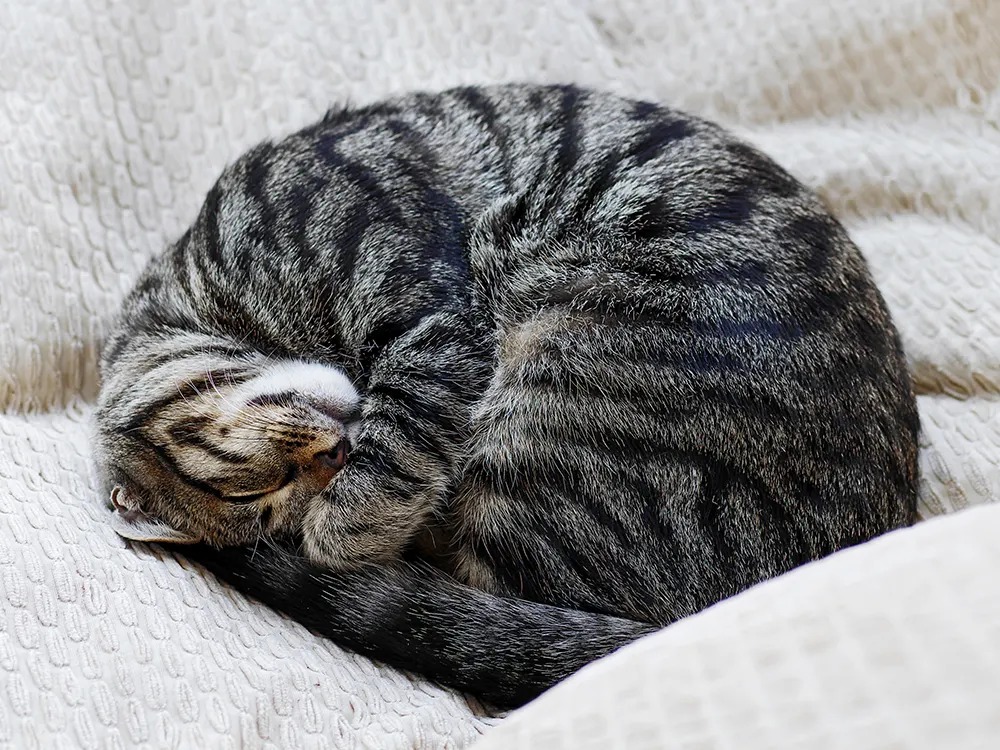
Search “why does my cat sleep so much” and you get a number. Ten to sixteen hours. Sometimes eighteen. Sometimes twenty for a kitten. The number is offered as reassurance, and then everyone moves on.
The number is close to worthless.
Look at the range for a second. If normal spans ten to eighteen hours, then a cat sleeping twelve hours and a cat sleeping seventeen are both squarely, boringly normal. Which means the number cannot tell you whether your cat is sick, because almost any amount of sleep clears the bar.
Here’s what does work. The only sleep figure with real diagnostic value is the difference between what your cat is doing now and what your cat used to do. And you are the only person in the world holding that data.
What the sleep is actually for
Briefly, because it explains the shape of the thing.
Cats are built around a hunt-eat-groom-sleep loop, run several times a day. A wild cat is engineered to catch a large number of very small animals — the working estimate is something like ten mice a day — which means a schedule of short, explosive effort followed by rest, repeated, rather than one long shift.
Your cat gets dinner in a bowl and hunts nothing. The loop stayed anyway. That’s why the sleep comes in many short naps rather than one nightly block, and why cats are crepuscular, most alive at dawn and dusk, which happens to be exactly when their prey moves and exactly when you wanted to be asleep.
There’s also a measurement problem hiding in all of this. A lot of what you count as sleep isn’t. Cats spend long stretches curled up, eyes closed, ears rotating toward every sound in the house — resting, not sleeping, and fully ready to move. So the mental figure you carry for your cat’s sleep is probably inflated to begin with. All the more reason not to trust the absolute number.
The delta is the signal
So: know your cat’s normal, in enough detail that a change is visible.
Where do they sleep, and in what order through the day? How deeply — do they startle awake, or do you have to nudge them? When are they up? What’s the first thing they do in the morning? Does the 4pm sunbeam get an hour or three?
This sounds fussy. It is the single most valuable health-monitoring habit available to a cat owner, and it costs you nothing, because you are watching anyway. Cats are famously good at concealing illness, an evolutionary hangover from being both predator and prey. They do not limp theatrically. They do not tell you where it hurts. What they do is get quieter, and sleep more, and stop doing one or two small things they used to do.
By the time a cat is obviously unwell, the illness has usually had a long run.
The owners who catch things early are almost never the ones who noticed a dramatic symptom. They’re the ones who said, ‘She stopped sleeping on the windowsill about three weeks ago.’ That’s not a small observation. That’s the whole diagnosis, handed to me at the door.
The changes worth acting on
Not every shift is alarming. These are.
Sleeping noticeably more, for more than a few days. Nearly any illness that makes a cat feel bad increases sleep. In an older cat the usual suspects are chronic kidney disease, diabetes, heart disease, and pain, particularly arthritis or dental disease. Pain is the one people miss most, because a cat in pain doesn’t cry, they simply do less.
The schedule inverting. A cat who slept through the night and now paces, yowls, or wakes you at 3am. This one is unusually informative, because it points somewhere specific: hyperthyroidism, high blood pressure, and feline cognitive dysfunction all disrupt the sleep-wake cycle in older cats. If your fourteen-year-old has started singing at night, that’s not eccentricity.
Sleeping harder. A cat who used to wake at the sound of a bag and now has to be touched to rouse. Depth of sleep changing is as meaningful as amount.
New noises in sleep. Cats breathe quietly. Wheezing, rasping, laboured or fast breathing while asleep is worth a video and a same-week appointment, because sleep is when respiratory disease and heart disease show themselves most honestly — nothing is masking it.
Sleeping in odd places. A cat who starts sleeping somewhere cold, hard, or exposed, or who abandons a favorite high perch, is often telling you they can’t do the thing they used to do. A cat who stops jumping to the top of the fridge may have arthritis, not a new opinion about the fridge.
The other stuff moving with it. Sleep changes are much more meaningful in company. Watch for weight loss, drinking more, peeing more, eating less, vomiting, litter box misses, or a cat who has stopped grooming and looks slightly unkempt. Sleep plus any one of those is a phone call.
The boring explanations, which are usually right
Before you spiral: a great many cats who sleep a lot are simply cats who sleep a lot.
Some are constitutionally sleepier and always have been. Some are bored, and boredom in cats looks exactly like laziness — a cat with nothing to hunt will nap by default, and the fix is a wand toy and a food puzzle, not a blood panel. Some are stressed, which can raise sleep along with hiding and appetite changes. Some are just cold, and the sunbeam moved.
Age matters too. Kittens sleep enormously and then sleep less as they get older and more capable. Seniors sleep more. Neither is a problem on its own.
The test is always the same. Is this new? If your cat has slept sixteen hours a day since the day you got her, sixteen hours is her number. If she was a twelve-hour cat until March, then sixteen hours is a finding.
What newer research adds
The most useful development in this area is that veterinary medicine has gotten much better at reading sleep changes in older cats as a specific signal rather than as general aging.
Feline cognitive dysfunction — the cat version of dementia — is now well characterized, and disruption of the sleep-wake cycle is one of its core features, alongside disorientation, changed social interaction, house soiling, and anxiety. The cat who wanders and yowls at night is the textbook presentation. It is real, it is common in cats over about eleven, and there are management strategies for it, which means it is worth naming rather than shrugging at.
Just as importantly, vets have gotten sharper about telling the look-alikes apart. Restlessness paired with weight loss and a big appetite points toward hyperthyroidism, not dementia. Sleep-wake reversal paired with confusion points toward cognitive dysfunction. Sleeping more with weight loss and increased thirst points toward kidney disease or diabetes. These are different problems with different treatments, and the combination of signs — not the sleep alone — is what separates them.
A 2025 survey of owners of cats over nine, looking at how osteoarthritis, kidney disease, hyperthyroidism, and cognitive dysfunction actually present at home, kept landing on the same theme: owners spot the behavioral change well before the medical one, and they routinely file it under “getting old” rather than reporting it.
So report it. “He’s sleeping more” sounds like nothing at the front desk. It is, quite often, the first sentence of the case.
References
- Cognitive Dysfunction Syndrome in Cats — International Cat Care.
- “The Impact of Disease on Behavior: Altering Behavior in the Course of Disease in Aging Cats,” Pets — 2025.
- Hyperthyroidism in Cats — Cornell Feline Health Center.
- Chronic Kidney Disease — Cornell Feline Health Center.
- AAFP Senior Care Guidelines — American Association of Feline Practitioners.
Common questions
Is my cat sleeping or just resting?
Often just resting. Cats spend a lot of time curled up with their eyes closed and their ears still swivelling toward sounds. It looks like sleep and isn't. This is one reason people overestimate how much their cat sleeps and then panic about a number that was never accurate.
My cat is suddenly sleeping more. What could it be?
Any illness that makes a cat feel bad can do it, and the common culprits in older cats are chronic kidney disease, diabetes, heart disease, arthritis, and dental pain. Boredom, stress, and simple aging also increase sleep. A sustained change lasting more than a few days deserves a vet visit and bloodwork, not a wait-and-see.
Why is my cat awake and yowling at night?
Cats are crepuscular, so being active around dawn and dusk is normal. What is not normal is a previously settled cat who begins waking, pacing, or vocalizing at night. In older cats this pattern is a classic sign of hyperthyroidism, high blood pressure, or feline cognitive dysfunction, and it is one of the more useful red flags a cat gives you.
Can I shift my cat's sleep schedule?
Somewhat. A hunt-eat-sleep cycle in the evening works with their wiring rather than against it: a real play session with a wand toy until they're actually tired, then a meal, then lights out. A cat who has hunted and eaten is a cat inclined to sleep. Feeding them when they wake you, by contrast, teaches them that waking you works.
Not a substitute for your vet. Our guidance is educational. For urgent symptoms, contact a vet or emergency clinic right away. Editorial standards
Dr. Park is a board-certified emergency and critical care specialist. She reviews our health and safety content for clinical accuracy and contributes guides on recognising urgent conditions. Her focus is helping owners act quickly and correctly when it matters most.
Meet our experts ↗Keep reading
 Health & WellnessThe Wobbly Cat Looks Like a Tragedy. It's One of the Easiest Special Needs There Is.Dr. Lena Park · 8 min
 LivingHe Fostered Six Kittens. Two Died in His Hands. He Kept Fostering.Dr. Amara Solis · 8 min
 Health & WellnessThe Cutest Cat Breeds Are Often the Sickest. The Look Is the Problem.Dr. Amara Solis · 8 min
 Health & Wellness13 Small Cat-Care Upgrades Your Cat Will Actually NoticeDr. Priya Nair · 8 min
 LivingScience Finally Cracked Orange Cats. The Gene Pulls a Trick No Other Animal Does.Claire Sutton · 5 min
 Health & WellnessYour Cat vs. the Christmas Tree: The Climbing Isn't the Real DangerDr. Ravi Mehta · 6 min