


Your Cat's Purr Sounds Like an Engine. Usually That's Great News, Sometimes It Isn't.
A loud purr is mostly a big, happy compliment. But purring is also a self-soothing tool cats reach for when they hurt, so the volume alone doesn't tell you everything.

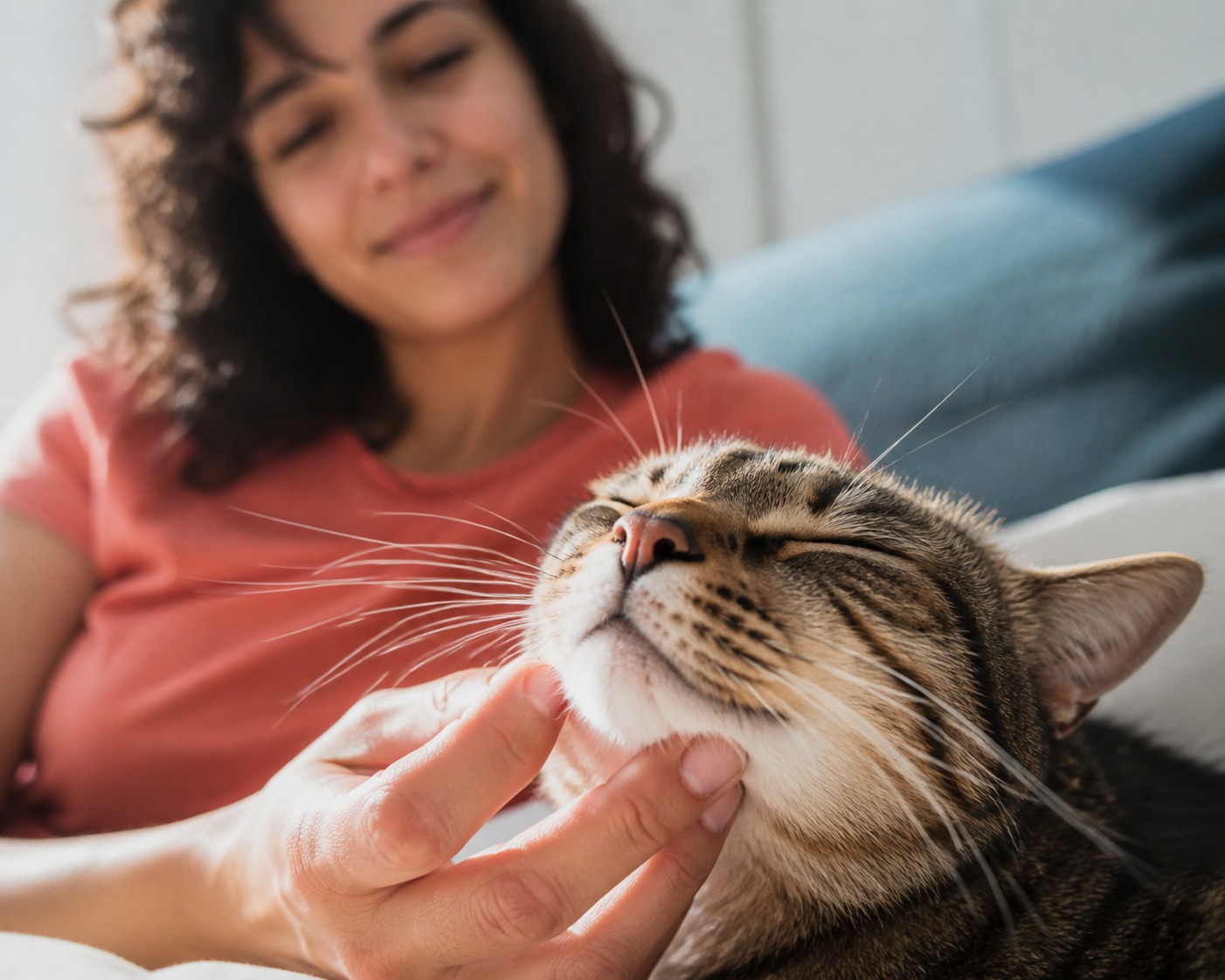
A cat purring on your chest is one of the great sensory rewards of living with one. When that purr cranks up to engine volume, the natural read is that you have done something very right, and usually you have. But the fuller answer is more interesting than “happy cat is happy,” because purring is not just an emotion. It is also a tool, and cats reach for it in more situations than most owners realize.
So the honest one-line version is this: a loud purr is usually a compliment, occasionally a coping mechanism, and the only way to tell which is to read the whole cat, not just the volume.
What a loud purr is, mechanically
A loud purr is not a different behavior from a regular purr; it is a stronger version of the same one. The sound comes from rapid muscle contractions in the throat, and a louder purr simply reflects more intense contractions.
I tell people to think of it like a smile versus a full-on grin. A louder purr is usually just a bigger, more emphatic version of a good feeling. The trick is remembering that the same instrument gets played for very different reasons.
Why some cats are just louder
Plenty of the reasons behind a big purr are wonderful and require nothing from you but appreciation.
- Pure contentment. A cat purring loudly while curled against you or being petted is broadcasting deep comfort. It is one of the clearest ways they say they love you.
- Self-soothing. Purring releases endorphins, so cats also use it to take the edge off stress or anxiety, a built-in calming mechanism they can switch on themselves.
- Communication. A purr can be a request as much as a mood. A cat may purr to get your attention, ask for play (sometimes purring at their toys), or signal that they are hungry.
- Individual quirk. Purrs vary in pitch, volume, and rhythm from one cat to the next. Every cat has a signature purr that is uniquely theirs, and it can change as they get older.
- Breed. Most domestic cats purr as a matter of course, but the style differs by breed, and some, like Maine Coons and Oriental Shorthairs, are famous for turning the volume up.
When the volume is worth a second look
Here is the part that reframes the whole topic. Because purring doubles as a self-soothing tool, a cat will sometimes purr not because they feel good but because they are trying to feel better. A stressed, unwell, or hurting cat may crank up the volume, leaning on the endorphin release and the vibration to help their body cope and settle.
That is why volume alone is not a health readout. What matters is the context around it. If a loud purr comes bundled with other changes, a drop in appetite, unusual fatigue, hiding, or any behavior that seems off, treat it as a nudge to call your vet rather than as reassurance that all is well. Learn to read your cat’s body language alongside the sound. A relaxed cat sprawled next to you is almost certainly purring out of joy. A cat purring hard while tucked in a corner, eating little, or recovering from something stressful may be self-medicating, and that is worth a professional look.
What newer research adds
The idea that a purr might be more than an expression of mood has real scientific backing, and it is genuinely charming. Cats purr within a frequency range of roughly 25 to 150 hertz, and researchers have noted that these are the same low frequencies used in medical vibration therapy to help heal bone and soft tissue. Lower frequencies, around 25 to 50 hertz, are associated with promoting bone density and healing, while somewhat higher ones line up with tendon and wound repair and pain relief.
This has led scientists to a striking hypothesis: that purring may function, in part, as a built-in self-repair mechanism, which would help explain why cats instinctively purr not only when content but also when injured or in pain. It is still a hypothesis, not settled fact, and it does not mean a purring cat is fine, if anything, it is one more reason to pay attention when a hurt or stressed cat is purring hard. But it does reframe that engine-like rumble as something more remarkable than a mood ring. Your cat may be running a low, ancient frequency that soothes their body and, as a bonus, happens to feel wonderful against your chest.
References
- Frank ML, von Muggenthaler E. “The felid purr: A healing mechanism?” The Journal of the Acoustical Society of America, 2001. https://pubs.aip.org/asa/jasa/article/110/5_Supplement/2666/550913/The-felid-purr-A-healing-mechanism
- Scientific American. “Why do cats purr?” https://www.scientificamerican.com/article/why-do-cats-purr/
- Cornell Feline Health Center. “Understanding Your Cat’s Behavior.” https://www.vet.cornell.edu/departments-centers-and-institutes/cornell-feline-health-center
Common questions
Can a loud purr mean my cat is sick or in pain?
It can. Cats also purr to self-soothe when they're stressed, unwell, or hurting. If loud purring comes with other changes, like poor appetite, hiding, or low energy, read it as a reason to check in with your vet rather than as reassurance.
Do some cat breeds purr louder than others?
Yes. Purr volume and pitch vary from cat to cat, and some breeds, such as Maine Coons and Oriental Shorthairs, are known for especially loud purrs. Every cat also has their own signature purr that can shift as they age.
Not a substitute for your vet. Our guidance is educational. For urgent symptoms, contact a vet or emergency clinic right away. Editorial standards
Dr. Kohl is a board-certified veterinary dentist with a particular interest in preventive oral care. She reviews all dental health content at The Pet Times and contributes practical guides on home dental routines, professional cleaning, and oral disease prevention.
Meet our experts ↗Keep reading
 Health & WellnessThe Wobbly Cat Looks Like a Tragedy. It's One of the Easiest Special Needs There Is.Dr. Lena Park · 8 min
 Health & WellnessThe Cutest Cat Breeds Are Often the Sickest. The Look Is the Problem.Dr. Amara Solis · 8 min
 LivingHe Fostered Six Kittens. Two Died in His Hands. He Kept Fostering.Dr. Amara Solis · 8 min
 LivingLong Hair Is the Least Important Thing About a Long-Haired CatDr. Amara Solis · 10 min
 TrainingToilet-Training Your Cat Means Throwing Away Their Health ChartDr. Ravi Mehta · 8 min
 LivingYour Cat Has Been Asking for the Same 7 Things. You Keep Hearing 'More Cuddles.'Dr. Priya Nair · 8 min