


This Cat Is 26. Her Secret Is 15 Boring Habits, Not One Magic Trick.
Miss Muffy is roughly 116 in human years and still has all her teeth. Nothing about how she got there is exotic. The habits that buy a cat extra years are unglamorous, repetitive, and mostly about preventing the accidents that end lives early.

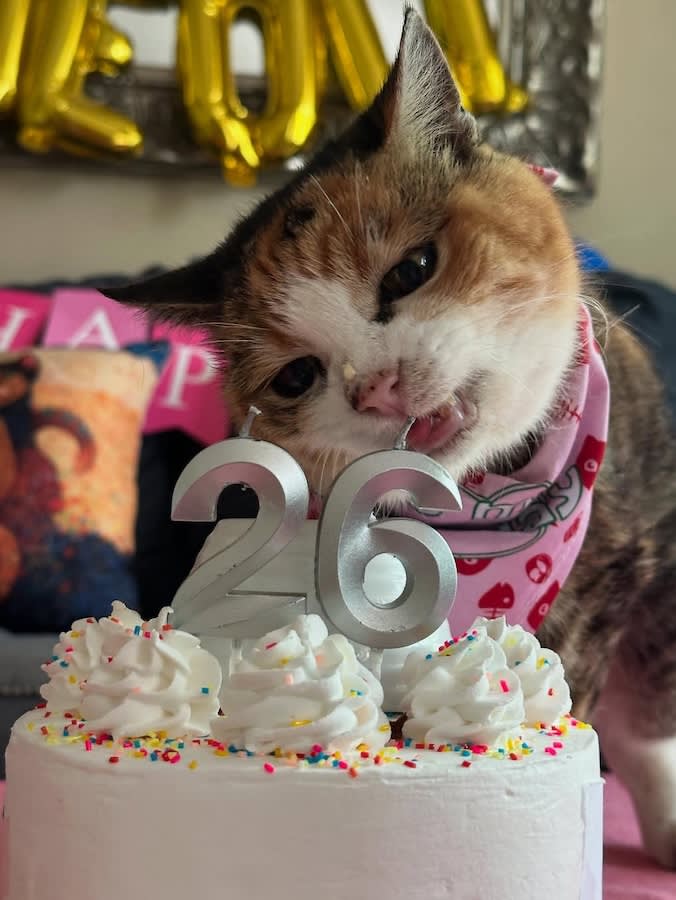
Miss Muffy is a tortoiseshell, and she arrived last out of her litter. When Diane Oickle carried her home in 1999, the kitten was tiny enough to ride in a shirt pocket. Oickle already had a house full of cats. She took her anyway.
Twenty-six years on, the cat has kept every tooth in her head, along with a glossy coat, a serious appetite, and enough energy to be a nuisance. She sleeps on Oickle’s left shoulder, in a groove worn there by a quarter century of doing exactly that.
Here is what makes her a useful story rather than just a charming one. There is no supplement in this. There is no exotic diet, no protocol, no product. What produced Miss Muffy is a long, dull sequence of ordinary decisions, made the same way for twenty-six years, in a home where nothing much ever went wrong.
That is the real finding, and it is a slightly deflating one. A long life is not won. It is accumulated.
First, the math, because everyone gets it wrong
The dog rule does not port over. A cat’s first year is roughly equal to a fifteen-year-old human. By year two they are closer to twenty-four. After that, add about four human years for each additional cat year.
Which makes a ten-year-old cat about fifty-six. And Miss Muffy, at twenty-five when this was reported, about 116.
For context: the average cat lives somewhere in the neighborhood of thirteen to seventeen years. Miss Muffy is not the median outcome of doing everything right. She is an outlier who also happened to have everything done right. Both things are true, and it is worth holding onto both before you read the list below and start assigning yourself blame.
The five levers that actually move the needle
These are the ones with the most behind them. If you only do five things, do these.
1. Keep her lean, with an asterisk. This is not about fat-shaming a cat, and it is the single item most vets would put at the top. One analysis found that for every quarter pound, roughly 100 grams, a cat carries over their ideal weight, lifespan drops by approximately 2.5 months. That number is stark and it is worth knowing.
But the honest version of this advice has an asterisk, and I would rather give you the asterisk than a clean lie. The relationship between feline weight and longevity is messier than that single figure implies. A University of Sydney study found cats with body condition scores in the 6 to 8 range, which is technically overweight, actually lived longer on average than leaner cats, even while obesity was clearly associated with developing chronic illness. Other work has found the opposite pattern in early adulthood. What is not in dispute is that obesity drives diabetes, urinary disease, and arthritis, and that a cat who cannot groom their own back end is suffering in a way that has nothing to do with a lifespan chart.
So: aim for lean, take the 2.5-month figure as a directional warning rather than a stopwatch, and do not starve a healthy senior cat in pursuit of a number.
2. Take her to the vet every year, and more often as she ages. Cats hide illness with a competence that borders on malice. Annual exams from the start, moving to twice-yearly in the senior years, are how urinary disease, thyroid problems, kidney and liver dysfunction, and early diabetes get caught while they are still cheap and fixable.
3. Run the bloodwork. An exam is not enough on its own. Ask for annual wellness bloodwork, meaning a complete blood count and a chemistry profile. Once your cat passes seven, add a thyroid test. This is where the invisible things surface.
4. Brush her teeth. Nobody wants to hear it, most cats will object strenuously, and dental disease remains one of the great quality-of-life destroyers in older cats. Try. A cat toothpaste your cat tolerates and three days a week beats a perfect protocol you abandon in a fortnight. Miss Muffy still having every tooth at twenty-six is not a coincidence.
5. Keep her inside. Outdoor and indoor-outdoor cats face trauma that indoor cats simply do not: cars, predators, infectious disease, and disappearance. If you want to give her the outdoors without the mortality, build a catio, a screened cat patio, and let her have the smells and the birds without the road.
The five accidents that end cat lives early
This is the category people skip, and it kills more cats than most diseases. None of these are health advice. They are household engineering.
6. Check the dryer. Every time. It sounds like a cartoon and it is not funny at all. Cats climb into washers, dryers, and laundry piles. Put a sign on the machine that says check for cats, and check for cats.
7. Get the lilies out of the house. Lilies are toxic to feline kidneys, and a bouquet from a well-meaning friend is one of the classic ways a healthy cat ends up in an emergency clinic. Audit your houseplants for feline toxicity and remove the offenders. When flowers arrive, check the bouquet before it hits the counter.
8. Do not trust the dog when you are out. This is the hardest one to hear. It is not rare for a dog in the home to attack a resident cat while the family is away, and it can happen after months or years of apparent peace. Separate them whenever you are out if the dog has real prey drive, has ever gone at the cat, or treats her as something to chase. Crate the dog. Close a door. The precaution costs you nothing and the alternative is unrecoverable.
9. Supervise very young children. Cats get dropped down stairs and shut in doors by toddlers who mean no harm at all, and that trauma can be severe or fatal. Watch the interaction, every time, until the child is old enough to be trusted with a small animal.
10. Hire a real cat sitter, and brief them properly. A sitter who does not know your cat’s normal cannot spot your cat’s abnormal. Tell them what normal looks like, leave your vet’s information and the address and number of the nearest emergency clinic, and if you will be unreachable at any point, name an emergency contact you trust to make medical decisions on your behalf. This is a ten-minute job that occasionally saves a life.
The five daily habits that add up
11. Play with her, every day. Movement keeps joints working and enrichment keeps the brain sharp. Ten minutes with a wand toy is a meaningful intervention, not a nicety.
12. Make her think. Treat puzzles, feather wands, laser pointers, a rotating cast of toys. Bored cats get stressed, and stressed cats get sick. The pathway from boredom to illness runs through the immune system, and it is real.
13. Watch the litter box like a hawk. Changes in litter box behavior are frequently the first sign anything is wrong, precisely because cats are so good at concealing everything else. More time in the box, straining, or peeing outside it earns a call, and urgently so in male cats, who are prone to life-threatening urinary blockages.
14. Feed her boringly. Simpler is better. Avoid boutique, raw, and grain-free diets, which have been linked to infections including Salmonella and to heart problems including cardiomyopathy. And keep her off your plate: garlic, onions, and raisins are toxic, and even a small square of cheese carries far too many calories and far too much fat for an animal this size. Also make sure the basics were covered early: spay or neuter, which reduces the risk of certain cancers, initial vaccines, and screening and treatment for parasites.
15. Know her. Nobody in the exam room, including me, has the information you have. The whole system above only works because somebody notices when something is subtly off, and that somebody is you. The more tuned in you are, the earlier the small changes get caught.
One more thing, on where you get the cat
Consider a shelter cat, and consider a mixed-breed one. It is the right thing to do for a full shelter, and it also happens to be a bet on longevity: purebred cats carry more health problems as a consequence of selective breeding. Maine Coons frequently develop hypertrophic cardiomyopathy. Flat-faced breeds like Persians and Himalayans routinely have respiratory, eye, and dental problems that trace directly to their shortened noses. Miss Muffy is a shelter tortie of no particular pedigree, which is not incidental.
There is no protocol that gets you to twenty-six. What gets you there is that nothing catastrophic ever happened, and that somebody was paying close enough attention to catch the small things while they were still small. That is not a strategy anybody can sell you. It is just showing up, over and over, for a very long time.
What newer research adds
The one place I would update the standard advice is weight, and it is worth saying out loud because the guidance has become slightly more honest than it was.
Feline obesity is genuinely common, affecting somewhere around 45 percent of owned cats, and it clearly drives disease. But the “every extra 100 grams costs 2.5 months” framing has real tension with other data, including work suggesting cats carrying a bit of extra condition can outlive leaner ones. The current picture is less “thin equals long life” and more “obesity causes disease, and being very thin in old age is its own warning sign.”
For an owner, the practical translation is unchanged and slightly gentler: keep your cat in shape while they are young and middle-aged, when weight gain does the most damage. Then, once they are genuinely old, stop chasing the number and start watching the cat. Sudden weight loss in a senior cat is a far more urgent signal than a slightly round twelve-year-old, and it is the one people miss.
None of which would surprise Diane Oickle, who has spent twenty-six years doing the unremarkable version of all of the above. Happy birthday, Miss Muffy.
References
- Overweight and Obesity in Dogs and Cats: An Exploration of Animal Welfare and Behaviour Impacts, and Recommendations for Management in Veterinary Primary Care
- From pathogenesis to prevention: an update on the management of obesity and its associated comorbidities in cats (Frontiers in Veterinary Science)
- Impact of Obesity on Quality of Life and Owner’s Perception of Weight Loss Programs in Cats
- Lilies: a toxic threat to cats (U.S. Food and Drug Administration)
Common questions
How long do cats usually live?
The average is somewhere in the range of 13 to 17 years. Cats reaching their mid-twenties are genuine outliers, not the expected outcome of good care.
Are purebred cats less healthy?
Often, yes. Selective breeding concentrates certain conditions. Maine Coons frequently develop hypertrophic cardiomyopathy, and flat-faced breeds like Persians and Himalayans commonly have respiratory, eye, and dental problems tied to their shortened noses.
Should I feed my cat a raw or grain-free diet?
There is no good evidence it helps, and there is evidence it can hurt. Boutique, raw, and grain-free diets have been linked to infections including Salmonella and to heart problems including cardiomyopathy. A conventional, complete, well-tested diet is the safer bet.
Not a substitute for your vet. Our guidance is educational. For urgent symptoms, contact a vet or emergency clinic right away. Editorial standards
Dr. Nair is a veterinarian focused on diet and feeding. She covers everyday nutrition, treats, and the many "can they eat this?" questions owners ask, grounding each answer in what is actually safe and sensible for dogs and cats.
Meet our experts ↗Keep reading
 FoodYour Cat's 'I'm Starving' Act Is Fake. A Skipped Meal Isn't.Dr. Lena Park · 6 min
 FoodWet vs. Dry Cat Food: The Moisture Question Settles Most of ItDr. Mara Chen · 6 min
 FoodForget the Clock: Build Your Cat's Feeding Schedule From Calories, Not Meal TimesDr. Mara Chen · 7 min
 FoodYour Cat Isn't Hungry. Unless These Three Things Are Also True.Dr. Priya Nair · 10 min
 Health & WellnessYour Cat's Diabetes Can Go Into Remission. The Window Is Smaller Than You ThinkDr. Mara Chen · 11 min
 FoodHigh-Calorie Cat Food Isn't an Upgrade. It's a Prescription.Dr. Lena Park · 6 min