


Why Your Cat Runs From Bananas (and Whether a Bite Is Safe)
A banana won't hurt your cat, but most cats want nothing to do with one. The reason is wired into feline biology: cats are genetically blind to sweetness, and the peel gives off a smell they're built to avoid. Here's the real story, plus how to share safely if yours is the rare banana fan.

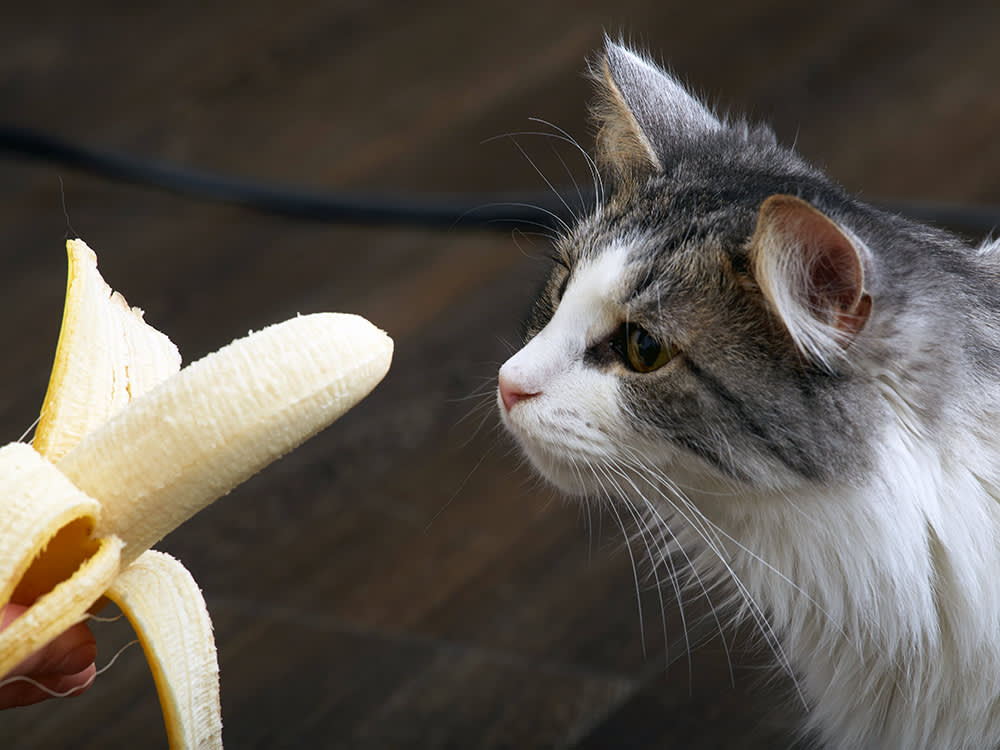
If you have ever peeled a banana and watched your cat recoil, ears back, like you produced a snake at the breakfast table, you have seen one of the more reliable comedy bits in pet ownership. The internet is full of these videos for a reason. But the question worth answering is not really “can cats eat bananas.” It is why so many cats so clearly do not want to, and what that tells you about whether to bother sharing at all.
The short version: a bite of banana is safe, your cat almost certainly does not need it, and the dramatic reaction you may be getting is wired into feline biology rather than being a quirk of your particular cat.
Cats are built to ignore the best part of a banana
Here is the part most “can cats eat” articles skip. Cats cannot taste sweetness at all. They carry a broken version of the gene (called Tas1r2) that, in humans and most mammals, builds half of the sweet-taste receptor. In cats that gene is a pseudogene, meaning it no longer functions, a finding researchers confirmed back in 2005. The leading theory is that cats lost the ability over evolutionary time simply because a strict meat-eater never encountered sugar and had no reason to keep detecting it.
So the single thing that makes a banana appealing to us (its sweetness) registers as nothing to your cat. When a cat does take an interest in banana, it is responding to texture, smell, or the simple fact that you are eating it, not to the flavor. This is the most useful thing to understand about feeding cats sweet human foods in general: you are never giving your cat a treat it can savor the way you do. You are giving it calories and sugar it cannot appreciate.
The peel, not the fruit, explains the drama
The fear response is a separate story, and it comes from the peel. Banana peels give off ethyl acetate, a compound that grows stronger as the fruit ripens. Many cats find the smell genuinely repellent and will leave the room rather than investigate. That is the outsized reaction caught in all those videos: not the cat tasting something awful, but the cat smelling something it is hardwired to avoid.
This is also a small safety bonus. The thing cats dislike most about a banana is the same part they should not eat anyway, since the peel is fibrous and hard to digest. If your cat is in the camp that flees, there is no need to coax it back.
If your cat is the rare banana fan
Some cats do like a nibble. If yours is one of them, a little plain banana flesh is fine. A few ground rules keep it that way:
- Keep the portion tiny. A thumbnail-sized piece is plenty. Banana runs about 12 grams of sugar per 100 grams, and a cat’s body is built for protein and fat, not a sugar load. Treats of all kinds should stay under 10 percent of daily calories.
- Cut it into small chunks. Cats that love banana sometimes get overexcited and try to gulp a whole piece, so portion it down to reduce any choking risk.
- Skip the peel entirely. It is hard to digest, and it carries the smell most cats dislike.
- Introduce it once, slowly. As with any new food, offer a small amount and watch for stomach upset. Because cats handle sudden changes in dietary sugar poorly, banana can occasionally cause diarrhea, constipation, vomiting, or regurgitation.
Cats simply aren’t equipped to process sugary foods the way we are, so a sudden hit of fruit can upset a sensitive stomach. If you want to share, think in terms of a single small bite, not a spoonful, and stop there.
Better fruit-bowl options (and what to keep away)
If your cat genuinely enjoys produce and you want safer variety, a few fruits are kinder choices than banana because they carry less sugar for the same novelty:
- Blueberries: low in sugar and rich in antioxidants, and the small size suits a cat’s mouth.
- Cantaloupe: safe in small amounts, and oddly popular with some cats, possibly because of an aroma compound it shares with meat.
- Strawberries: fine in tiny pieces, with a little fiber and potassium.
And the hard no’s, which matter more than any “safe” list:
- Grapes and raisins: treated as toxic to cats, with no safe amount.
- Cherries and pits: the pits contain cyanide compounds and are a choking hazard.
- Onion and garlic: toxic, and worth mentioning because they hide in human snacks far more often than people expect.
The bottom line
A banana is safe for your cat and almost beside the point nutritionally. Your cat cannot taste its sweetness, may actively dislike its smell, and gets everything it needs from a complete and balanced cat food. If yours is one of the rare cats that begs for a bite, give a thumbnail-sized piece of plain flesh now and then and call it enrichment. If yours is one of the many that bolts at the sight of the peel, trust the instinct and finish your breakfast in peace.
References
Common questions
Why does my cat hate bananas?
Two reasons. Cats are genetically unable to taste sweetness, so the main appeal is lost on them, and the peel releases a compound called ethyl acetate that many cats find off-putting, which is why some flee the room at the sight of one.
How much banana can a cat have?
A thumbnail-sized piece once or twice a week at most. Treats of any kind should stay under 10 percent of your cat's daily calories, and banana is sugary, so a little goes a long way.
Can cats eat banana peels?
No. The peel is fibrous and hard for cats to digest, and it carries the smell most cats dislike. Always remove it.
Not a substitute for your vet. Our guidance is educational. For urgent symptoms, contact a vet or emergency clinic right away. Editorial standards
Dr. Nair is a veterinarian focused on diet and feeding. She covers everyday nutrition, treats, and the many "can they eat this?" questions owners ask, grounding each answer in what is actually safe and sensible for dogs and cats.
Meet our experts ↗Keep reading
 FoodCan Cats Eat Ice Cream? They Can't Even Taste Why You'd ShareDr. Lena Park · 6 min
 FoodWatermelon Won't Hydrate Your Cat the Way You ThinkDr. Ravi Mehta · 5 min
 FoodThe 'Superfood' Strawberry Does Nothing for Your Cat. They Can't Even Taste ItDr. Priya Nair · 5 min
 FoodCats and Marshmallows: The Bag Your Dog Should Worry About MoreDr. Priya Nair · 6 min
 FoodFor a Carnivore, 'Is It Safe?' Is the Wrong Question About Human FoodDr. Priya Nair · 6 min
 FoodYour Cat Begs for Olives and Cheetos. There's a Chemical Reason Why.Dr. Priya Nair · 7 min