


Your Cat's Rusty Eye Stains Aren't Cosmetic. And the Popular Fix Can Backfire
Those reddish-brown streaks under a cat's eyes have a name, a chemistry, and sometimes a medical cause worth catching. Here's what they mean, and why the drugstore 'tear stain remover' is one to skip.

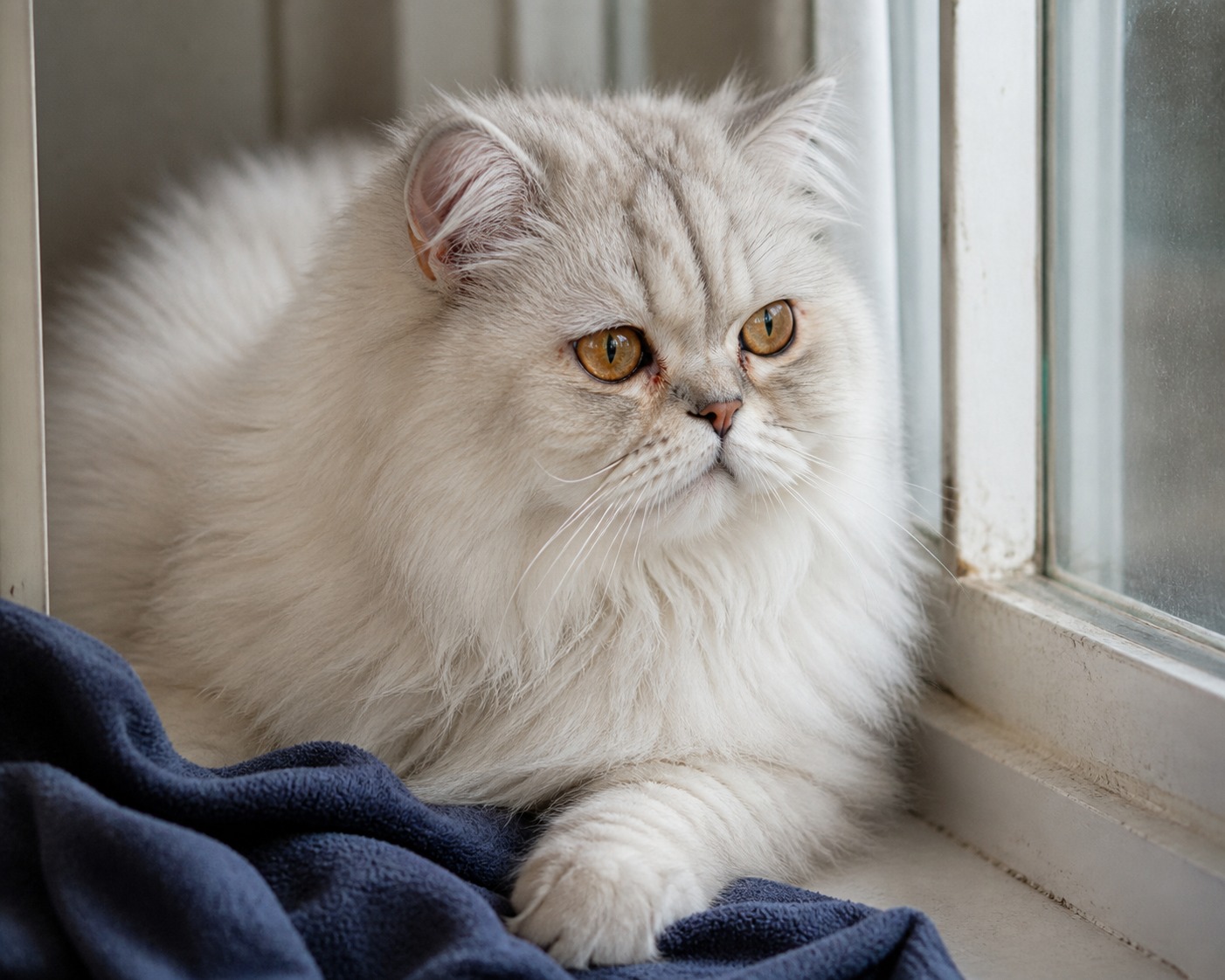
A white cat with rusty streaks running down from the eyes looks a little unwell, a little unkempt, like a favorite T-shirt that won’t come clean. It’s tempting to treat it as a grooming problem and reach for whatever product promises to wipe it away. That’s the wrong instinct on two counts. Tear staining is usually a symptom, not a stain to be scrubbed, and the most popular category of “fix” can do more harm than the discoloration ever would.
Let’s take the stain apart: what it is, what’s actually causing it in your cat, why the drugstore remedy deserves suspicion, and when a rusty streak is your cue to call the vet.
What the rust is, chemically
A cat’s eyes make tears constantly to lubricate the surface, flush out debris, and protect vision. Under normal conditions those tears drain away through the nasolacrimal duct, the tear duct, which runs from the eye down to the nose. When a cat produces more tears than that duct can carry, the overflow spills over the lids and runs down the face.
The color comes from a compound called porphyrin. Tears, like saliva and urine, are mostly water carrying a few electrolytes and waste products, and porphyrin is one of them, an iron-containing byproduct of red blood cells breaking down. It’s the iron that turns rusty when it’s left sitting on fur and exposed to air. The paler the coat, the more obvious the stain, which is why white and light cats seem to get it worst even though every cat makes porphyrin.
So a tear stain is really two things at once: evidence that tears are overflowing, and a pigment doing what iron does when it oxidizes. The question that matters is why the overflow is happening.
Why your cat, specifically
All cats make tears, but not all cats stain, so something is tipping the balance. The causes fall into a few buckets.
Facial structure. Flat-faced, brachycephalic breeds like Persians, Himalayans, and Exotic Shorthairs are built in a way that makes tear drainage inefficient. The shortened muzzle and the position of the tear ducts leave tears with nowhere good to go, so they spill. Pair that conformation with light fur and staining is almost expected. (The same holds for smush-faced dog breeds.)
Eye infections and upper-respiratory infections. Cats are famously prone to both, and either can crank up tear production past what the duct can drain. Look for company: eye redness and swelling, sneezing, nasal discharge, and goopy or colored gunk from the eyes alongside the staining.
Blocked or malformed tear ducts. Even with normal tear production, a duct that’s blocked or built wrong can’t drain properly, and the tears back up over the eyelids and down the face.
Allergies. Like an infection, allergies ramp up tear production as the eyes try to flush out irritants, often with some redness, sneezing, and nasal discharge alongside. Airborne triggers like pollen, dust, and mold can do it, and so can food allergies.
Yeast infection. A stain that skews more brown than red can signal a yeast infection, which warrants a prompt vet visit rather than a wait.
Kitten teething. Some kittens tear more while their baby teeth give way to adult ones. There’s a lot of inflammation in a teething mouth, and because the tooth roots sit close to the nasolacrimal duct, that swelling can pinch off drainage and push tears out onto the face.
Diet. Nutrition plays a supporting role. A well-balanced diet can help settle eye inflammation tied to food allergies, while a high-salt diet can drive hypertensive changes in the retina, and a diet short on taurine, an essential nutrient in quality cat food, can lead to serious retinal degeneration.
Other irritants. Corneal ulcers from eyelashes, stray hairs, foreign objects, or injury will spike tear production, often with redness, swelling, and discharge. Tumors of the eye or eyelid can do the same.
The popular fix that’s worth skipping
Here’s where a lot of well-meaning cat parents go wrong. Search “cat tear stains” and you’ll be steered toward tear stain removers that promise to clear the rust. A big share of them contain an antibiotic called tylosin, and that’s a problem.
Tylosin isn’t approved for use in cats or dogs at all; its only FDA approvals are in chickens and swine. Back in 2014, federal authorities told several companies to stop selling unapproved tear stain products, some of them tylosin-based, including well-known lines marketed for pets. The products stayed widely available anyway, which is exactly why it’s on you to read the label.
The deeper issue is what casual antibiotic use does. Low-level, unsupervised antibiotics are a recipe for resistance, helping ordinary bacteria evolve into harder-to-treat “superbugs.” Dosing a cosmetic stain with an antibiotic your vet didn’t prescribe trades a harmless bit of discoloration for a genuine risk. If a product lists tylosin, or any antibiotic, don’t use it without your vet’s guidance.
When someone shows me a tear-stained cat, the stain itself is the least interesting thing in the room. It’s a signpost. My job is to find what’s making the eyes overflow, an infection, a blocked duct, a scratched cornea, and treat that. Reaching for an over-the-counter antibiotic wipe skips the diagnosis and risks a resistance problem to cover up a cosmetic one. That trade never makes sense.
When a rusty streak means “call the vet”
A little discoloration on an otherwise pristine face can feel like no big deal, but because staining can sit on top of something more serious, it’s worth a professional look, especially if it’s new or changing.
Your vet will start with an exam of the eyes and the surrounding structures to rule out injury, infection, or other abnormalities. They may measure tear production, apply a stain to check for corneal ulcers, and test the pressure inside the eye. The reason to move on any sudden change in tear overflow, or epiphora, is twofold: it can flag a real underlying issue, and left alone, the constant moisture on the skin can breed infections and irritation of its own.
Treating it the right way
The road to a clearer face runs through the cause, not the stain. Depending on what your vet finds, that might mean flushing a blocked tear duct or surgically correcting an eyelid abnormality that’s causing irritation or blockage. Infections, allergies, or eye injuries may call for medicated eye drops, and an upper-respiratory infection may need broader supportive care.
When the staining is purely down to facial structure and there’s no underlying problem to fix, the goal shifts to management: keep the area clean and dry. Gently clipping the fur near the nose and beneath the eyes keeps it from holding moisture that can breed skin infections, and wiping the eyes with a damp cloth clears buildup. If you’re ever unsure about cleaning the area, or the situation looks like more than cosmetics, don’t hesitate to call your vet.
The takeaway
Rusty streaks under your cat’s eyes are porphyrin riding a tear overflow, and the overflow is the thing that matters. Sometimes it’s just a flat face and pale fur. Sometimes it’s an infection, a blocked duct, or a scratched eye asking for attention. Either way, the answer is a vet’s read on the cause, not an antibiotic wipe off the shelf.
References
- U.S. Food and Drug Administration / AVMA. “FDA Warns Makers of Unapproved ‘Tear Stain’ Products.” JAVMA News, 2014. https://www.avma.org/javma-news/2014-10-15/fda-warns-makers-unapproved-tear-stain-products
- University of Missouri Veterinary Health Center. “Corneal Ulcers.” https://vhc.missouri.edu/ophthalmology/corneal-ulcers/
- University of Florida College of Veterinary Medicine. “Feline Ophthalmology.” https://smallanimal.vethospital.ufl.edu/files/2012/06/Cat-eye-problems.pdf
Common questions
Which cats get tear stains the most?
Flat-faced breeds like Persians, Himalayans, and Exotic Shorthairs, because their facial structure doesn't drain tears well, and light-colored cats, because the stain shows up more against pale fur.
Should I use a tear stain remover on my cat?
Be careful. Many popular tear stain removers contain the antibiotic tylosin, which isn't FDA-approved for cats and drew federal warnings. Casual antibiotic use also feeds resistance. Treat the underlying cause with your vet instead of masking the stain.
When should tear stains send me to the vet?
Any sudden change in tear overflow, or staining that comes with redness, swelling, colored discharge, squinting, or sneezing. Those point to an eye or upper-respiratory issue, not just a cosmetic one.
Not a substitute for your vet. Our guidance is educational. For urgent symptoms, contact a vet or emergency clinic right away. Editorial standards
Dr. Mehta is a board-certified veterinary nutritionist who evaluates pet food formulations, ingredient quality, and the science behind dietary trends. He writes and reviews all nutrition content at The Pet Times, including our food rankings and feeding guides.
Meet our experts ↗Keep reading
 Health & WellnessYour Cat Probably Has Herpes. The Go-To Remedy Doesn't Work.Dr. Lena Park · 6 min
 Health & WellnessCats Are America's Most Rabid Pet. The Indoor Ones Aren't Exempt.Dr. Ravi Mehta · 8 min
 Health & WellnessWhy Does My Cat Snore? When It's Adorable and When to Call the VetTom Hadley · 7 min
 Health & WellnessMost Cat Colds Are Harmless. Learn the One Kind That Isn't.Dr. Mara Chen · 7 min
 Health & WellnessA Kitten Sneeze Is Cute Once. Here's the Line It Shouldn't Cross.Dr. Mara Chen · 8 min
 Health & WellnessYour Cat's Drool Is Only Cute If Your Hand Is on ThemDr. Lena Park · 8 min