


A Kitten Sneeze Is Cute Once. Here's the Line It Shouldn't Cross.
One sneeze is plumbing. A pattern is a diagnosis. What the frequency, the company it keeps, and the calendar tell you about a sneezing kitten.

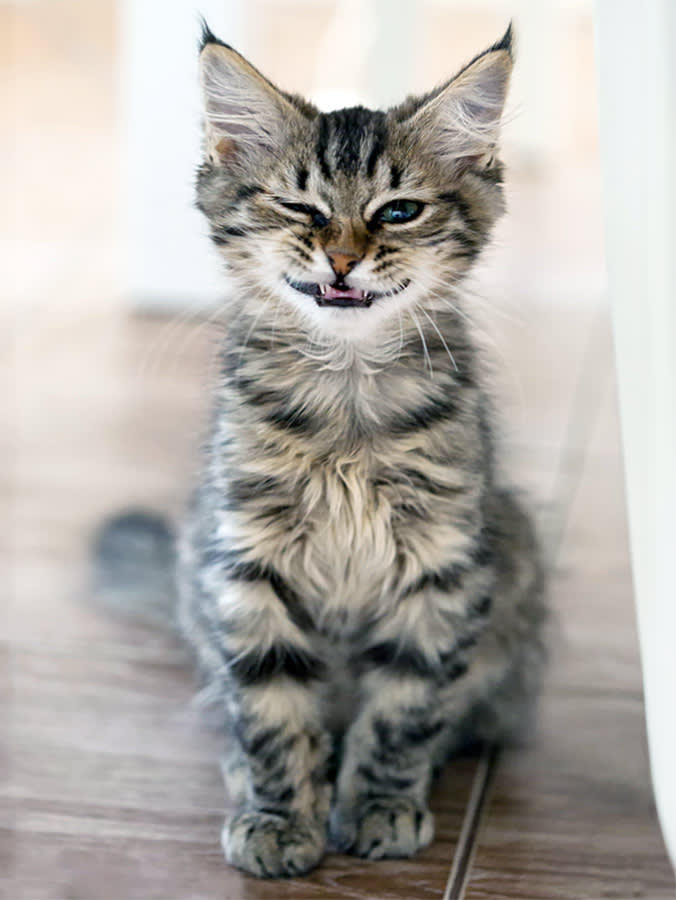
A sneeze is a very good piece of engineering. Something lands in the nose that should not be there, the sensitive lining registers it, and the body fires a blast of air to evict it before it can travel any further down. Sometimes that takes one blast. Sometimes it takes a comedy sequence of six, and your kitten looks briefly astonished by their own head.
None of that is a problem. The problem is when the sneezing stops being a reflex and starts being a pattern.
That is the line this article is about, and it is not really a line of frequency. It is a line of duration and company. Ask two questions of any sneezing kitten: how long has this been going on, and what else is going on with it? A kitten who sneezes twice after sticking their face in a dusty corner and then goes back to attacking your shoelace is fine. A kitten who has been sneezing for days, with a wet nose and goopy eyes and a lackluster appetite, is a kitten with an infection, and the clock on that one runs faster than people expect.
What a kitten’s nose is reacting to
The nasal lining is deliberately touchy, because its whole purpose is to catch things before they reach the lungs. So a kitten will sneeze at dust, at pollen, at grass seed, at a candle, at your cleaning spray. It will also sneeze at inflammation caused by an infection, which is why the same reflex covers both “I inhaled some dust” and “I have a virus.”
The difference is the shape of the episode. Dust gets you one or two sneezes. Feline calicivirus gets you a kitten who sneezes for weeks.
The five things that actually cause sustained sneezing
Respiratory infection, and the two viruses to know
If a kitten is sneezing a lot, for a long time, this is the leading suspect. Cats are exceptionally well supplied with respiratory pathogens, viral, bacterial, and even fungal, and kittens catch them easily.
Two names matter: feline herpesvirus and feline calicivirus. Both are common, both are vaccinated against, and between them they account for the great majority of the sneezing, snotty, gunky-eyed kittens who come through a clinic door. Along with sneezing, an infected kitten may show watery or gooey eyes and nose, coughing, fever, a lost appetite, and, in the worst cases, difficulty breathing.
Some of these infections clear on their own. Others need help from you and your vet. Because you cannot reliably tell which is which from the couch, the frequency and duration are your triggers to call.
Environmental irritants
Constant exposure to smoke, cleaning chemicals, or strongly scented air fresheners will make a kitten sneeze far past the occasional level. Your best move is the simplest one: remove the thing. If the sneezing tracks with the room you use the plug-in air freshener in, believe your kitten and not the packaging.
Allergies
Allergies take time to develop, so they are an unlikely cause in very young babies but a real one in older kittens. Dust, pollen, mold, and smoke can leave a kitten sneezing, with watery eyes, a runny nose, or skin problems alongside. The treatment is avoidance, which is often more a matter of luck than skill. If avoidance is not possible, your vet has options.
Something stuck up there
A kitten’s nose is tiny, but the world contains many things that are smaller. Grass seeds, insects, and other small objects can lodge in the nasal passage and set off a determined, one-sided storm of sneezing as the body tries to eject them. Look for discharge or bleeding from the nose, and for a kitten pawing at their face.
If sneezing does not shift it, infection sets in behind it: swelling, thick colored nasal discharge, and difficulty breathing. Foreign bodies usually need a vet, and often sedation, to remove.
The vaccine reaction
Vaccination is the single best thing you can do to prevent serious disease in a kitten, and it can also make them sneeze for a day or two. Intranasal vaccines, squirted straight up the nose, are the most likely to do it, but any vaccine can leave a kitten with a low-grade fever, some lethargy, and sneezing while their immune system does the work.
Most of this resolves within a day or two. If your kitten still feels off after two to three days, that is a phone call.
The part nobody tells new kitten parents
Here is the piece of the picture that changes how you think about a sneezing kitten, and it rarely comes up at the adoption counter.
These viruses are extremely common in the population your kitten came from. When researchers sampled hundreds of cats across eight California shelters, they found feline calicivirus in 13% to 36% of cats depending on the shelter, and feline herpesvirus in 3% to 38%. A Belgian rescue shelter study put calicivirus at 33% and herpesvirus at 20%, with 10% of cats carrying both. Kittens, dehydrated cats, and cats in isolation were the most likely to be affected.
If you adopted from a shelter or a rescue, or your kitten came from a foster home with other cats, the odds that they were exposed are not small. That is not a knock on shelters; it is what happens when you put a lot of cats in one building.
And herpesvirus does not really leave. A cat who recovers from a feline herpesvirus infection typically stays latently infected for life. The virus goes quiet and hides in nerve tissue, and stress, illness, or immune suppression can wake it back up, at which point the cat sheds virus and often gets a fresh round of eye and nose symptoms.
So the practical translation is this: a kitten who has one bad bout of sneezing and snot may well have a rerun during a stressful move, a boarding stay, or a new-cat introduction two years from now. That is not you failing. That is the biology of the virus. What you can do is manage the triggers, keep stress low during transitions, and treat flare-ups early rather than waiting them out.
The question I get is always ‘is this serious,’ and honestly the more useful one is ‘is this the first day or the fourth.’ Kittens have almost no reserve. A little one who stops eating because they cannot smell their food goes downhill fast, and that is usually the thing that hurts them, not the virus itself.
Getting to the answer
Repeated sneezing can be genuinely hard to pin down, and the work starts with you.
Watch the pattern. Note when the sneezing gets worse and better. Is it only in one room? Only in the evening? Only after you clean? Look for the companions: nasal discharge, watery eyes, difficulty breathing. Is your kitten pawing at their nose or rubbing their face, which suggests something is up there?
That information is worth a lot, because it can be acted on. Reducing exposure to a suspected irritant is a free experiment you can run in a day.
Then take it to the vet. If the answer is not obvious, your vet can look further: an exam, a look up the nose, blood work, imaging. Go any time your kitten is sneezing more than is normal for them, and go without hesitating if that sneezing comes with a snotty nose, gunky eyes, coughing, a fever, or any breathing trouble.
Treatment, honestly
Different causes get different treatments, which is precisely why the diagnosis comes first.
At home, for irritants and allergies, the whole intervention is exposure reduction. Do not smoke around your kitten. Skip the strongly scented cleaners and air fresheners. An air filter thins out what is floating around.
For a kitten with a respiratory infection, a bit of relief goes a long way: bring them into the bathroom while you run a hot shower, and the warm, humid air helps loosen congestion. Wipe the eyes and nose gently. Warm the food to make it smell stronger, because a blocked-up kitten who cannot smell dinner will simply not eat it.
Do not give your kitten any medication or supplement without talking to your vet first. Human decongestants in particular are dangerous to cats.
At the vet, treatment gets more specific: medications for infections or allergies, sedation and removal for a foreign body, supportive care for a rough vaccine reaction.
Prevention is mostly two things: vaccinate on schedule, and limit contact with unfamiliar or unwell cats. Bear in mind that you are a vector too. If you have handled other cats, germs can travel home on your clothes and shoes. Keep harsh chemicals out of the house, vacuum regularly, and run a filter if you have one.
What’s new since this was written
The evidence that has firmed up recently is less about new treatments and more about how ordinary these infections are, and how differently that should make you plan. A 2024 scoping review of feline upper respiratory infection prevalence pulled together studies from around the world and found the same story on every continent: high infection rates in shelter and multi-cat environments, and kittens carrying the heaviest burden.
The takeaway for a new kitten parent is a slightly less anxious one than you might expect. If your kitten came home sneezing, you did not miss a warning sign. You adopted a kitten from a place with other cats in it, and that is what that looks like. What matters now is that they eat, that they stay hydrated, and that you make the call early rather than late.
References
- Bannasch, M. J., & Foley, J. E. (2005). Epidemiologic evaluation of multiple respiratory pathogens in cats in animal shelters. Journal of Feline Medicine and Surgery, 7(2), 109–119.
- Zicola, A., Saegerman, C., Quatpers, D., et al. (2009). Feline herpesvirus 1 and feline calicivirus infections in a heterogeneous cat population of a rescue shelter. Journal of Feline Medicine and Surgery, 11(12), 1023–1027.
- Fernandez, M., et al. (2024). A Scoping Review of the Evidence on Prevalence of Feline Upper Respiratory Tract Infections and Associated Risk Factors. Veterinary Sciences.
- Cornell University College of Veterinary Medicine, Baker Institute for Animal Health. Feline Calicivirus.
- Cornell Feline Health Center. Feline Herpesvirus Infection (Feline Viral Rhinotracheitis).
- American Association of Feline Practitioners. 2020 AAHA/AAFP Feline Vaccination Guidelines.
Common questions
When should a sneezing kitten see a vet?
Any time the sneezing is more frequent than normal for that kitten, or comes with a snotty nose, watery or gooey eyes, coughing, fever, appetite loss, or any difficulty breathing. Kittens have very little reserve, so 'wait and see' is a shorter window than it is with an adult cat.
Can vaccines make a kitten sneeze?
They can, briefly. Intranasal vaccines are the likeliest to cause sneezing, but any vaccine can leave a kitten with a low-grade fever, tiredness, and some sneezing for a day or two while their body responds. If they still feel unwell after two to three days, call your vet.
Not a substitute for your vet. Our guidance is educational. For urgent symptoms, contact a vet or emergency clinic right away. Editorial standards
Dr. Chen is a small-animal veterinarian who leads health and safety coverage at The Pet Times. She writes and reviews the bulk of our illness, condition, and safety content, translating clinical guidance into clear, practical advice owners can act on at home.
Meet our experts ↗Keep reading
 First DaysYour Kitten's First Year Is a Series of Doors That CloseDr. Lena Park · 8 min
 First DaysThe Kitten Nursing Clock Is a Lie. Watch the Milestones InsteadDr. Priya Nair · 6 min
 First DaysA Kitten's Body Keeps a Calendar. Here's How to Read It.Dr. Priya Nair · 5 min
 First DaysYour Kitten's Scale Is the Best Early-Warning System You Have. Here's How to Read It.Dr. Amara Solis · 6 min
 First DaysEight Weeks Is a Shelter Deadline, Not a Kitten's Biology. The Data Says 14.Dr. Priya Nair · 9 min
 First DaysOrphaned Kittens Can't Poop on Their Own. Miss This and They Crash Fast.Dr. Priya Nair · 8 min