


Your Kitten's Scale Is the Best Early-Warning System You Have. Here's How to Read It.
A kitten's weight is the single most reliable sign of how they're doing. The trick is watching the trend line, not any one number, and knowing the milestones that tell you they're on track.

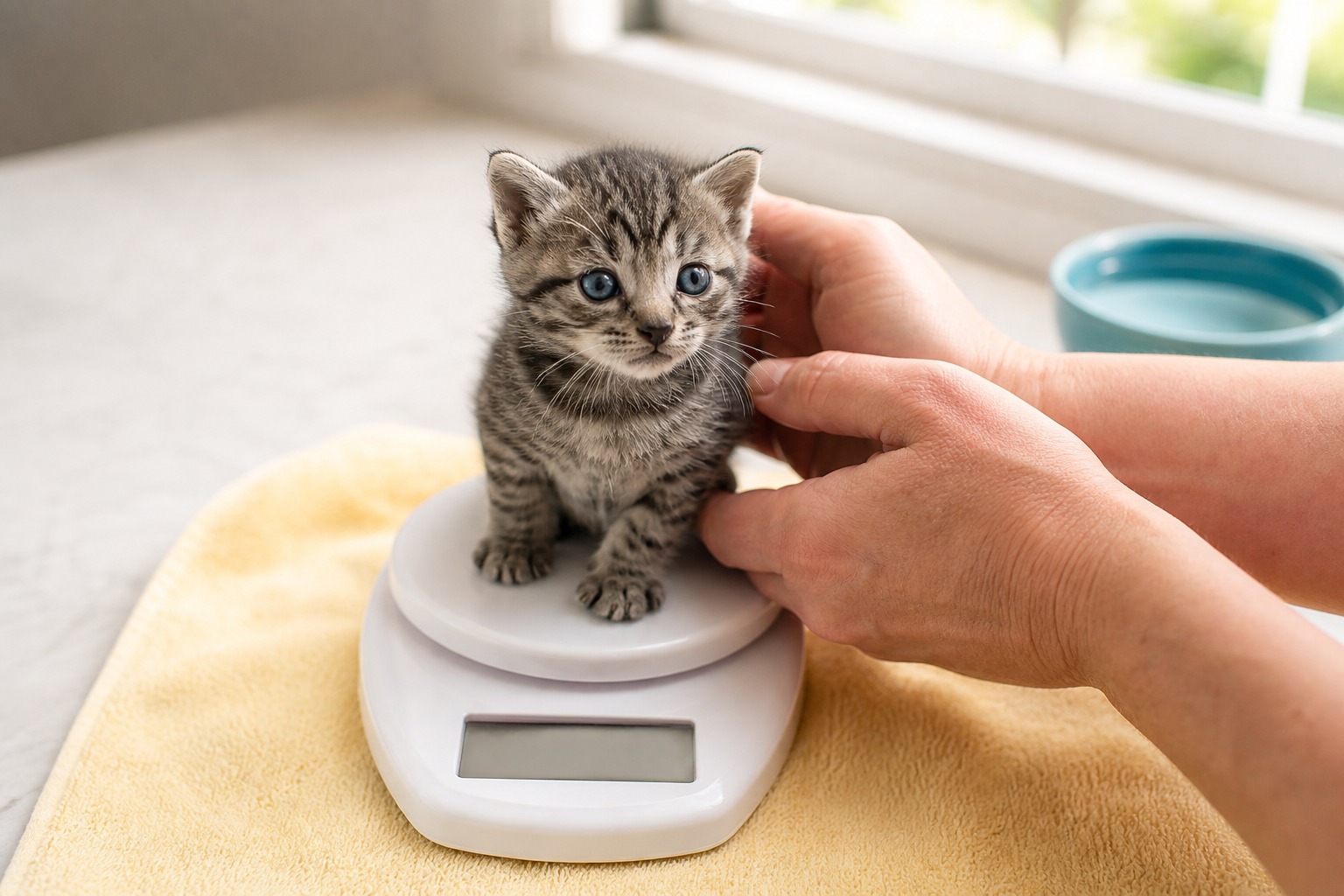
If you bring home one habit for a new kitten, make it this: weigh them, and keep a running record. A kitten’s weight is the most honest, earliest signal you have about their health, and it costs you nothing but a small scale and thirty seconds. The catch is that people read it wrong. They fixate on whether today’s number hits some chart, when the thing that actually matters is the direction the numbers are heading.
A single weigh-in tells you almost nothing. What I want to see is the line those numbers draw across a week. A kitten climbing steadily is a healthy kitten, even if the scale barely budges on any given day.
Young kittens grow fast and, helpfully, along a fairly predictable curve, which is exactly what makes weight such a useful tool. There’s even a rule of thumb that works remarkably well through the early months: a healthy kitten gains roughly one pound per month of age, up to about four months old. So a one-month-old lands near a pound, and a four-month-old near four.
A rough kitten weight chart
Treat these as averages, not targets. Individual kittens vary, and unless someone witnessed the birth, your kitten’s “age” is usually an educated estimate that can be off by a week or more. The chart is a guide; your kitten’s own trend is the real data.
| Age | Approximate weight |
|---|---|
| Birth | 75–115 g (about 2.5–4 oz), average ~100 g |
| 1 week | ~150–250 g (5–9 oz) |
| 2 weeks | ~250–350 g (9–12 oz) |
| 3 weeks | ~300–450 g (11–16 oz) |
| 1 month | ~450 g (~1 lb) |
| 2 months | ~900 g (~2 lb) |
| 3 months | ~1.4 kg (~3 lb) |
| 4 months | ~1.8 kg (~4 lb) |
| 5 months | ~2.3 kg (~5 lb, increasingly variable) |
To catch changes of just a few grams, weigh on a gram scale meant for light objects, and weigh at the same time of day for consistency, since a kitten’s number drifts with when they last ate, drank, peed, or pooped.
The milestones worth knowing
Newborns. A healthy birth weight runs about 75 to 115 grams, averaging around 100. Anything under 75 grams is more fragile and needs close monitoring. Across the first five weeks, kittens put on somewhere between 7 and 15 grams a day. Studies land on slightly different daily figures, so don’t panic over a flat 24-hour stretch, that can just be scale noise or a kitten who won’t hold still. What you’re looking for is a clear upward trend over days to weeks. It’s time to call the vet when a kitten isn’t gaining over several days, is losing weight, or isn’t eating consistently.
Five weeks to four months. After week five, growth accelerates, with gains of up to 20 grams a day through about week 16. This is the window where that pound-per-month rule holds tightest.
Four months to adulthood. Past four months, growth gets far more individual, and the tidy pound-per-month math falls apart. Most kittens slow down between six and eight months and keep growing until roughly a year old. Large breeds such as Maine Coons can fill out until closer to 18 months. Once a cat reaches adult size around 12 months, its metabolism shifts and its calorie needs drop, which is the moment to adjust portions so a growing kitten doesn’t quietly become an overfed adult.
Big breeds. If you have a Maine Coon, Norwegian Forest Cat, Ragdoll, or Bengal, expect them to outpace the average domestic shorthair, but the same principle applies: steady, consistent gains. Kittens adopted from a breeder come with two advantages, a known exact age and a look at the parents’ adult sizes, both of which sharpen your predictions.
How to actually assess the weight
Most kittens eat like they’ve never seen food and scream for more, which makes it hard to tell whether they’re genuinely well-fed, especially if littermates crowd the bowl. This is where a body-condition score comes in, the same tool your vet uses. It’s based on feeling for bony landmarks, the ribs, hips, and spine. Ideally those bones are easy to feel under a light layer but not visible to the eye. A kitten whose ribs and spine stand out is short on muscle and fat.
If you suspect your kitten is underweight, get them examined promptly. Young kittens lack the reserves of an adult and can slide into dehydration or low blood sugar fast. Strays are often underweight on arrival, and with good care and a solid appetite they usually catch up, this is exactly when your growth record earns its keep, by documenting the climb.
True overweight is rare under four months. Kittens this age are growing and busy, and their round post-meal bellies (sometimes bloated by intestinal parasites) can look like chub without being it. In kittens over four months, if the ribs and spine are hard to feel under thick padding, that may signal excess weight. Because cats grow until about a year, don’t restrict a kitten’s calories to slim them down without a vet’s guidance; you can shortchange their development.
What moves a kitten’s growth
Several forces shape how a kitten grows. Nutrition leads: kittens under a month need to nurse or take a kitten-specific formula on the right schedule, and once weaned they need food formulated for kittens or labeled for all life stages, served in small, frequent meals. Cats are obligate carnivores with exacting needs, and a diet that isn’t complete and balanced risks real deficiencies.
Health issues can stall growth, from congenital problems like cleft palates, liver shunts, dwarfism, or hypothyroidism to acquired ones like intestinal parasites and other infections that sap appetite and nutrient absorption. Most are caught on a routine kitten exam, which is why vaccines and dewormings are part of the standard schedule. Environment matters too, strays without steady food, or kittens outcompeted at the bowl in a multi-cat home, or a nervous newcomer still settling in, can all fall behind. And genetics set the outer bounds, most obviously in purebred cats bred to predictable sizes.
What the research says
Weight-for-age isn’t just folk wisdom. A 2019 study in the Journal of Feline Medicine and Surgery found that body weight is a reliable enough proxy that shelters can use it to estimate a kitten’s age, precisely because early growth is so linear. It’s also why formal percentile growth charts now exist for kittens, the feline equivalent of a pediatric growth curve, letting you plot your kitten over time and spot a stall early rather than after weeks of lost ground. The takeaway for a pet parent is the same one you started with: log the weight, and trust the trend line.
References
- DiGangi, Brian A., et al. “Assessment of Body Weight for Age Determination in Kittens.” Journal of Feline Medicine and Surgery, vol. 22, no. 4, 2019, pp. 322–328. doi.org/10.1177/1098612X19844846
- RSPCA Australia, Animal Welfare Science Update, April 2022. rspca.org.au
- WALTHAM Petcare Science Institute, Healthy Growth Charts for kittens. waltham.com
Common questions
How big is my kitten going to get?
You can't pin it to the ounce, but a growth chart that plots your kitten against data from similar cats gives a good estimate, and if you know the biological parents' adult sizes, those are a strong predictor too.
How do I know if my kitten is underweight?
See a vet first, since young kittens crash quickly. Vets use a body-condition score, feeling for the ribs, hips, and spine. Those bones should be easy to feel but not visibly sticking out. A steadily climbing weight is the reassuring sign.
Dr. Solis is a board-certified veterinary dermatologist with over twelve years of clinical experience. She advises on skin conditions, allergies, and grooming practices that affect coat and skin health. All dermatology and allergy content at The Pet Times is reviewed by her team before publication.
Meet our experts ↗Keep reading
 Health & WellnessYour Vet Injects Your Kitten in the Leg for a Reason. It Isn't Convenience.Dr. Priya Nair · 9 min
 First DaysA Kitten Landed in Your Lap and Can't Eat on Its Own. Here's the Playbook.Dr. Priya Nair · 10 min
 First DaysThere's No 'Best' Kitten Dewormer. Why the Schedule Beats the BrandDr. Mara Chen · 7 min
 First DaysOrphaned Kittens Can't Poop on Their Own. Miss This and They Crash Fast.Dr. Priya Nair · 8 min
 First DaysEight Weeks Is a Shelter Deadline, Not a Kitten's Biology. The Data Says 14.Dr. Priya Nair · 9 min
 First DaysA Kitten's Body Keeps a Calendar. Here's How to Read It.Dr. Priya Nair · 5 min