


Why Does My Cat Snore? When It's Adorable and When to Call the Vet
Cat snoring is real, often harmless, and undeniably cute. Here's why cats snore, how to quiet a snorer, and the warning signs that mean it's time for a vet visit.

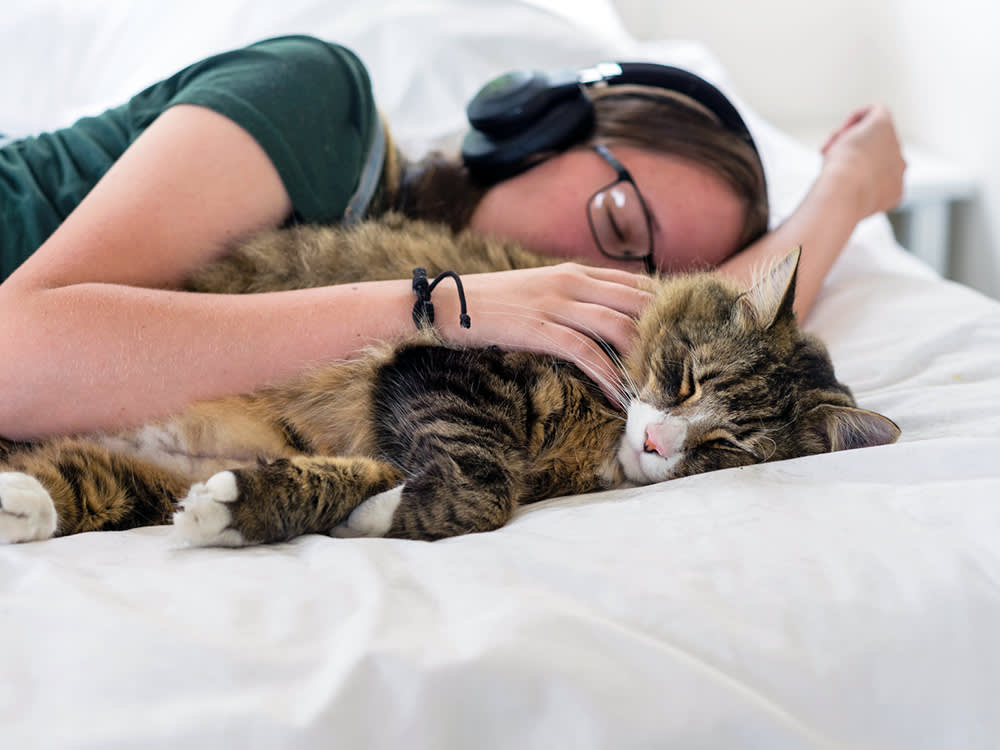
Cats are capable of a lot: knocking your phone off the desk the instant you stop paying attention, drinking from the water glass you just filled, head-butting you off balance to demand a second dinner, depositing toy mice on your pillow as a love offering. But can they snore? It turns out, yes — snoring belongs on the long list of feline quirks.
Like us, cats can snore during sleep for a handful of reasons: relaxed throat muscles, nasal congestion, or an awkward sleeping position. Occasional snoring is generally considered normal and harmless. Still, it raises understandable questions, so we talked through the whole topic with Tom Hadley, a certified feline behavior consultant, to sort out when a snore is just a snore — and when it’s worth a phone call to the vet.
Is cat snoring normal?
“I like to draw a line between normal and common,” Hadley says. “Snoring in cats isn’t especially common, but it does happen, and it’s completely normal. My own cat, Pepper, snores like a champion.” Hadley’s bottom line: snoring is fine on its own, and only worth worrying about when it points to a medical problem.
Why do cats snore?
Just like human snoring, feline snoring has many possible causes. Some breeds are simply more prone to it, some cats have allergies, others might be fighting a cold, and plenty are just sleeping in a goofy position. The upside? A snoring cat is far cuter — and quieter — than a snoring human.
Anatomy
If your cat is sawing logs, breed anatomy may be the culprit. “Brachycephalic cats — the flat-faced breeds like Persians — are more likely to snore,” Hadley says. “Their shortened skull and compressed airways create bone and tissue structures that naturally encourage snoring.”
Sleeping position
If you’ve ever elbowed a snoring partner to get them to roll over, you already understand this one. “The angle of your cat’s neck can produce a snore, and a shift in position can release a little puff of air that comes out as a snore or a whine,” Hadley says. “Pepper sometimes does this funny ‘moaning snore’ that’s half gentle groan, half delicate snore.”
Respiratory issues
Cats can catch colds, complete with runny noses and swollen nasal passages that lead to snoring. If a snoring cat is also sneezing, coughing, wheezing — and especially if they seem to be working hard to breathe — call your vet to rule out something more serious.
Allergies
A cat with allergies may snore much like an allergic human does. Sneezing, clear nasal discharge, or wheezing can hint that an environmental allergen is behind the snoring. Your vet can help you figure out the trigger.
The snore-vs-stertor distinction worth knowing
Here’s a line that helps you sort the cute from the concerning. A soft, occasional snore that only happens during deep sleep is one thing. A constant raspy, snorting, congested sound your cat makes even while awake, called stertor, is different: it points to an obstruction or narrowing higher in the airway rather than the gentle vibration of a relaxed sleeping throat. If the noise is there when your cat is up and alert, not just curled up asleep, treat it as a reason to call the vet rather than a quirk. The timing of the sound, awake versus asleep, is one of the most useful clues you can hand your veterinarian.
If the snoring is keeping you up, there are a few things to try.
A gentle nudge
“I genuinely love Pepper’s snore, but if I pet her softly, she’ll usually quiet down — at least for a while,” Hadley says. Sometimes a light touch is all it takes to ease them into a different position.
Run a humidifier
Air quality matters, especially in winter when heating systems dry everything out. “Dry air can make snoring worse, so a humidifier may help,” Hadley says — and it’s good for the humans in the house, too.
Help an overweight cat slim down
No body-shaming the chonks, but extra weight can contribute to snoring. “Some overweight cats snore — Pepper is a touch round herself — so weight loss may quiet things down,” Hadley says. Diet and exercise under your vet’s guidance can make a real difference, both for the noise and for overall health.
See the vet
When in doubt, a vet call is never the wrong move. There may be an easily treatable cause. “If there’s an underlying medical issue — a nasal polyp, for example — removing or treating it should resolve the snoring,” Hadley says.
When snoring warrants a vet visit
Hadley is clear that he can’t give medical advice — he’s a behavior consultant, not a veterinarian — but he flags a few situations that justify a vet visit. The reassuring news is that in most cases, feline snoring is nothing to fret about.
“As a rule, if the snore isn’t paired with other symptoms and your cat is sleeping well, they’re probably fine,” Hadley says. “But coughing, panting, open-mouth breathing, wheezing, labored breathing, or a swollen face all point to a medical problem. And if your cat isn’t sleeping well, that’s a flag too.”
Call your vet if you notice any of the following:
- Very loud snoring. A cat’s snore should be soothing, not seismic. If it sounds like a truck rumbling by, take a video to show your vet.
- Wheezing. Wheezing and snoring aren’t the same thing, and wheezing is cause for concern.
- Panting. Dogs pant to cool off. Healthy cats shouldn’t pant, so it’s a red flag.
- Open-mouth breathing. Breathing with the mouth open, or any heavy breathing, signals a cat who’s struggling.
- Coughing. A cough might be nothing (hairballs happen), but a snoring cat who’s also coughing should get checked.
- A swollen face. Facial swelling warrants a vet visit on its own, snoring or not.
- Refusing to eat. Cats can be picky, but a genuine hunger strike means it’s time to call.
- A sudden new snore. “Any abrupt behavior change is a good reason to check in with your vet,” Hadley says. “If a cat who’s never snored suddenly starts, call to see whether a visit is warranted.”
A little more on cat sleep
Since we’re talking about sleeping cats, a few quick questions Hadley hears often:
Do cats dream? “If you see a cat twitching in their sleep — whiskers, paws — that’s the dreaming phase,” he says. “Most of their sleep is non-REM and very light, but they do drop into short, deep stretches that make them genuinely hard to wake.”
Why do cats wake up so early? “Cats are crepuscular — most active at dawn and dusk — which syncs with the activity of prey like birds and mice,” Hadley says. “In other words, the early cat gets the meal.”
Why does my cat twitch in their sleep? “They’re dreaming,” he says.
What’s new since this was written
Veterinary attention to flat-faced cat breeds has grown sharply in recent years. As Persians, exotic shorthairs, and similar brachycephalic cats have surged in popularity, veterinary organizations have raised concern that the same skull shape that makes these cats snore can also cause genuine breathing difficulty, eye problems, and birthing complications. If you live with a flat-faced breed, it’s worth discussing brachycephalic airway health with your vet rather than writing off heavy breathing as “just how the breed is.”
There’s also a growing market of pet-monitoring cameras and apps that track sleep and breathing, which can be a handy way to capture a worrying snore or breathing pattern on video for your vet — far more useful than trying to describe the sound from memory.
References
- Cornell Feline Health Center. “Feline Upper Respiratory Infection.” Cornell University College of Veterinary Medicine. https://www.vet.cornell.edu/departments-centers-and-institutes/cornell-feline-health-center/health-information/feline-health-topics/feline-upper-respiratory-infection
- International Cat Care. “Brachycephalic (flat-faced) cats.” https://icatcare.org/articles/brachycephalic-cats
- PetMD. “Why Is My Cat Breathing Heavy? Causes and What To Do.” https://www.petmd.com/cat/symptoms/why-my-cat-breathing-heavy
Common questions
Do cats dream?
It appears so. When you see a sleeping cat twitch their whiskers and paws, that's typically the dreaming (REM) phase. Most feline sleep is non-REM and light, but cats do have brief stretches of sleep deep enough that they're hard to wake.
Why do cats wake up so early?
Cats are crepuscular, meaning they're most active at dawn and dusk, which lines up with the activity cycles of prey like birds and mice. The early cat, as it were, gets the meal.
Why is my cat twitching in their sleep?
They're most likely dreaming. Twitching whiskers, paws, and the occasional muffled noise during sleep are normal signs of the REM phase.
Not a substitute for your vet. Our guidance is educational. For urgent symptoms, contact a vet or emergency clinic right away. Editorial standards
Tom Hadley writes about training and behavior, helping owners understand what their pets are trying to tell them. His work covers everyday manners, decoding common behaviors, and the small changes at home that make dogs and cats easier to live with.
Meet our experts ↗Keep reading
 Health & WellnessYour Cat Isn't Being Spiteful. Almost Every 'Bad Cat' Behavior Is Anxiety.Dr. Priya Nair · 9 min
 Health & WellnessCat Anal Gland Leaks Are a Symptom, Not the DiseaseDr. Lena Park · 8 min
 Health & WellnessCats Get Their Own 'Parvo.' The Cat Version Is Often Deadlier.Dr. Mara Chen · 6 min
 Health & WellnessYou Can't Feel a Cat's Fever. You Can Only Measure ItDr. Lena Park · 7 min
 Health & WellnessThe 'Rice' Near Your Cat's Tail Is Alive. Here's What to Do.Dr. Lena Park · 6 min
 Health & WellnessYour Cat Probably Has Herpes. The Go-To Remedy Doesn't Work.Dr. Lena Park · 6 min