


You Can't Feel a Cat's Fever. You Can Only Measure It
Warm ears prove nothing, and the human fever drug in your cabinet can kill a cat. Feline fever comes down to two hard rules: the only real read is a thermometer, and the only safe fix is your vet. Here's the number that means emergency and how to check at home.

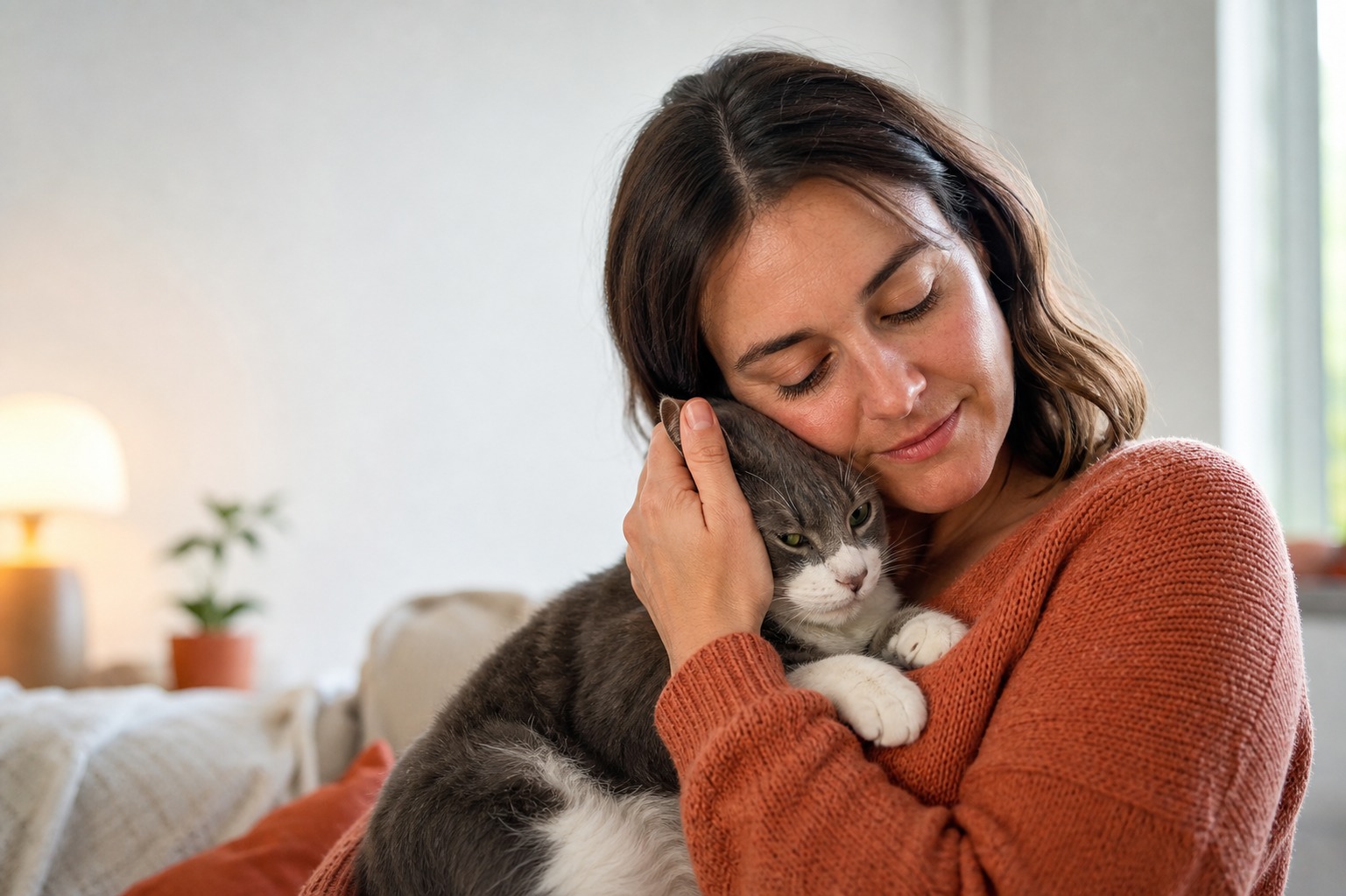
Cats get fevers, and two facts about them matter more than anything else you’ll read here. The first: you cannot detect one by touch. Warm ears, a dry nose, a hot-feeling belly, none of it is reliable, and a cat can be seriously feverish while feeling perfectly normal to your hand. The only honest read is a thermometer. The second: the medicine most people reach for when they have a fever, acetaminophen, is lethal to cats, so the instinct to “give a little something” is exactly the instinct to override.
Everything else, the causes, the subtle signs, the at-home technique, hangs off those two rules. Cats are experts at hiding illness, so the early clues (lethargy, a poor appetite, shivering, a stiff gait) are easy to miss, which is all the more reason the measurement, not your palm, is what you trust.
What a fever actually is
A fever can be a perfectly normal part of the immune response. Normal body temperature for a cat sits between 100 and 102.5 degrees Fahrenheit (37.7 to 39.2 degrees Celsius). Cross 102.5, and you’re into fever territory. An elevated temperature usually means the immune system has kicked into gear, often to fight off an infection.
Here’s the mechanism: when a sick cat’s immune system activates, the brain receives signals to turn up the body’s internal thermostat. That rise in temperature helps stimulate immune cells and makes life harder for the invaders.
It’s worth distinguishing a fever from hyperthermia, which is an abnormally high body temperature caused by something external, like environmental heat or overexertion, rather than the immune system. A true fever has built-in limits, but hyperthermia can push body temperature past safe levels, reaching 106 degrees Fahrenheit or higher.
That number, 106 degrees Fahrenheit, is the one to burn into memory, because it’s where the risk turns from “sick” to “organ damage.” Above 106, a cat’s internal organs are in genuine danger, and it’s an emergency whatever the cause. Two thresholds tell you when to stop watching and act: any reading over 106, or any fever that persists beyond about 24 hours, means an urgent call to your vet or a trip to the emergency clinic, not another night of monitoring.
Cats are usually pretty sensible about not running themselves to exhaustion, so heatstroke from overactivity is far less common than it is in dogs. But a cat left in a parked car on a warm day is in real danger of hyperthermia. That’s a true emergency, and it’s entirely different from the fever a sick cat develops on their own.
What causes fevers in cats
A fever is usually the body’s answer to an underlying infection or inflammation, but really, anything that triggers the immune system can do it. Common causes include:
- Infections (bacterial, viral, or fungal)
- Inflammation
- Trauma
- Cancer
- Vaccine response
- Immune-mediated disease
- Certain medications
- Parasitic disease
- Fever of unknown origin
The signs to watch for
Because cats are so good at masking illness, the signs of a fever tend to be non-specific. Often the most telling clue is simply that your cat seems subdued, missing their usual spark. Watch for:
- Lethargy
- Loss of appetite
- Shivering
- Hiding
- Reluctance to move
- A stiff gait
- Decreased grooming
- Rapid breathing
How to take your cat’s temperature
A warm-feeling pair of ears might make you worry, but ear temperature by touch is not a reliable way to detect a fever. The only way to know for certain is to actually take your cat’s temperature, and the gold standard is a rectal reading with a digital thermometer.
If that sounds like a fast track to bites and scratches, there are alternatives, though their reliability varies. The best of the bunch is an axillary (armpit) temperature, which typically reads about one degree Fahrenheit below the true temperature. A veterinary-specific ear thermometer is less accurate but useful for tracking whether a temperature is trending up or down. Skip non-contact infrared thermometers, since studies have shown they simply aren’t reliable in cats.
If you want the most accurate reading, here’s how to take a rectal temperature at home:
- Gather supplies. Get a digital thermometer and clearly label it “for cat use only” so it never makes its way back into human rotation. You’ll also need a water-based lubricant or petroleum jelly.
- Recruit a helper. Optional, but cats can be wriggly acrobats even when they feel awful. An extra set of hands makes gentle restraint easier.
- Keep things calm. Take the temperature in a relaxed setting. Stress and excitement can temporarily raise body temperature and make it look like a fever where there isn’t one.
- Lubricate the tip. Apply a small amount.
- Position your cat. They can stand or lie on their side or belly. If they squirm, wrap their body in a towel, leaving the rump and tail exposed.
- Insert gently. Lift the tail and ease the thermometer about an inch into the rectum. Hold until it beeps.
- Clean up. Remove and wipe the thermometer, and tidy up your cat’s hind end.
- Reward generously. Treats and snuggles for a cooperative patient.
- Don’t force it. If the whole thing turns into a rodeo, stop. Take your cat to the vet and let the pros handle it.
How to care for a cat with a fever
A cat recovering from a fever needs some extra TLC.
Keep fresh water flowing. Any illness that brings on a fever can also dampen appetite and thirst, which risks dehydration. Make sure your cat always has easy access to plenty of fresh water.
Encourage eating. Monitor food intake. If your cat usually eats dry kibble, tempting them with canned food can help. If they refuse food entirely, call your vet, since cats need proper nutrition to heal.
Follow your vet’s plan. A feverish cat should be evaluated so the cause can be found and treated. Once you have a plan, stick to it, and give medications exactly as prescribed. If medicating is a struggle, ask your veterinary team to help you find an approach that works.
Never reach for human meds. Very few over-the-counter human medications are safe for cats, and none are safe for fever. Acetaminophen (Tylenol) in particular is extremely toxic to cats, and the numbers explain why this is non-negotiable: cats lack the enzyme needed to process it, so a single regular-strength 325-milligram tablet can poison an average cat, and a second can be fatal. It damages red blood cells first (starving tissues of oxygen and turning gums brown or blue) and then the liver, often within hours. Ibuprofen and aspirin are dangerous too. There is no safe human fever medication for a cat, full stop.
Provide a calm space. Give your cat quiet and rest. As tempting as it is to hover and re-check their temperature constantly, that just adds stress. Offer snuggles instead, and only re-check if your vet has asked you to.
What’s new since this was written
The professional guidance for handling feverish, anxious patients has continued to evolve toward low-stress, cat-friendly care. Feline-medicine groups have refined their handling guidelines to minimize the fear and stress of exams and at-home procedures like temperature-taking, recognizing that stress itself can muddy a reading and make a sick cat sicker. The practical takeaway for cat parents is the same advice that’s always worked: go slow, stay calm, and don’t push it.
On the warning side, awareness of acetaminophen toxicity in cats remains a steady drumbeat in veterinary toxicology. It bears repeating because the temptation to “just give a little something for the fever” is so common, and in cats it can be fatal. When in doubt, the answer is always a call to your vet or a pet poison hotline, not the medicine cabinet.
FAQs
How can I tell if my cat has a fever?
The only sure way is a rectal temperature. Signs that warrant checking include lethargy, poor appetite, shivering, stiffness, and rapid breathing.
What is a cat’s normal temperature?
Between 100 and 102.5 degrees Fahrenheit (37.7 to 39.2 degrees Celsius). Above 102.5 is considered a fever.
What kind of thermometer can I use on my cat?
A digital rectal thermometer is best. An armpit reading runs about a degree low, ear thermometers are good for trends, and infrared thermometers aren’t accurate in cats.
References
Not a substitute for your vet. Our guidance is educational. For urgent symptoms, contact a vet or emergency clinic right away. Editorial standards
Dr. Park is a board-certified emergency and critical care specialist. She reviews our health and safety content for clinical accuracy and contributes guides on recognising urgent conditions. Her focus is helping owners act quickly and correctly when it matters most.
Meet our experts ↗Keep reading
 Health & WellnessCats Are America's Most Rabid Pet. The Indoor Ones Aren't Exempt.Dr. Ravi Mehta · 8 min
 Health & WellnessCoffee-Ground Ears? Your Cat Has Company, and It SpreadsDr. Priya Nair · 7 min
 Health & WellnessThe Twitchy Back Is Usually Nothing. The One Time It Isn't Has a Name.Dr. Lena Park · 8 min
 Health & WellnessYour Cat Isn't Being Spiteful. Almost Every 'Bad Cat' Behavior Is Anxiety.Dr. Priya Nair · 9 min
 Health & WellnessA Thirsty Cat Is Often a Sick Cat. Here's the Number to WatchDr. Priya Nair · 7 min
 LivingHe Fostered Six Kittens. Two Died in His Hands. He Kept Fostering.Dr. Amara Solis · 8 min