


Pouch or Pudge? The 10-Second Test for Your Cat's Swinging Belly Flap
That jiggly flap on your cat's lower belly is almost always a normal primordial pouch, not fat. Here's a quick hands-on test to tell them apart, plus what the pouch is really for and when it's worth a vet call.

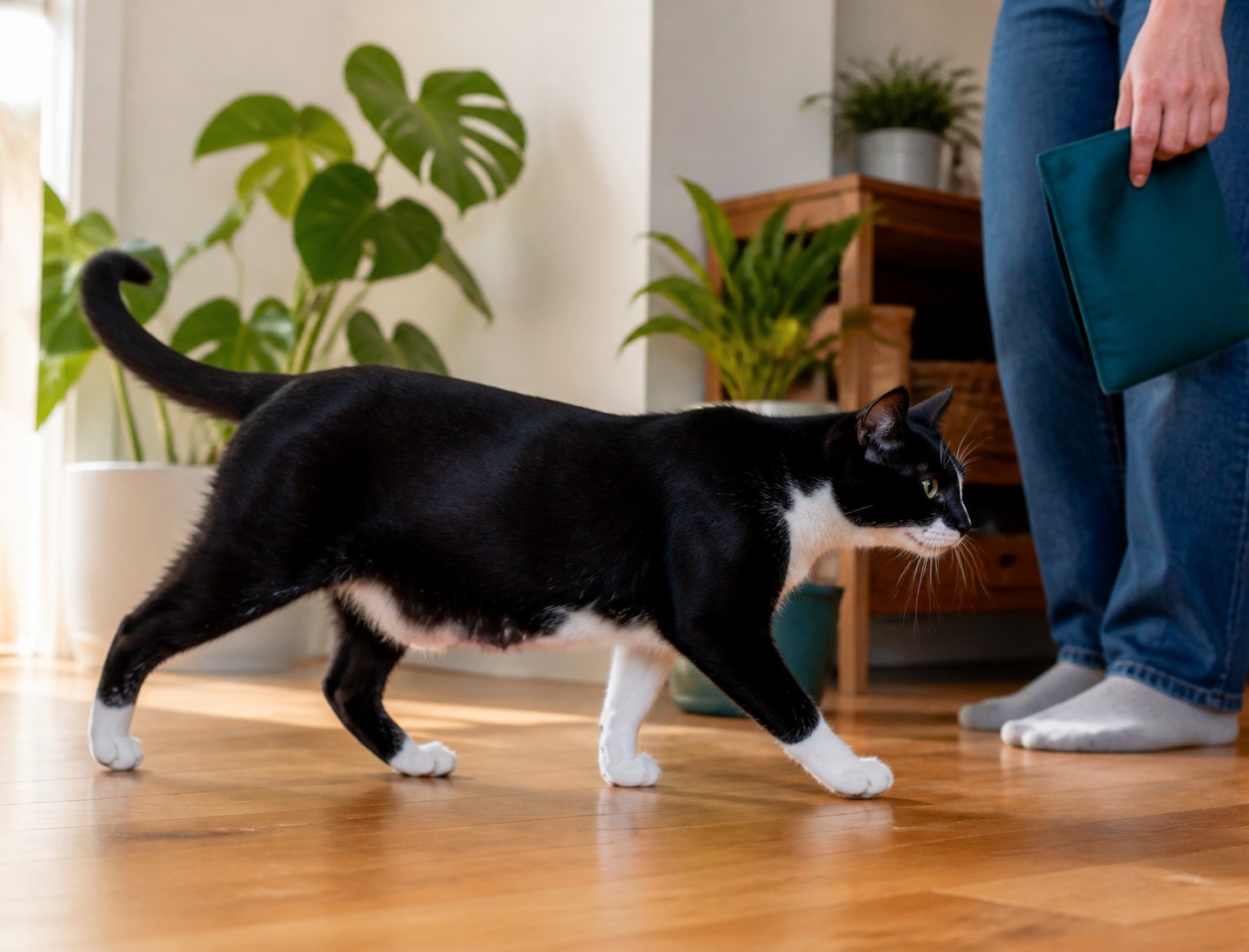
Nearly every worry about the primordial pouch boils down to one quiet question owners are too polite to ask out loud: is my cat secretly fat? So let’s answer that first, with a test you can run in about ten seconds, and get to the biology after. Because in the overwhelming majority of cases, that loose, swinging flap along your cat’s lower belly is a completely normal feature that every cat on earth has, including the sleekest, most athletic cat you have ever met.
The 10-second pouch-or-pudge test
Put your worry to rest with your hands, not your eyes. Three quick checks settle it almost every time.
First, location. Feel where the softness sits. The primordial pouch lives only along the lower belly, that hammock of skin slung between the back legs. Real excess fat does not stay put; it spreads across the ribs, the spine, and the neck too. If everything above the lower belly feels lean, you are looking at a pouch.
Second, texture. Gently cup the flap. A pouch feels soft, loose, and almost empty, like a fold of skin with a little padding. Body fat feels firmer and more solid, and it fills in the spaces where you should be able to feel bone. Run your fingers along your cat’s side: if you can easily feel the ribs, weight is probably not the issue.
Third, movement. Watch your cat trot or run. A pouch swings side to side like a little pendulum precisely because it is loose and lightly loaded. A genuinely overweight body moves as one heavier mass, without that free, independent swing at the belly.
If the belly jiggles when your cat runs but the rest of the body stays trim, that is the pouch, full stop. If you truly cannot tell, that is exactly what a vet visit and a body condition score are for. Do not diagnose weight from the wobble alone.
So what is the primordial pouch?
The primordial pouch is the loose flap of skin and fat that hangs along a cat’s lower abdomen, extending back toward the hind legs. It is standard feline anatomy. You notice it most in motion, swaying as your cat walks. A cat does not need an extra ounce on them to have one.
Some breeds simply wear theirs more obviously. Bengals, Egyptian Maus, and Japanese Bobtails are all known for especially prominent pouches, so a dramatic flap on one of those cats is even less cause for concern.
Why cats have one, and why the popular answer isn’t proven
Here is where most explainers overreach. You will often read, stated as fact, that the pouch exists to shield a cat’s organs during fights. It is a satisfying story, and it may well be partly true, but it is worth being honest that the evidence is thin. There is no solid scientific confirmation of the various proposed functions in wild cats, so treat the theories below as reasonable hypotheses, not settled science. They are also not mutually exclusive.
The leading ideas are these. Protection: the slack skin may cushion the belly during a scrap. When cats tussle, they often “bunny-kick” with their powerful hind legs at an opponent’s midsection, and a loose pouch could put an extra layer between claws and vital organs. Flexibility: the give in the skin may let a cat stretch, sprint, and leap without the belly restricting the stride. You see the same loose-bellied build in cheetahs, whose flexibility feeds their running speed. Fuel storage: wild cats do not eat on a schedule, they gorge when a kill is available, so the pouch may give the stomach and a small energy reserve room to expand after a big meal. House cats do not need this anymore, but evolution is slow, and outdated features can ride along for many generations.
The pouch is one of those leftover wild-cat traits that survived the trip into our living rooms. It’s tempting to hand it a heroic job, but the truth is we don’t have strong proof of any single function. It is not a flaw, and it is not something to fix. Sometimes ‘harmless holdover’ is the whole answer.
Why some pouches look so much bigger
If your cat’s flap looks dramatic, a few ordinary factors are usually behind it. Age is one; older cats tend to carry larger, looser pouches. Weight loss is another, and it surprises people: when a cat slims down, the emptied pouch can actually look more pronounced for a while as the skin catches up. And plain genetics plays a role, with some cats simply built to carry more there.
What if my cat actually is overweight?
The pouch itself never proves excess weight, since all cats have one. But if the test above turns up padding on the neck, back, and ribs as well, weight may be a real concern worth addressing. Feline obesity is common and it shortens lives, so it is worth taking seriously.
Keeping a cat trim comes down to a few steady habits: feed a balanced diet in measured portions rather than free-pouring kibble, build in daily active play and keep engaging toys around to get them moving, and book routine check-ups so a vet can track body condition over time. Your vet can assign a body condition score and tell you whether weight loss is genuinely warranted, which beats guessing from the belly.
When the pouch is worth a phone call
A primordial pouch is almost always nothing to worry about. A handful of situations do earn a vet call:
- The pouch suddenly changes size.
- Your cat seems to be in pain or is having trouble moving.
- The area shows signs of infection, like redness, heat, or swelling.
- You feel firm lumps or unusual growths that were not there before.
“A slow, symmetrical pouch is boring in the best way,” Dr. Kohl says. “What gets my attention is sudden change, or a cat who flinches when you touch the area. Don’t try to diagnose that by feel. That’s the version worth getting checked promptly.”
Why the internet can’t leave it alone
Part of the pouch’s charm is the contrast. Cats carry themselves with such poise that when they do something goofy, like trotting along with a belly flap swinging merrily side to side, it is irresistible. Fans have handed it a whole nickname collection, from “jelly belly” to “cat flap” to the simply accurate “pouch of adorableness.”
The bottom line: every cat has a primordial pouch. It is a natural, mostly mysterious holdover that may offer some protection, flexibility, and storage, or may just be along for the ride. Learn the ten-second test, keep an eye out for the few red flags above, and otherwise there is nothing to fix and nothing to fret over. It is one more quirk that makes your cat your cat.
References
- Santora, Tyler. “Why Do Cats Have Belly ‘Pouches’?” Live Science, 10 Apr. 2021.
- “What Is a Cat’s Primordial Pouch?” PetMD, reviewed by a veterinary team.
- “The Primordial Pouch in Nebraska’s Native Cats.” Nebraskaland Magazine, Nebraska Game and Parks Commission, 2 Aug. 2024.
Common questions
How can I tell the pouch apart from body fat?
Run the two-hand test. The pouch lives only under the lower abdomen and feels soft and pliable, almost empty, and it swings freely when your cat trots. Excess fat is firmer, spreads across the ribs, spine, and neck, and you struggle to feel the ribs under it. If the belly jiggles when your cat runs but the rest of the body stays lean, it's the pouch.
When should I call my vet about it?
Check in with your vet if the pouch suddenly changes size, if your cat seems to be in pain or has trouble moving, if the area shows signs of infection like redness, heat, or swelling, or if you feel firm lumps or unusual growths that weren't there before.
Not a substitute for your vet. Our guidance is educational. For urgent symptoms, contact a vet or emergency clinic right away. Editorial standards
Dr. Kohl is a board-certified veterinary dentist with a particular interest in preventive oral care. She reviews all dental health content at The Pet Times and contributes practical guides on home dental routines, professional cleaning, and oral disease prevention.
Meet our experts ↗Keep reading
 Health & WellnessThe Glow in Your Cat's Eyes Is a Free Eye Exam. Learn to Read It.Dr. Ravi Mehta · 8 min
 Health & WellnessStop Wrestling Your Cat for Pills. Train Them Instead.Dr. Lena Park · 9 min
 Health & WellnessA Kitten Sneeze Is Cute Once. Here's the Line It Shouldn't Cross.Dr. Mara Chen · 8 min
 Health & Wellness8 Reasons Your Cat's Pee Suddenly Smells Worse (a UTI Is Rarely One)Dr. Lena Park · 9 min
 Health & WellnessMost Cat Colds Are Harmless. Learn the One Kind That Isn't.Dr. Mara Chen · 7 min
 Health & WellnessA Thirsty Cat Is Often a Sick Cat. Here's the Number to WatchDr. Priya Nair · 7 min