
Here is the part nobody leads with: lice are one of the easier problems your cat can have. A week or so of the right treatment usually ends it. What’s more interesting is the question underneath it, the one your vet is quietly asking the moment they spot a nit: why did lice manage to take hold on this cat in the first place?
Because they usually don’t. A healthy adult cat who grooms well is a hostile place for lice to live. When an infestation actually settles in, it’s often flagging something else, a cat who is very young, very old, run-down, or simply unable to keep up with their own coat. Treat the lice, yes. But treat the reason too.
What lice actually are, and how a cat ends up with them
Lice are tiny, wingless insects that live in the fur and feed on flakes of dead skin and, in some species, blood. Cats get the chewing louse Felicola subrostratus, and its constant gnawing at the skin is what makes an infested cat so miserable. The insects spread through direct contact with an already-infested cat, or indirectly through shared brushes, combs, and bedding. Unlike fleas, they can’t leap onto your cat from the yard or the carpet. Someone has to hand them over.
That transmission route is exactly why lice cluster where cats live in close quarters and stress runs high: shelters, catteries, foster homes, and crowded multi-cat households. It’s also why the cats who get hit hardest tend to be kittens, seniors, malnourished cats, and cats whose immune systems are already busy fighting something else. Long-haired older cats who can’t twist around to groom their back end are especially prone. Infestations show up more in the cold months than in summer.
“When I find lice on a cat, my next move isn’t just the shampoo, it’s figuring out why this particular cat couldn’t fend them off,” says Dr. Ravi Mehta. “Nine times out of ten there’s a story, a senior who can’t groom anymore, a kitten who came from a rough situation, a cat quietly losing weight. The bug is the symptom. My job is the sentence after it.”
The good news for the squeamish: you don’t need a microscope. Adult lice are visible to the naked eye, moving slowly on the skin, and the females glue their eggs, called nits, onto individual hairs where they look like little white specks.
Types of lice, and why “species-specific” matters
Lice come in two broad camps based on how they feed: chewing lice and sucking lice. Cats deal with the chewing kind. The single most reassuring fact about all of them is that they are exquisitely picky about their host. Cats give lice to other cats. Dogs give lice to other dogs. People give lice to other people. The lines almost never cross, which is why a lice diagnosis in your cat is not a household-wide emergency the way fleas can be.
What an infestation looks like
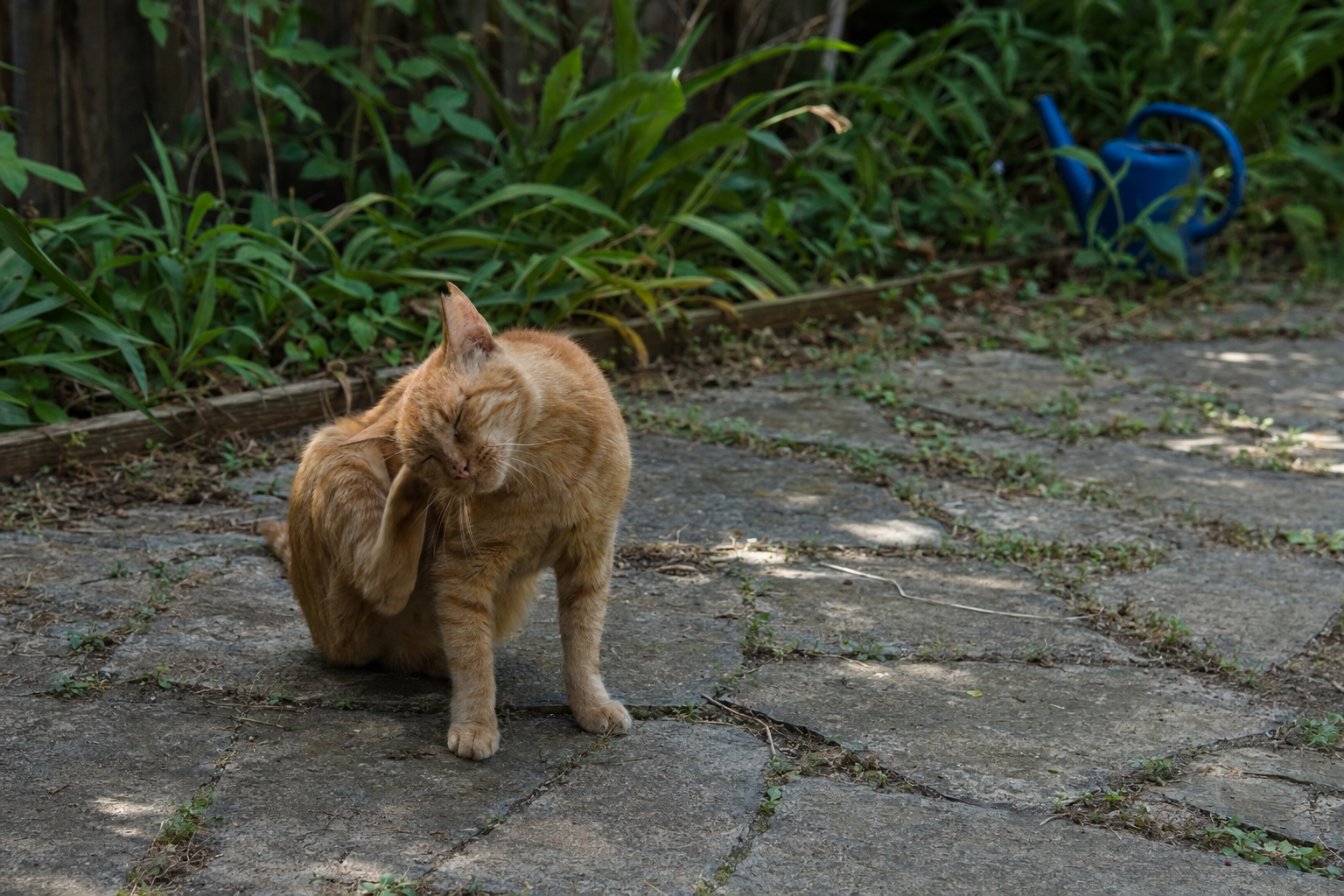
Lice cause many of the same signs as other skin parasites, and the through-line is itch. The relentless gnawing drives cats to scratch and over-groom, and that restlessness is often the first thing owners notice. Watch for:
- Restlessness and obvious agitation
- Scratching and biting at the skin
- Excessive or frantic grooming
- Hair loss, often in patches
- Scabs and small skin abrasions
- White specks (nits) clinging to the fur
- A dull, matted coat
Why you shouldn’t just wait it out
A lice infestation alone rarely kills a healthy cat, but “rarely” is doing real work in that sentence, and leaving it untreated invites a stack of complications:
Anemia. A heavy infestation can drain enough blood to drop a cat’s red cell count. In a tiny kitten or a frail senior, that anemia can turn from “lethargic and weak” into genuinely dangerous.
Skin infections. All that scratching breaks the skin, and broken skin is an open door for bacteria. Infected areas get red, swollen, painful, and smelly, and a widespread skin infection can make a cat feel sick all over.
A miserable cat, and a miserable household. Constant itching wears on a cat’s nerves. They get anxious and agitated, and the round-the-clock sound of scratching and licking wears on you too.
A spreading problem. An untreated cat becomes the source that reinfests every other cat in the home, and the cycle just keeps feeding itself.
Clearing lice, step by step
The treatment is straightforward, which is the whole reason lice are the easy part. Most cats are lice-free within a week or two of doing this properly.
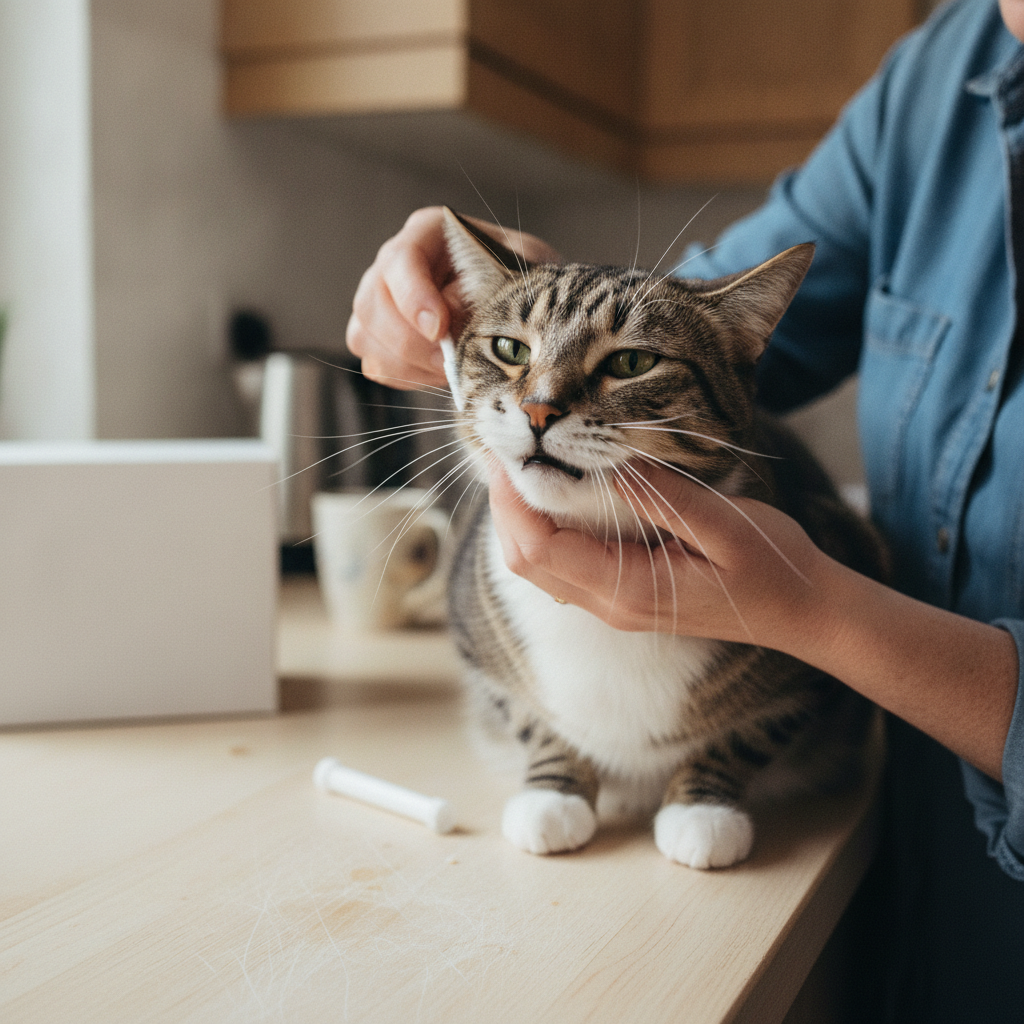
Start with your vet. A vet confirms it’s actually lice and not fleas, mites, or another skin condition, checks for secondary infections, and steers you to a product that’s both effective and safe for cats. That safety point is not a formality; keep reading.
Do the grooming groundwork. A fine-toothed flea comb physically lifts out some adults and nits, though combing alone never gets them all, so the leftovers keep the cycle alive. Cats with heavily matted or unkempt fur may need a bath and a good brush-out first, and if the coat is badly matted, your vet may clip it so the medication can actually reach the skin.
Apply a vet-approved medication. Several formats work, shampoos, sprays, and spot-on treatments, and many of them double as flea-and-tick control. Because eggs are shielded from many products, most treatments need a repeat in one to two weeks to catch newly hatched lice.
Here is the warning worth putting in bold: never put an over-the-counter insecticide on your cat without your vet’s okay. Some products made for dogs, especially those containing permethrin or high-dose pyrethrins, are toxic to cats and can cause tremors and seizures. This single mistake sends cats to the emergency room every year.
Clean the environment. Vacuum thoroughly, wipe down surfaces your cat uses, and wash or replace bedding. Disinfect every comb, brush, and clipper between uses.
Treat every cat in the house. Even if only one cat is visibly crawling, treat all of them. Otherwise you’re just passing the infestation back and forth.
About that “can I catch it” worry
You cannot get lice from your cat, full stop. And if you’re currently losing the battle with your own kid’s head lice, you can’t give those to your cat either. The one asterisk: lice can occasionally carry other organisms, such as Bartonella bacteria, the cause of cat-scratch fever, but transmission to people through lice specifically is rare. It’s a footnote, not a reason to keep your distance.
Keeping them from coming back
Recurrence is usually a treatment-that-stopped-too-early problem. Finish the full course, including the repeat dose, keep up with routine parasite prevention, and stay on top of grooming, especially for a senior cat who can’t reach everywhere anymore. After treatment, keep checking the coat for a few weeks. If you spot live lice or fresh nits, or the scratching ramps back up, loop your vet back in before it snowballs.
And circle back to the real question. If lice found your cat once, ask why. A senior who’s stopped grooming may be arthritic or in pain. A cat who keeps getting run-down may have an underlying illness worth investigating. The lice are gone in a week. The reason they got a foothold is the thing worth your attention.
References
- Merck Veterinary Manual. “Lice in Dogs and Cats.” merckvetmanual.com
- Companion Animal Parasite Council. “Lice.” capcvet.org
- Bezerra-Santos, M. A., et al. “Efficacy of a topical formulation containing esafoxolaner, eprinomectin and praziquantel (NexGard Combo) against natural infestations with the cat louse Felicola subrostratus under field conditions.” Parasites & Vectors, 2022.
- Rani, P. A. M. A., et al. “The dog louse Heterodoxus spiniger from stray cats in Penang, Malaysia.” Tropical Biomedicine.