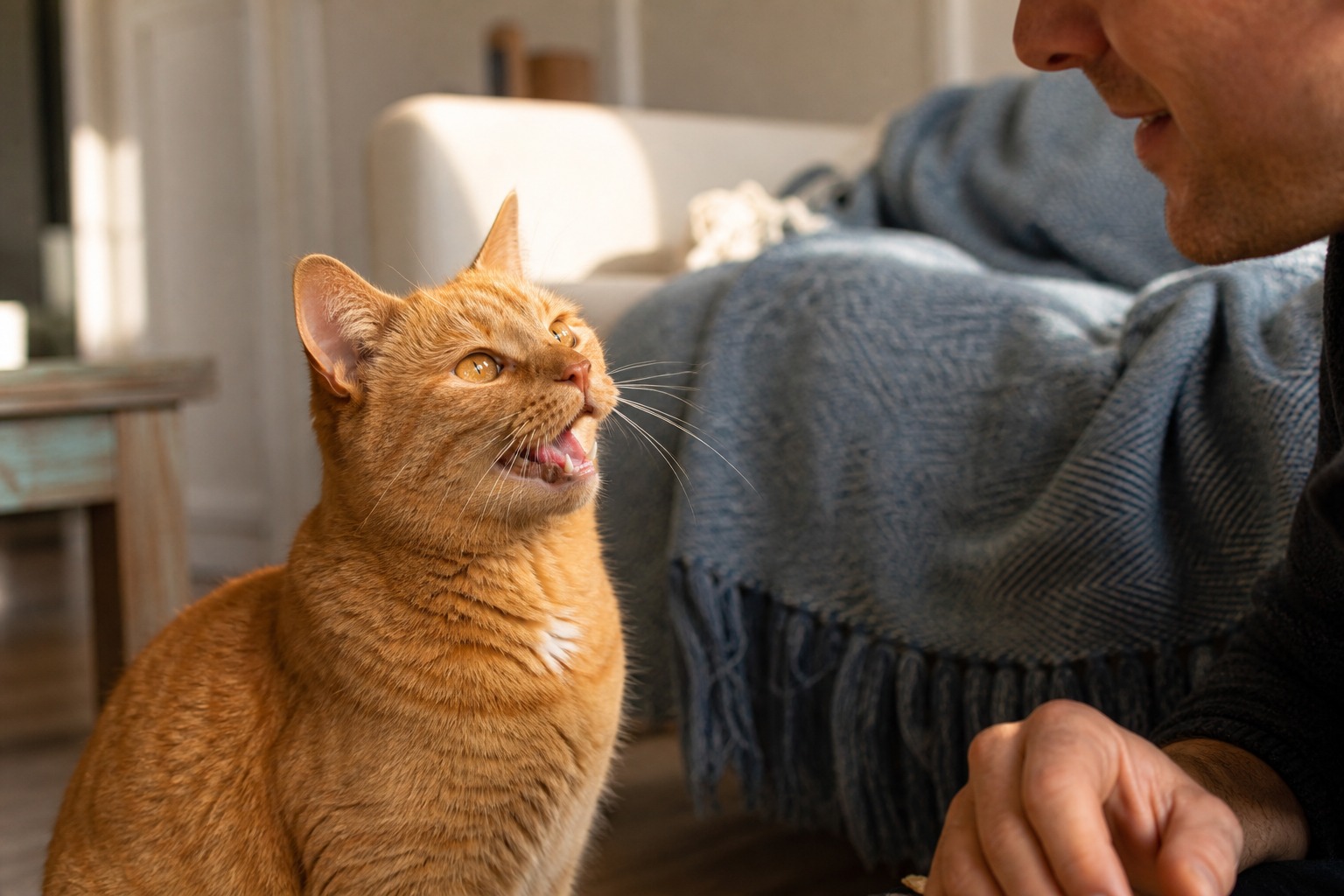

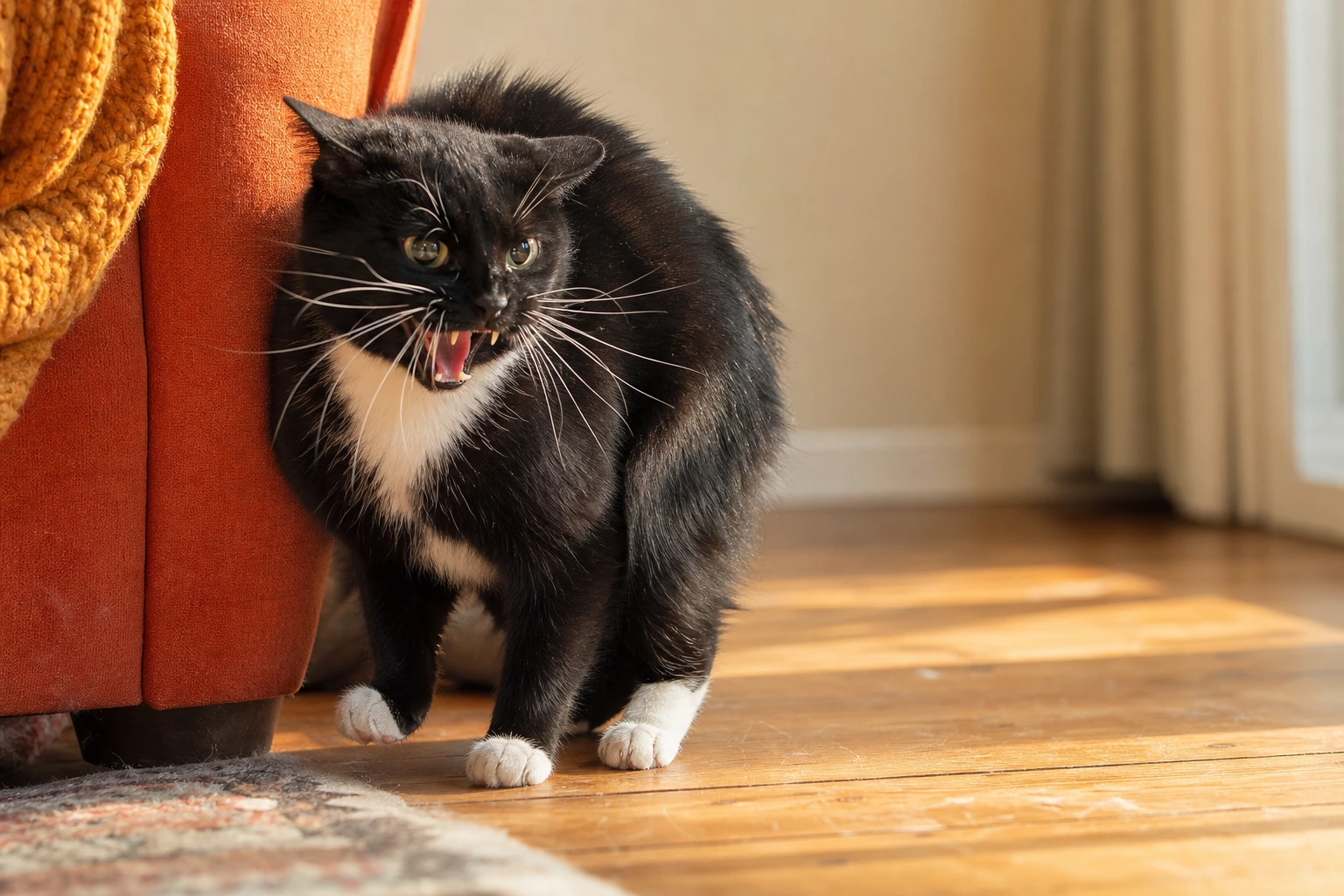
Here is the reframe that changes how you handle a hissing cat: the hiss is not the start of a fight. It is your cat’s best attempt to prevent one. Cats are small predators with a lot to lose in a real brawl, so they evolved a loud, theatrical way of saying “do not make me do this.” A cat that hisses is a cat that is still negotiating. The bite comes when the negotiating fails, usually because nobody listened.
That means the hiss is a favor. It is information, delivered free of charge, about something your cat cannot tell you any other way. Punishing it, or pushing through it, teaches your cat that the warning does not work. And a cat that learns warnings do not work skips straight to teeth. Your job is not to stop the hissing. It is to figure out which of five messages it carries, because the fix is different for each one.
“A hiss is your cat drawing a line, not picking a fight. Cats that feel cornered get loud precisely because they want to avoid using their claws,” says Dr. Nina Kohl.
Message one: “I’m scared, and I can’t see the exit”
Fear is the most common trigger. A frightened cat hisses because something feels dangerous, and their body will tell you: weight shifted back, ears sideways, eyes scanning the room for a way out. The single most useful thing you can do is make sure that way out exists. A cat with an escape route or a hiding spot almost always takes it instead of escalating.
You can also shrink the threat itself. If the trigger is a strange cat prowling outside the window, block the view and dim the room so your cat stops feeling watched. If the trigger lives with you permanently, a new pet, a new baby, a new roommate, that calls for a slow, structured introduction, and a certified behavior professional is worth the money if it is going badly.
One rule with no exceptions: do not pick up a fearful, hissing cat. Their alarm system is fully armed, and hands arriving from above read as an attack. Cats in that state redirect on whoever is closest, and that will be you.
Message two: “I’m furious”
Anger looks different from fear. An angry cat holds their ground rather than hunting for exits: pupils narrowed to slits, ears rotated back, tail bristled and held low. This is a cat broadcasting that aggression is on the table if the intruder does not withdraw.
The good news is that it is almost always theater. House cats overwhelmingly prefer a loud argument to an actual fight, because fights are expensive for both sides. Give the angry cat space and time, and the production usually closes on its own. The warning is real, though. If the hiss comes with spit, chasing, or swatting, believe it and back away.
Message three: “This is mine”
Hissing can also be an opening move rather than a defensive one: a claim staked on territory. Males do this more, the tomcats-in-an-alley cliché exists for a reason, but indoor cats do it too, and in multi-cat homes the flashpoint is almost never abstract. It is a perch, a food bowl, a litter box, a sunny spot.
Feline social structure is built around resources and safety, and this is where owners get it backwards. We assume our cats are fine sharing one food station and one litter box because they seem to tolerate each other. From the cats’ side, forced sharing is exactly what sets the turf war off. Duplicating resources, one feeding spot, one box, and one refuge per cat, plus a spare, defuses most of these standoffs better than any correction ever could.
“If two housemates trade the occasional hiss over a windowsill, I don’t worry. When it becomes the soundtrack of the house, the real issue is usually shared resources, so give each cat their own food station, litter box, and refuge before assuming they simply hate each other,” Dr. Kohl says.
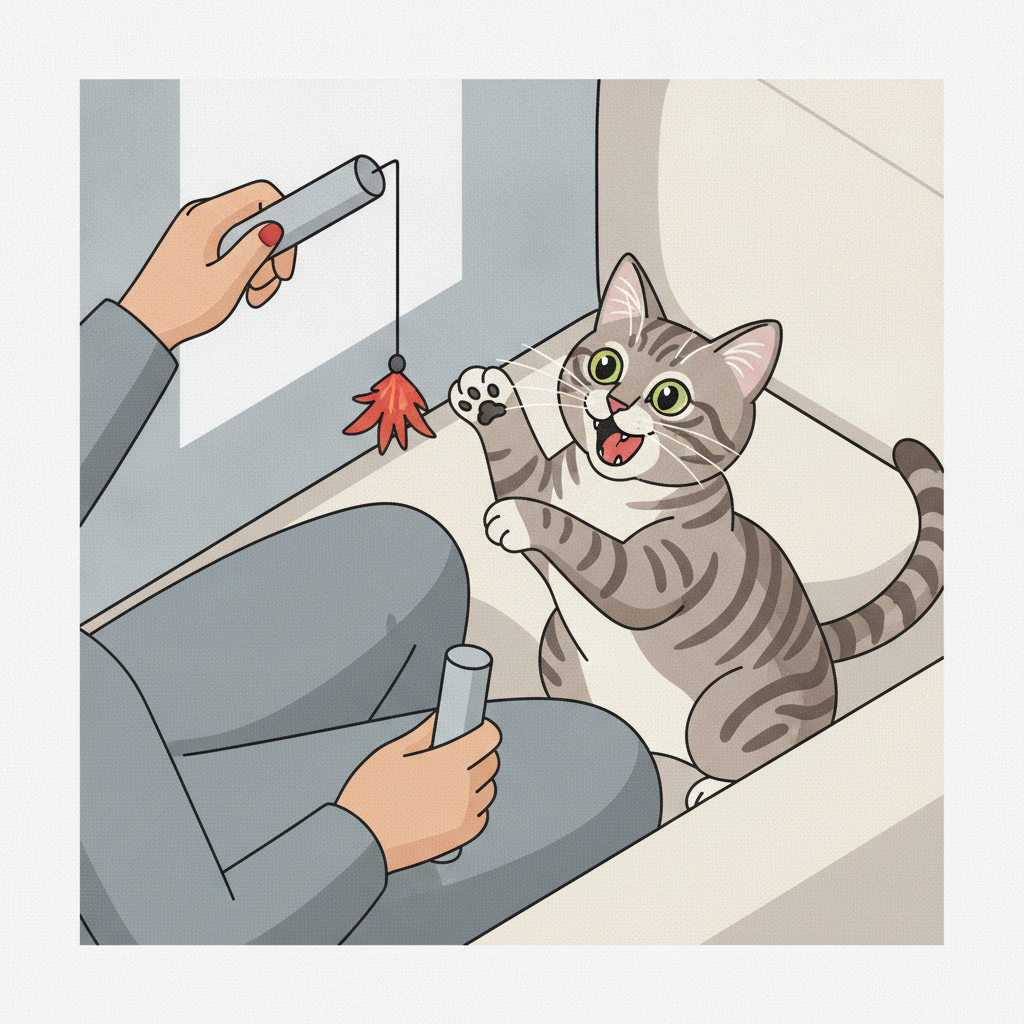
Sometimes the territorial hiss lands on a person, often the houseguest or family member trying hardest to make friends. Counterintuitively, the trying is the problem: a cat pursued by affection loses all control over the interaction. Have that person stop courting the cat entirely and become useful instead, as the one who fills the bowl and drops the treats. Interactive play with a wand toy helps too, because it builds a good association from a distance the cat chooses. Let the cat close the gap on their own schedule.
Message four: “It hurts”
A hiss with no visible trigger deserves a different kind of attention. If your cat hisses when lifted, touched along the spine or hips, or when they jump down from furniture, pain is a real possibility. Arthritis and dental disease are both common, both underdiagnosed, and both painful enough to make a normally tolerant cat snap at hands they love. There is also the acute version, hiss plus swipe the instant you step on a tail, which needs no interpretation.
Handle a possibly-hurting cat gently and minimally, and book a vet visit. A behavior problem that appears out of nowhere in a middle-aged or senior cat is a medical problem until a vet says otherwise.
Message five: “I’m overstimulated”
Not every hiss is grim. A kitten hissing at the toy they are wrestling is not angry; they are rehearsing a hunt at full emotional volume, possibly with catnip involved. And then there is the famous betrayal: your cat is purring under your hand, everything is lovely, and then a hiss, a swat, and an exit. Behaviorists call it petting-induced aggression, and the driver is repetitive contact hitting a hard limit. The affection meter filled up, and nobody was watching the gauge.
Do not take it personally. Watch for the early signals instead: skin rippling along the back, tail starting to lash, ears flicking. End the petting session while it is still good. If your cat seems chronically on edge, hissy over small things and hard to settle, a pheromone diffuser can lower the baseline, and a vet visit can rule out the medical causes of a short fuse.
What newer research adds
The 2024 intercat tension guidelines from the American Association of Feline Practitioners treat hissing exactly the way this article does: as normal communication, not misbehavior, and as an early flag that something in the home needs adjusting, most often how resources are spread out. Their headline advice for multi-cat friction is separate stations for food, water, and litter placed so one cat can never ambush another at any of them.
Newer work on human-directed aggression points the same direction. Studies reviewed in 2025 found that most cat bites to people follow provocation or mishandling that the cat warned about first, and that owners routinely miss those warnings during petting and play. The hiss is the loudest, clearest signal in that chain. Cats that get listened to at the hiss stage rarely need to go further.