


The Best Pet Vacuum Isn't the Strongest. It's the One Your Cat Lets You Run
A hands-on review of the Airsign HEPA vacuum, told through the only metric that matters in a pet home: whether the machine is bearable enough that you actually use it.

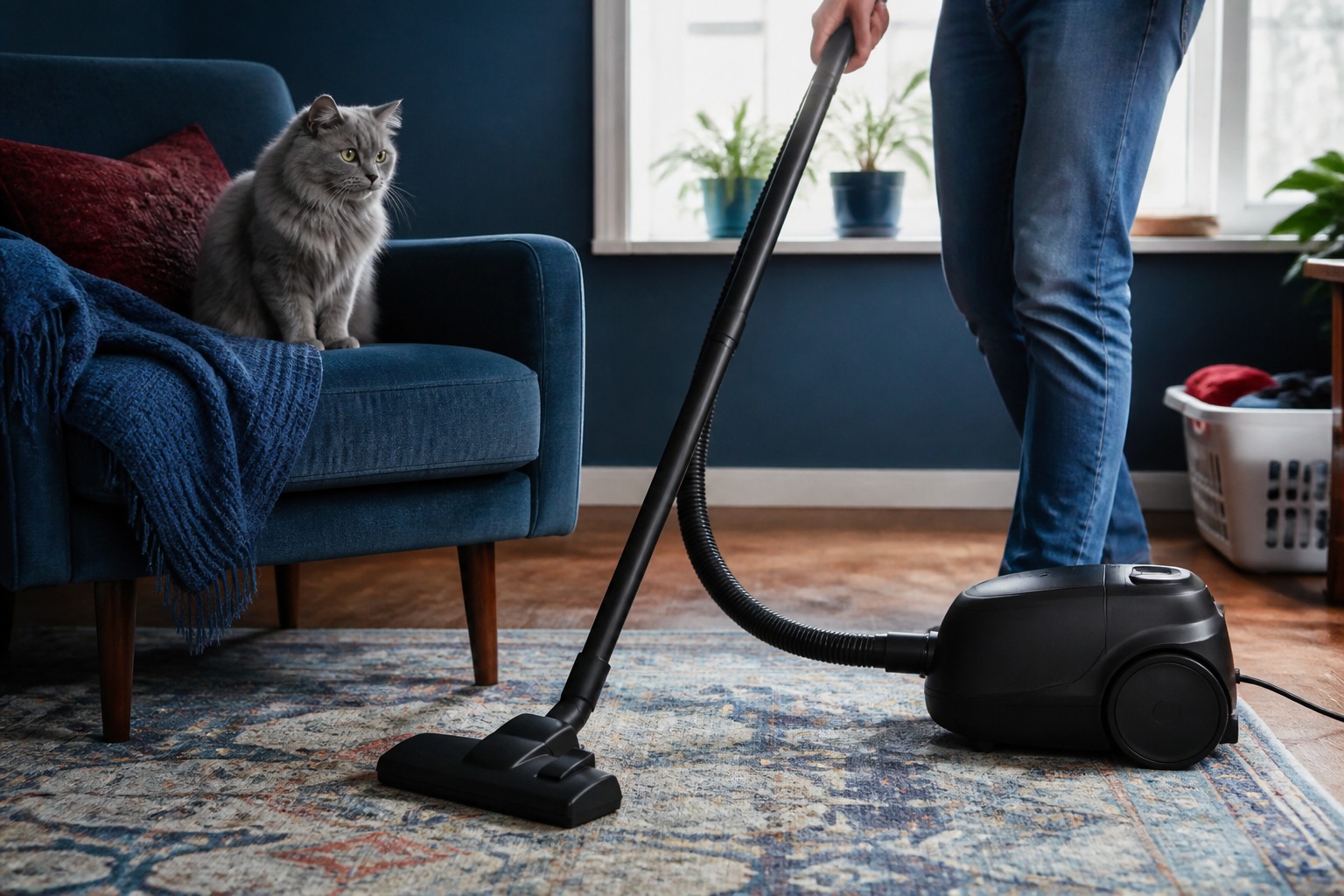
Here is the dirty secret of owning a vacuum in a pet home: the best machine is not the one with the most suction. It is the one you can stand to turn on. A 200-watt monster that lives in the closet because it terrifies your cat and rattles your fillings cleans nothing. A merely good vacuum that you reach for daily, without dread, keeps the floors livable. By that measure, the only one that counts, the Airsign HEPA vacuum surprised me. So did my cat.
My cat, Pumpkin, is a long-haired Russian Blue (a Nebelung, technically, the long-coated variety) and a connoisseur of quiet, gentle things: naps, cuddles, and piles of unfolded laundry, clean or dirty, no discrimination. He does not merely shed. He makes a production of getting in and out of his litter box, tracking clay dust across the apartment, and he has a habit of eating, then bringing back up, the dust bunnies he finds along the way. My bedroom rug needs daily attention or it starts to look salvaged from a dumpster. Skipping a day is not an option, which is exactly why my old Dyson was a problem: the moment it roared to life, Pumpkin flattened himself against the far wall and sulked there until I was done. Given my frankly irrational devotion to him, that daily ordeal was wearing on both of us. When I was offered the Airsign HEPA vacuum to test, the pitch that hooked me was not the suction figure. It was the word “quieter.”
Does the quiet claim hold up? Mostly, and it matters
Let me settle the headline first. The Airsign is not silent. No corded canister vacuum is. But it is meaningfully quieter than the Dyson it replaced for two weeks, enough that Pumpkin’s behavior changed. He still objects when I poke the brush attachment at whatever surface he has chosen to occupy, but he no longer flees the room and hides. He stays, watches, mildly affronted, and that is a genuine improvement in the daily quality of life for a cat who hates noise. For anyone living with a noise-averse animal, that single difference is the whole review. A vacuum your pet can tolerate is a vacuum you will run often, and running it often is what actually keeps a shedding-cat household clean.
The part that earns it the spot: it is built to be repaired
The eco-friendly angle sounds like marketing until you sit with what it actually means for longevity. The vacuum arrived in a plain cardboard box, parts cushioned in more cardboard rather than molded foam. The body uses 20 percent recycled plastic, which Airsign claims is the highest share of any vacuum on the market. More usefully, the company says it builds the machine with no glue, no permanent snap-fits, and no painted or co-molded parts, so it comes apart and the components are individually replaceable.
That is the feature I would actually pay for. The reason most vacuums end up in a landfill is not that they stop sucking, it is that one $4 part fails inside a sealed housing you cannot open, so the whole machine becomes trash. A vacuum you can take apart and fix is one you keep for a decade instead of replacing every few years, and over that span it is both cheaper and dramatically less wasteful. Even the bags are biodegradable, where most sneak plastic in somewhere, and you can set up automatic replacement shipments so you never run out mid-mess. The bags are small but hold a surprising amount, and changing them, which I expected to dread, took seconds.
Living with a canister (and a wand that finally fits)
Assembly was simple enough that I ignored the instructions. The result is genuinely handsome for a vacuum: matte black, minimalist, almost sculptural, which matters when your apartment has no storage and the thing lives in plain sight.
I had never used a canister vacuum, having gone from my parents’ upright to a cordless after moving to New York, and I was sure I would hate dragging one around. For about a day, I did. Then I adjusted. Yes, a corded canister means hunting for outlets and towing the body room to room, but it never dies mid-clean the way a cordless does, it is light at around 10 pounds, and a button retracts the cord in an instant.
The one moment I nearly wrote it off is worth passing along, because it would trip up plenty of buyers. On first use I set it on my rug and could barely shove it forward. I assumed the suction was absurdly strong, and I was annoyed. The actual problem was the wand angle. I am six-foot-one and have always fought short vacuums, but once I extended the wand fully, the Airsign glided. If you are tall and your vacuum feels like it is fighting you, extend the wand before you blame the motor. As a bonus, I cleaned my whole apartment upright, no hunching, for the first time in my adult life.
On the filtration claim, and the verdict
Airsign’s spec sheet says the vacuum traps “an outstanding 99.995 percent of harmful particles” through HEPA-14 filtration, the same sealed-filtration class hospitals and allergy sufferers look for. I cannot independently verify a number like that with a two-week loan and no air-quality instruments, so treat it as a manufacturer claim rather than a tested fact. What I can confirm is that it kept my floors and baseboards visibly clean and did not kick a haze of fine dust back into the room the way a leaky bagless vacuum does, which is the practical thing sealed HEPA filtration is supposed to deliver for a cat-allergic household. Airsign also loaned me a prototype spinning floorhead built for plush carpet and pet hair; the vacuum works well without it, but I preferred it and would tell any owner to add one.
At $295 it is not cheap, but it undercuts comparable Miele and Dyson canisters, and you are buying repairability and a tolerable noise level rather than a spec-sheet suction figure. I will be sorry to send it back. When my old Dyson finally retires, this is what I will replace it with, and Pumpkin, who has stopped fleeing the room, is counting the days right along with me.
References
Tom Hadley writes about training and behavior, helping owners understand what their pets are trying to tell them. His work covers everyday manners, decoding common behaviors, and the small changes at home that make dogs and cats easier to live with.
Meet our experts ↗Keep reading
 Health & WellnessWhy the Cat Pee Smell Keeps Coming Back (and How to Actually Kill It)Sara Lim · 17 min
 LivingThe Cat Decides When the Photo Shoot Is Over. Never the Photographer.Sasha Ford · 6 min
 Product PicksThe Window Hammock That Ends the Cat-Versus-Houseplant WarSara Lim · 3 min
 Product PicksYour Cat Doesn't Want a Present. She Wants Territory.Sara Lim · 6 min
 Product PicksNo Box Fixes a Litter Box Problem. Here's What Actually Does.Dr. Lena Park · 10 min
 Product PicksHow to Choose Cat-Proof Carpet: A Buyer's Framework, Not a Brand ListSara Lim · 5 min