


Cat Hairballs Are a Plumbing Problem, Not a Cough
The pile on the rug is not the real story. A vet explains what a hairball actually signals about your cat's gut, how to tell a true hairball from something more serious, and the frequency that should send you to the clinic.

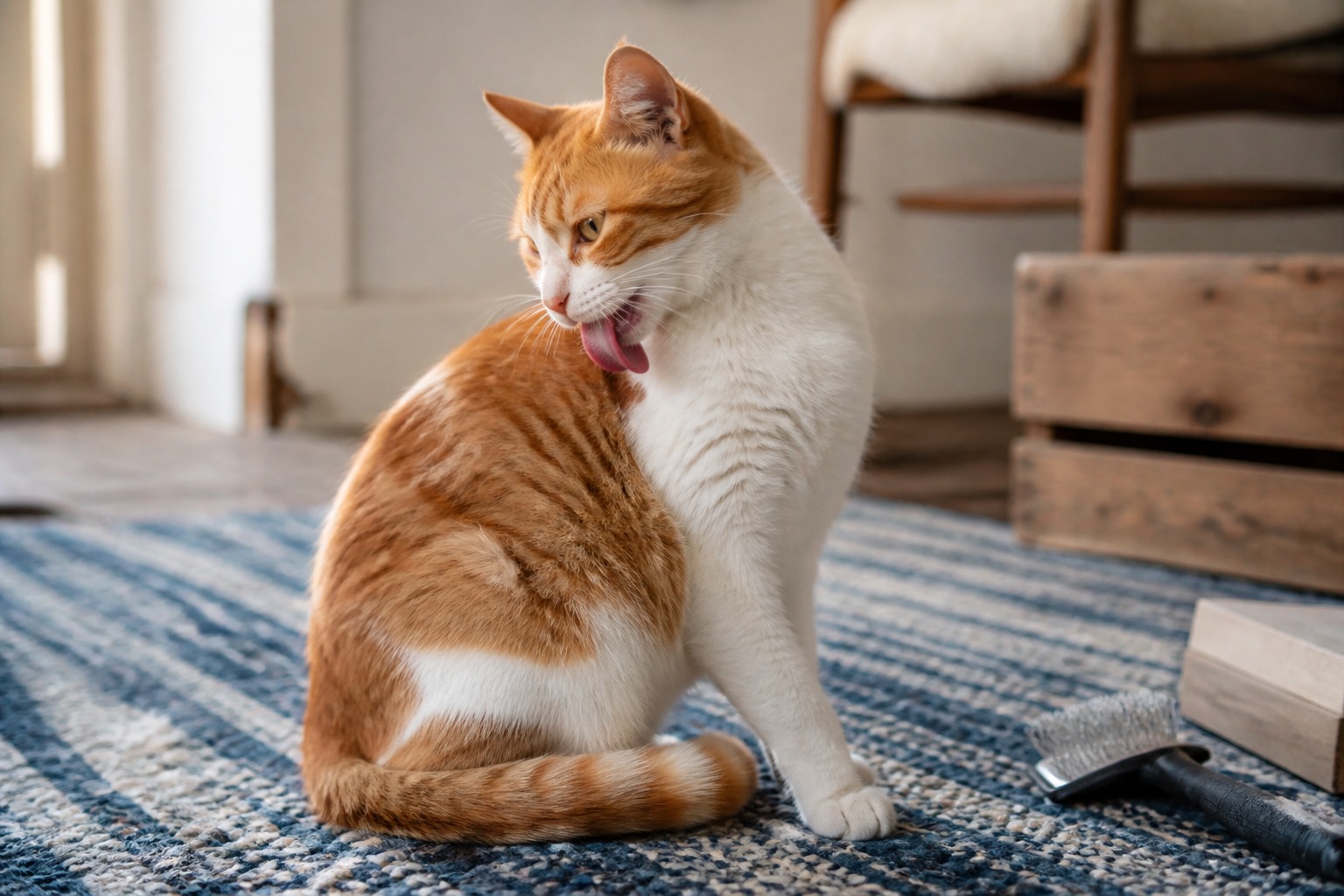
Most advice about hairballs starts at the wrong end of the cat. It fixates on the wet, unwelcome mass on the rug, when the thing that actually matters is happening a foot upstream, in the gut. A hairball is not really a hair problem. It is a throughput problem. Every cat swallows hair when it grooms, and in a healthy cat that hair keeps moving and leaves quietly with the stool. A hairball on your floor is what happens when the pipe backs up and the body chooses the emergency exit instead.
That reframe changes what you should watch for. The question is never “did my cat cough up a hairball.” Cats do that, and it is usually fine. The question is whether hair is still exiting the body at all, and whether the coughing you are seeing is even a hairball in the first place. Get those two things right and you will know when to shrug and grab a paper towel, and when to get in the car.
First, make sure it is actually a hairball
Here is the part almost every hairball guide skips, and it is the most important thing in this article. A cat that hunches over, makes dramatic retching noises, and produces nothing is not always working on a hairball. That exact performance is also the classic sign of feline asthma, a chronic airway condition that affects an estimated one to five percent of cats. Owners routinely wave it off for months as “just hairballs,” and the cat quietly gets worse.
You can usually tell them apart by watching the body, not listening to the sound.
When a cat is bringing up a true hairball, the back arches, the whole body heaves, and cats often walk backward as they retch. Something comes out: fur, fluid, or both. It is a vomiting motion, and it ends when the mass is expelled.
When a cat is coughing from asthma, the posture is completely different. The neck and back go straight and stay roughly parallel to the floor, the elbows point out, and the cat stays more or less in place rather than backing up. The cough is dry. Nothing comes up. And unlike the occasional hairball, asthma coughing tends to come in clusters, worsen at night or after activity, and sometimes end in a bubbly swallow as the cat clears loosened mucus.
The tell I teach owners is the spine. A hairball is a whole-body vomit with an arched back and something on the floor at the end. An asthma cough is a flat, level crouch that produces nothing, over and over. If your cat is doing the second one, stop treating it as a hairball and film a thirty-second clip on your phone. That video is the single most useful thing you can hand a vet.
If you are seeing repeated dry coughing with nothing produced, skip the rest of this article’s home remedies and book an exam. Everything below assumes you have confirmed you are actually dealing with hair.
What is really going on inside
Run your hand the wrong way along a cat’s tongue and you feel the whole mechanism. Feline tongues are covered in tiny backward-facing barbs made of keratin, and a 2018 study in the journal PNAS by researchers Alexis Noel and David Hu showed those barbs are hollow and scoop-shaped, wicking saliva deep into the coat. That is what makes a cat such an effective self-groomer, and it is also a one-way conveyor belt. The barbs comb out loose and dead fur and funnel every strand toward the back of the mouth, where it gets swallowed.
The gut cannot digest hair. It has no enzyme for keratin, so the stomach and intestines simply try to move it along with the rest of the waste. In a well-hydrated cat with decent fiber intake and a normal shedding load, that works, and the hair exits invisibly in the stool. A hairball is a sign that this normal clearance failed for one reason or another and the hair got sent back up instead.
Understanding it as a clearance failure is what makes the prevention section below make sense. Everything that helps is really just helping the pipe stay open.
The three levers that decide how often it happens
There is no normal number of hairballs. Some cats produce one or two a year, others manage one a week, and the difference comes down to three things you can partly control.
The first is how much hair goes in. Long-haired breeds like Persians, Himalayans, and Maine Coons swallow far more fur per grooming session, so they naturally hairball more. Heavy shedders of any coat length do too. Spring and fall make it worse, because cats “blow their coat” during those seasons, dumping a wave of old fur that drives extra grooming right when there is extra hair to swallow.
The second is how fast the gut can move it. This is where fiber and water do their work, and it is the lever most owners never touch. A higher-fiber diet gives the intestine bulk to push against and pulls in water to keep everything sliding, so more hair leaves the back end instead of coming up the front. A dehydrated cat on a dry, low-fiber food has the slowest possible plumbing.
The third is anything that slows the gut for medical reasons. Older cats and cats with inflammatory bowel disease or other motility problems clear hair less efficiently, which is why a cat that suddenly starts hairballing after years of not doing so deserves a look rather than a shrug. A change in pattern is information.
When a hairball stops being a nuisance
Most of the time a hairball is a chore for you and a non-event for your cat. The dangerous version is when a wad of hair grows big enough to physically block the intestine.
“The gut has no tools for breaking hair down, so it simply travels,” Dr. Chen says. “Trouble starts when a wad grows past what the intestine’s slim bore can push through, nothing behind it moves either. At that point you are not dealing with a hairball anymore. You are dealing with a blockage, and blockages can kill.”
Treat the following as red flags that point toward a blockage, not a hairball:
- Lethargy or hiding
- Refusing to eat, or eating far less
- Retching repeatedly while producing nothing (and confirmed not to be the flat-backed asthma cough above)
- Vomiting liquid or foam
- Constipation, or straining in the litter box with little result
- A tense, painful belly, or a hunched, guarded posture
An intestinal obstruction is an emergency. Some of these cats need surgery to clear it, and the outcome is much better when they arrive early. Do not spend two days waiting to see if it passes.
How to keep the pipe open
You will never prevent every hairball, because grooming is hardwired. But you can shrink both the size and the frequency, and every effective tactic is really just supporting clearance.
Brush the hair off before the tongue gets to it. This is the highest-leverage habit and the most underused. Every strand you catch in a brush is a strand your cat cannot swallow. Aim for at least weekly for short coats and several times a week for long coats, especially during spring and fall shedding surges. It doubles as bonding time and coat-health maintenance.
Push water hard. Cats are famously reluctant drinkers, and dehydration is the enemy of gut clearance. Offer fresh water in more than one spot, try a fountain to tempt a picky drinker, and lean on wet food, which can add a meaningful amount of daily moisture over kibble.
Consider a hairball-control or higher-fiber diet. These foods are built around added fiber and oils. The fiber stimulates the intestinal contractions that move waste along and draws in water; the oils coat the hair so it slides rather than snags. The same approach helps cats with sensitive stomachs.
Add a targeted supplement if a full diet change is not realistic. Options include fiber boosters like a spoonful of plain canned pumpkin or a little grated carrot, cat grass, digestive enzymes, and lubricating hairball gels. Run any of these past your vet first, especially the gels, and never use a human laxative on a cat.
The bottom line
A hairball is your cat’s grooming system working exactly as designed, colliding with a gut that momentarily could not keep up. The pile on the rug is almost never the emergency. The two things that are worth your attention are the cough that produces nothing over and over, which may be asthma rather than hair, and the cat that stops eating, stops pooping, and keeps retching, which may be an obstruction. Everything in between is a paper-towel problem, and it gets rarer the more you brush, hydrate, and feed for a gut that keeps things moving.
Frequently asked questions
How do I know if it is a hairball or feline asthma? Watch the posture. A hairball comes with an arched back, a whole-body heave, often walking backward, and something produced at the end. An asthma cough is a flat, level crouch with the neck parallel to the floor, produces nothing, and tends to repeat and worsen at night or after exertion. If it is the second one, film it and see your vet.
Which cats get the most hairballs? Long-haired breeds and thick double-coated cats swallow the most fur, and heavy shedders of any coat rank high. Cats with slower gut motility, including some seniors, also clear hair less efficiently.
Can a hairball actually make a cat sick? Yes. A large mass of hair that cannot pass or come up can cause an intestinal blockage, which is an emergency. A cat that is lethargic, not eating, not pooping, or showing belly pain needs a vet right away.
How can I help my cat pass a hairball? More fiber and more water are the reliable levers. A lubricating or fiber-based oral remedy can help too. Never give a cat any product or laxative without checking with your vet first.
My cat suddenly started getting hairballs after years without them. Is that normal? A clear change in pattern is worth a vet visit rather than a shrug. New or increased hairballing can point to a shift in grooming, coat, or gut motility, and occasionally to an underlying condition.
References
- Noel, Alexis C., and David L. Hu. “Cats Use Hollow Papillae to Wick Saliva Into Fur.” Proceedings of the National Academy of Sciences, 19 Nov. 2018. https://pmc.ncbi.nlm.nih.gov/articles/PMC6298077/
- “Feline Asthma.” Cornell Feline Health Center. https://www.vet.cornell.edu/departments-centers-and-institutes/cornell-feline-health-center/health-information/feline-health-topics/feline-asthma
- “Coughing in Cats.” VCA Animal Hospitals. https://vcahospitals.com/know-your-pet/coughing-in-cats
- “The Danger of Hairballs.” Cornell Feline Health Center. https://www.vet.cornell.edu/departments-centers-and-institutes/cornell-feline-health-center/health-information/feline-health-topics/danger-hairballs
Not a substitute for your vet. Our guidance is educational. For urgent symptoms, contact a vet or emergency clinic right away. Editorial standards
Dr. Chen is a small-animal veterinarian who leads health and safety coverage at The Pet Times. She writes and reviews the bulk of our illness, condition, and safety content, translating clinical guidance into clear, practical advice owners can act on at home.
Meet our experts ↗Keep reading
 Health & WellnessThe Cutest Cat Breeds Are Often the Sickest. The Look Is the Problem.Dr. Amara Solis · 8 min
 Health & WellnessCat Anal Gland Leaks Are a Symptom, Not the DiseaseDr. Lena Park · 8 min
 FoodHigh-Calorie Cat Food Isn't an Upgrade. It's a Prescription.Dr. Lena Park · 6 min
 Health & WellnessThe Hungriest Cat in the House Might Be the SickestDr. Lena Park · 9 min
 Health & WellnessThe Cat Loaf Has a Dark Version. It's in the Face, Not the Paws.Dr. Mara Chen · 8 min
 Health & WellnessYou Can't Feel a Cat's Fever. You Can Only Measure ItDr. Lena Park · 7 min