


Two Kinds of Cat Eye Color: The Kind You're Born With and the Kind to Worry About
A cat's eye color is locked in by kittenhood, so anything that changes it later is medical news, not a fun fact. Here is how the genetics work, and how to tell a harmless iris freckle from the early signs of an eye tumor.

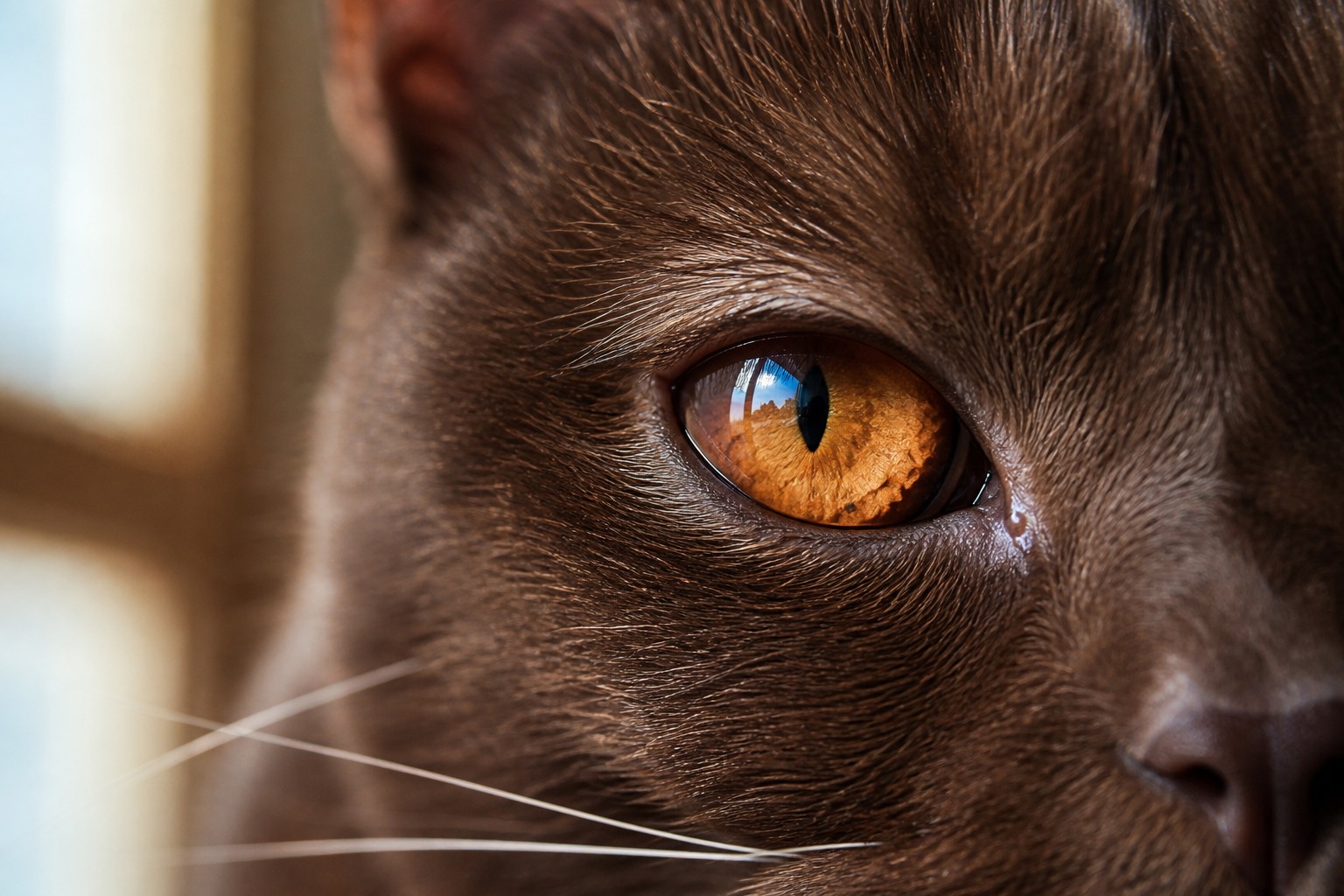
Here is the single most useful thing to know about your cat’s eyes, and it is the thing most eye-color guides bury near the bottom: a cat’s iris color is finished by the time they are a few months old, and after that it should never change again. That one rule cleanly splits everything about feline eye color into two very different categories.
The first category is the color your cat was born to have. It is genetics, pigment, and physics, it is permanent, and it is purely for your appreciation. The second category is any color or clarity that changes in an adult cat. That is not a quirk or a late bloom. It is a symptom, and it is the part of this subject worth taking seriously. Read your cat’s eyes with that split in mind and you will both enjoy them more and catch trouble sooner.
Category one: the color your cat was born with
The color you see in an iris comes down to a pigment called melanin, made by cells called melanocytes, plus a little physics. How many of those cells a cat has, and how hard they work, sets the shade.
Fewer, quieter melanocytes make a light eye; more, busier ones make a dark eye. When there is very little pigment at all, the iris looks blue for the same reason the sky does: light scatters inside it. There is no blue pigment in a cat’s eye anywhere. And a separate set of genes, the ones behind white coats, pointed patterns like the Siamese, and albinism, can suppress melanin entirely, which is why those cats so often end up blue-eyed or mismatched.
This is also why every kitten is born blue-eyed. Newborn melanocytes are not up and running yet, so there is no pigment to see. As those cells mature over the first weeks of life, melanin accumulates and the true adult color emerges, usually between six and twelve weeks, occasionally as late as four or five months. That slow reveal is the one and only time a color change is normal.
The common shades, and the rare ones worth showing off
Most cats land in a familiar range. Gold and yellow are the most common by far, filling out the domestic shorthairs, tabbies, and mixed breeds from pale lemon to deep amber-gold. Green, produced by a moderate amount of pigment, is typical of brown tabbies, black cats, and gray cats, running from seafoam to vivid emerald. Amber, a richer warm orange, shows up in Abyssinians and some Burmese. Copper, one of the darkest orange-browns and occasionally almost red, is prized in British Shorthairs and Persians. Blue is the signature of pointed breeds like the Siamese, Himalayan, and Birman, along with white cats and cats with albinism.
Then there are the shades that genuinely stop you.
Odd-eyed cats, the heterochromic ones, wear two different colors, often one blue eye beside a green, gold, or copper one. It comes from melanin being distributed unevenly between the two eyes during development, and it turns up in solid white cats and in breeds like the Turkish Van, Turkish Angora, and Khao Manee.
Dichroic or split eyes take that unevenness inside a single iris, so one eye holds two colors at once, sometimes as a ring of one shade around a core of another. It is rarer still.
Intense, crystal-bright emerald green, the kind associated with the Russian Blue and the Egyptian Mau, is uncommon enough to be a breed calling card. So is ultra-deep copper, the near-molten “pumpkin” eye seen most often in show cats.
Why breed and coat color travel together
Because coat-color genes and eye-color genes overlap, certain pairings recur. White cats can carry any eye color including odd eyes, because the white-coat gene can reduce iris melanin. Pointed cats almost always have blue eyes, thanks to a temperature-sensitive form of albinism that limits pigment where the body is cooler. Black and dark-coated cats usually have green, yellow, or gold eyes, matching their heavy body pigment. Orange and red cats tend toward warm golden, amber, or copper eyes. Purebreds are more predictable than mixes precisely because breeders select for a standard color, which is why so many pedigrees, from the blue-eyed Ragdoll to the emerald-eyed Havana Brown, have an eye color written into their breed description.
Category two: when eye color becomes a symptom
Everything above is fixed and harmless. This is the part to actually act on.
Once a cat is grown, the iris color should hold indefinitely. A new change, whether it is darkening, lightening, clouding, or a fresh patch of pigment, is not aesthetic. It can point to uveitis (inflammation inside the eye, which can look dull, red, or cloudy), glaucoma (raised internal pressure, which can give a bluish or hazy cast), infection, trauma, systemic disease, or a growth. The specific change that trips up the most owners is a new brown spot, so it is worth understanding in detail.
The freckle-versus-tumor problem
Many adult cats develop small flat brown spots on the iris. Most are iris melanosis, a benign increase in surface pigment, essentially an eye freckle. But feline diffuse iris melanoma, the most common eye cancer in cats, can look almost identical when it starts, and melanosis can occasionally convert into it. That overlap is exactly why a new spot deserves attention rather than a shrug.
The distinction that matters is behavior over time, not the spot on any single day. Reassuring features are pigment that stays flat, stays the same size and shape, and causes no discomfort. The features that push toward cancer, and that research has found carry the highest predictive value, are a spot that grows or changes shape, iris thickening or a raised area, pigment dispersing into other parts of the eye, and above all glaucoma, which dramatically raises the odds that a pigmented lesion is malignant.
When an owner shows me a new brown spot on the iris, the honest answer is that a single look often cannot tell melanosis from early melanoma. So we do the thing that actually works: we photograph it, with a scale for reference, and we compare over months. Flat and stable is reassuring. Thickening, spreading, or raising the eye pressure is the trio that gets my attention. The only definitive diagnosis is a biopsy, and in the eye that usually means removing it, so early monitoring is how we avoid ever having to make that call in a hurry.
The practical takeaway: if you spot a new pigment change, ask your vet to document it with serial photos and set a recheck schedule. You are not overreacting. You are building the timeline that tells melanosis and melanoma apart.
The one color that is a clue from birth
There is a second health link, and this one is present from the start rather than developing later. A white cat with one or two blue eyes has a meaningfully higher risk of deafness, because the genes that suppress iris pigment also affect inner-ear development. Not every blue-eyed white cat is deaf, and the risk is higher when both eyes are blue. It is worth knowing so you can test a suspected cat’s hearing rather than mistaking deafness for stubbornness.
When to call the vet, plainly
See your veterinarian promptly for any of the following in an adult cat: a new or changing eye color, a new brown spot or one that is growing or thickening, cloudiness or a bluish haze, squinting, redness, discharge, a visibly enlarged eye, or any sign of changed vision. None of these are “watch it for a few weeks” findings once your cat is past kittenhood.
The bottom line
Your cat’s eye color is a beautiful fixed fact, set by genetics and light and finished in the first few months of life. Enjoy the gold, the emerald, the odd eyes, the pumpkin copper. Then hold onto the one rule that turns all of it into a health tool: after kittenhood, the color should never change again. When it does, it is your cat telling you to make an appointment.
What the newest research adds
Feline eye-color genetics is still being mapped. A 2025 study in Animal Genetics identified a new PAX3 gene variant behind dominant blue eyes in Maine Coons, a pathway to blue eyes separate from the classic pointed and white-coat routes, and other researchers have begun reconstructing how iris color evolved across the whole cat family. On the health side, 2026 work assessing which clinical signs best predict feline diffuse iris melanoma reinforced the practical rule above: thickening, pigment dispersion, and glaucoma are the findings that most strongly separate a dangerous lesion from a harmless freckle. None of it changes the advice, but it sharpens the reason behind it.
Frequently asked questions
At what age does a kitten’s eye color settle? Usually between six and twelve weeks as melanin develops, though some kittens take until four or five months. That transition is the only time a color change is normal.
My adult cat has a new brown spot on the iris. Is it cancer? Often it is benign iris melanosis, an eye freckle, but early iris melanoma can look the same. Have your vet photograph it and monitor it over time. Growth, thickening, spreading pigment, or raised eye pressure are the warning signs.
Are all white cats with blue eyes deaf? No, but they carry a higher risk of deafness, and the risk is greater when both eyes are blue. It is worth testing a suspected cat’s hearing.
Can an adult cat’s eye color change naturally? No. After the kitten-to-adult transition, a healthy cat’s eye color stays put. Any change warrants a vet visit.
Why do kittens all start with blue eyes? Their melanin-producing cells are not fully active yet, so there is no pigment to see. Blue is what an eye with almost no pigment looks like, thanks to light scattering.
References
- Abitbol, Marie, et al. “Dominant Blue Eyes in Maine Coon Cats: New PAX3 Variant and Updated Phenotypic Data.” Animal Genetics, vol. 56, no. 3, June 2025. https://doi.org/10.1111/age.70020
- Geigy, Caroline A., et al. “Does a Pleiotropic Gene Explain Deafness and Blue Irises in White Cats?” The Veterinary Journal, vol. 173, no. 3, 2007, pp. 548 to 553. https://doi.org/10.1016/j.tvjl.2006.07.021
- “Feline Iris Melanosis.” Colorado State University Veterinary Health System, Ophthalmology Service. https://vetmedbiosci.colostate.edu/vth/services/ophthalmology/feline-iris-melanosis/
- “Assessment of the Diagnostic Accuracy of Clinical Signs in Feline Diffuse Iris Melanoma.” Frontiers in Veterinary Science, 2026. https://www.frontiersin.org/journals/veterinary-science/articles/10.3389/fvets.2026.1795617/full
- Tabin, Julius A., and Katherine A. Chiasson. “Evolutionary Insights into Felidae Iris Color through Ancestral State Reconstruction.” iScience, vol. 27, no. 10, 2024. https://www.cell.com/iscience/fulltext/S2589-0042(24)02128-X
Not a substitute for your vet. Our guidance is educational. For urgent symptoms, contact a vet or emergency clinic right away. Editorial standards
Dr. Kohl is a board-certified veterinary dentist with a particular interest in preventive oral care. She reviews all dental health content at The Pet Times and contributes practical guides on home dental routines, professional cleaning, and oral disease prevention.
Meet our experts ↗Keep reading
 Health & WellnessBright Red or Dark and Tarry? The Detail That Tells You How Worried to Be About Cat StoolDr. Mara Chen · 6 min
 First DaysThere's No 'Best' Kitten Dewormer. Why the Schedule Beats the BrandDr. Mara Chen · 7 min
 Health & WellnessYour Cat Doesn't Have to Eat the Lily. The Vase Water Will Do.Dr. Amara Solis · 9 min
 Health & WellnessYour Cat's Pink Eye Probably Isn't an Infection You Can Cure. It's a FlareDr. Mara Chen · 7 min
 Health & WellnessYour Senior Cat's 3 a.m. Yowling Might Be DementiaDr. Priya Nair · 8 min
 Health & WellnessThat 'Hairball' Cough Might Be Asthma. Here's How to TellDr. Ravi Mehta · 9 min