


Your Cat Doesn't Have to Eat the Lily. The Vase Water Will Do.
Two petals. A dusting of pollen groomed off a paw. A sip from the vase. Any of it can shut down a cat's kidneys, and there is no antidote. The only thing that reliably saves them is the clock.

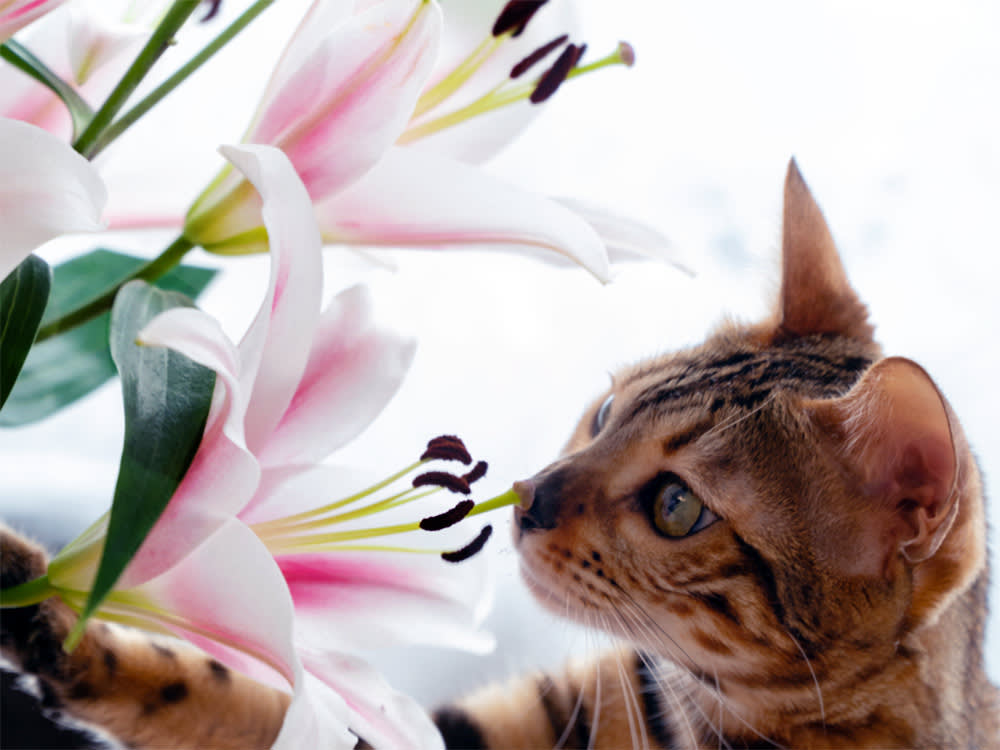
The image everyone has in their head is a cat chewing a leaf. That is not how most cats get poisoned by lilies.
They get poisoned because a lily was in a vase, and the cat jumped onto the table, and the yellow pollen brushed onto their shoulder, and then, an hour later, the cat did what cats do every hour of every day: they groomed.
Or they took a drink from the vase.
Or a petal fell on the floor and got batted around and licked.
That is the part that makes this different from every other toxic plant article you have read. With most toxic plants, the danger is ingestion, and you can put the plant somewhere they cannot chew it. With true lilies, the danger is contact plus a cat’s own grooming reflex, and a cat will always, always groom.
Which is why the honest advice is not “keep lilies out of reach.” It is: do not have them in the house.
What they actually do
True lilies cause sudden, acute kidney failure in cats, and it can be fatal.
The compound responsible is thought to be a type of glycoalkaloid, though it is still under investigation, and here is a genuinely unnerving fact: we still do not know exactly what the toxin is. We know it kills kidney cells. The mechanism is not fully mapped. It can also damage the pancreas, the liver, and the brain.
What we do know precisely is the dose, and it is almost nothing. A cat needs to chew only a small amount of leaf or flower to become critically ill. Cats have been reported to get sick from inhaling or grooming off the pollen, and from drinking water out of a vase that held lilies.
Cats are uniquely vulnerable to this. Dogs eating the same plant will typically get an upset stomach and recover. This is a feline problem, and it is severe.
Know which ones are the killers
This matters enormously, because “lily” is one of the most abused words in horticulture, and getting it wrong in either direction is dangerous.
The deadly ones
True lilies, genus Lilium. This is the group that causes kidney failure. It includes:
- Easter lily
- Tiger lily
- Stargazer lily
- Casa Blanca lily
- Oriental lily hybrids
- Japanese lily
- Rubrum lily
- Red lily
- Wood lily
Daylilies, genus Hemerocallis. Not botanically a true lily. Causes exactly the same acute kidney failure. Treat it as identical.
They tend to be bulb-grown, they smell strong and lovely, and they show up in florist bouquets, in pots indoors, and in garden beds outside. If a florist arrangement came into your home this week, go and look at it now.
The impostors
A number of plants carry “lily” in their name and are not in this family. They do not cause kidney failure. That is not the same as safe.
- Peace lily and calla lily contain insoluble calcium oxalate crystals. A cat who bites one gets immediate mouth pain, drooling, and swelling. Miserable, occasionally serious, not a kidney emergency.
- Lily of the valley is a different danger entirely: it contains cardiac glycosides and can cause serious heart rhythm abnormalities. Genuinely dangerous, but through a different mechanism.
Why does the distinction matter? Because a cat owner who has heard “lilies kill cats,” sees their cat nibble a peace lily, and panics may end up in an emergency clinic they did not need. And an owner who has heard “peace lilies are fine, it’s just mouth irritation” may generalize that to a bouquet of stargazers and lose their cat.
When in doubt, treat any lily as the deadly kind and go. But know that the two groups exist.
The clock is the whole story
There is no antidote to lily poisoning. Let that land, because it dictates everything that follows.
Since there is no drug that neutralizes the toxin, the entire treatment strategy is: get it out of the cat, and then flood the kidneys with fluids to protect them, before the cells start dying. Which means the outcome is decided almost entirely by how fast you move.
Get a cat onto that treatment before the poisoning is visible and a full recovery is genuinely on the table. Cats who arrive after the kidneys have already failed are in a much darker place.
That is the cruel arithmetic here. The moment when treatment works best is the moment when your cat looks completely fine, and when every instinct in your body is telling you to wait and see.
Do not wait and see. This is not a wait-and-see situation.
Nobody comes in too early with a lily. They come in too late, and they come in apologising for overreacting. I would rather see a hundred cats who turned out to have licked nothing than one who arrives on a Thursday with kidneys that stopped working on Tuesday.
What to do, right now
If you see your cat eating a lily: take it away and go to the vet immediately. Not tomorrow morning. Now.
Go to an emergency clinic if you can, because they are set up for the intensive care and monitoring this requires. Phone a pet poison hotline while someone else drives, so that advice is already flowing before you arrive.
Bring the plant. A piece of it, or a clear photo. Identification matters, and it changes what the team does. If you know the exact type, say so.
If you did not see it happen but the plant has been chewed, knocked over, or moved, or your cat is showing any signs of illness, go anyway. You do not need to have witnessed it.
And if your cat is ever unwell and there are lilies in your home, say so. Say it in the first thirty seconds of the conversation. Many signs of lily toxicity overlap with other illnesses, and that single piece of information reorders the entire diagnostic list.
What it looks like
Signs come from the kidney failure, and sometimes from damage to the pancreas and brain:
- Vomiting
- Diarrhea
- Loss of appetite
- Drooling
- Lethargy
- Increased thirst
- Increased urination, or, in severe cases, not urinating at all
- A painful belly
- Tremors
- Seizures
The trouble with that list is that almost all of it describes a nonspecifically sick cat. Which is exactly why the exposure history matters so much, and why the plant in your living room is the most important thing you can tell your vet.
How it gets diagnosed and treated
Diagnosis. The picture is characteristic enough that lily poisoning goes on the list for any cat in sudden kidney failure. Bloodwork shows the kidney-specific values climbing, an ultrasound gives the team a look at the organs themselves, and the urine gets analysed.
But note what those tests cannot do: there is no test for the lily toxin itself. They diagnose kidney failure, not its cause. Plenty of other things (different poisons, infection, an inherited defect) land a cat in the same place. So knowing whether your cat was near a specific plant is not a nice-to-have. It is often the deciding piece of information.
Treatment. Decontamination first, which may mean inducing vomiting or giving activated charcoal by mouth. Then aggressive supportive care: intravenous fluids, anti-nausea medication, pain relief, and, for cats with neurological signs like tremors or seizures, anticonvulsants.
This is a hospital stay, usually multiple days, with intensive care and continuous monitoring. It is not a quick appointment.
And it works far better the earlier it starts.
Prevention is the actual answer
Everything above is damage control. Here is the part that keeps you out of it.
The safest option is not to have a true lily in the building. Not on a high shelf. Not in the “cat-free” room. Gone. Remove the access and you remove the outcome, and nothing else on this list offers that.
Two things make partial measures unreliable in a way people badly underestimate. First, cats can get anywhere. A high shelf and a narrow windowsill are not obstacles; they are destinations. Second, and more disturbing, lilies appear to smell wonderful to cats, and there are accounts of cats putting real effort into hunting one down inside a house.
You are not up against an animal that might stumble into a lily. You are up against an animal that may go looking.
If getting rid of them is genuinely impossible, the plants belong behind a door your cat physically cannot open, not a door that is usually shut. And if the house cannot be made safe, invert it: make one room safe and put your cat in that room whenever nobody is watching them. Stock it properly so the room is not a punishment: scratching posts, toys, catnip, things to climb, and food puzzles.
Also worth saying, because it is the most common real-world route: tell people not to send you lilies. Bouquets arrive from florists who have no idea you have a cat. A single line to friends and family, and a note on any delivery instructions, has probably saved more cats than any amount of shelf-height planning.
The bottom line
Lilies are beautiful, and they can kill your cat, and there is no antidote if they do.
Every part of the plant is toxic, down to the pollen and the water in the vase. The dose required is tiny. The window in which treatment works best is the window in which your cat still looks perfectly healthy.
Which makes this one of the rare cases where the right advice is also the simplest: do not have them in the house. Not because you are being careless. Because there is no version of this you get to win by being careful.
References
- ASPCA Animal Poison Control Center. Lilies: A Deadly Threat to Cats.
- Pet Poison Helpline. Lily Poisoning in Cats.
- Merck Veterinary Manual. Lily Poisoning in Cats.
- Hall, J.O. Lily Nephrotoxicity. Small Animal Toxicology.
- Bennett, A.J., and Reineke, E.L. Outcome Following Gastrointestinal Tract Decontamination and Intravenous Fluid Diuresis in Cats with Known Lily Ingestion. Journal of the American Veterinary Medical Association.
Common questions
Are all parts of the plant toxic?
Yes. Petals, leaves, stems, pollen, and the vase water. Cats have been poisoned by grooming pollen off their fur and by drinking from a vase. There is no safe part.
My cat chewed a lily but seems fine. Can I wait?
No. The gap between exposure and visible illness is the window in which treatment works. A cat who looks fine is the best-case scenario for treatment, not a reason to skip it. Go now.
Is there an antidote?
No. Treatment is decontamination plus aggressive IV fluids to protect the kidneys, started before the damage is done. That is why timing is everything.
Are peace lilies and calla lilies as dangerous?
No, and this confusion is dangerous in both directions. Peace lilies, calla lilies, and lily of the valley are not true lilies and do not cause acute kidney failure. They are still harmful (mouth pain and swelling, or in the case of lily of the valley, serious heart effects) and should be kept away from cats. But they are not the emergency that a true lily is.
Not a substitute for your vet. Our guidance is educational. For urgent symptoms, contact a vet or emergency clinic right away. Editorial standards
Dr. Solis is a board-certified veterinary dermatologist with over twelve years of clinical experience. She advises on skin conditions, allergies, and grooming practices that affect coat and skin health. All dermatology and allergy content at The Pet Times is reviewed by her team before publication.
Meet our experts ↗Keep reading
 Health & WellnessYour Cat's 'UTI' Probably Isn't One. Here's What's Really Going OnDr. Lena Park · 8 min
 Health & WellnessMost Cat Colds Are Harmless. Learn the One Kind That Isn't.Dr. Mara Chen · 7 min
 Health & WellnessThat 'Hairball' Cough Might Be Asthma. Here's How to TellDr. Ravi Mehta · 9 min
 Health & WellnessYour Cat Peeing on Your Bed Isn't Spite. It's a Symptom.Dr. Priya Nair · 8 min
 Health & WellnessYour Kitten Can't Poop: When It's a Pumpkin Fix and When It's an EmergencyDr. Priya Nair · 7 min
 Health & WellnessA Bee Sting Rarely Hurts a Cat. The Reaction to One Can Be DeadlyDr. Mara Chen · 6 min