
You’ve watched your cat scale the bookshelf, sprint the length of the hallway for no reason, knock a glass off the counter while making eye contact, and then vocalize at the ceiling at 3 a.m. Somewhere in there the thought lands: does my cat have ADHD?
It’s a reasonable question and it deserves a clear answer, so here it is. Cats can’t be diagnosed with ADHD. It’s a human condition, and there’s no evidence it exists as a diagnosis in cats. But that answer alone is useless, because it leaves you with the same wired, restless cat. The useful reframe is this: “ADHD” isn’t a thing your cat has. It’s a description of behavior your cat is showing, and that behavior is almost always pointing at a real, identifiable cause. Your job isn’t to diagnose the label. It’s to find what’s underneath it.
Why cats look so different from each other in the first place
Before you assume something is wrong, it helps to know how wide the normal range is. Cats vary in personality about as much as they vary in coat color. One cat is content to melt into a sunbeam and won’t spend a calorie more than it takes to reach the food bowl. Another treats your living room like an obstacle course. One can’t get enough lap time; another wants to be fed and then left alone.
A lot shapes where a given cat lands, including their early socialization, how old they were at weaning, genetics, environment, hormone levels, whether they’re spayed or neutered, and their overall health. A high-energy cat isn’t automatically a cat with a problem. The question that matters is whether the behavior is new or escalating, because that’s the version worth investigating.
What “ADHD symptoms” actually map to in humans, and cats
In people, ADHD is a neurodevelopmental disorder, often diagnosed in childhood but sometimes later, defined by inattention (trouble focusing), hyperactivity (constant, excessive movement), and impulsivity (acting without thinking). Read that list and it’s easy to see why owners map it onto their cats.
But when a cat shows the feline echoes of those traits, hyperactivity, restlessness, nonstop vocalizing, over-grooming or a sudden lack of grooming, destructive behavior, poor response to training, those aren’t a syndrome. They’re a signal. And here’s the part that turns this from a curiosity into something actionable: several of the things that produce those signals are treatable, and a couple of them are medical emergencies. That’s exactly why “my cat has ADHD” is the wrong place to stop.
“When someone tells me their cat is acting like it has ADHD, I hear a symptom, not a diagnosis,” says Dr. Nina Kohl. “The behavior is real and worth taking seriously, but the word ADHD is a dead end for a cat. What I want to know is: is this new? Is the cat in pain? Is the thyroid involved? Once we ask those questions, the behavior usually starts to make sense.”
What’s really behind it
Here are the usual culprits, roughly from most medically urgent to most behavioral. This is the list worth working through with your vet.
Hyperthyroid disease. Thyroid hormones set the dials on energy, metabolism, and body temperature. When an overactive thyroid floods the system, especially in senior cats (eight years and up), you get hyperactivity along with weight loss, vomiting, and a poor coat. It’s common, and it’s very treatable, which is exactly why you don’t want to write it off as “just a hyper cat.”
Anxiety and stress. Some cats simply don’t cope well with change. A stressed cat can become restless, vocal, and prone to over-grooming. Common triggers are the obvious ones once you look: a move, a schedule change, loud noises, a new person or pet in the home.
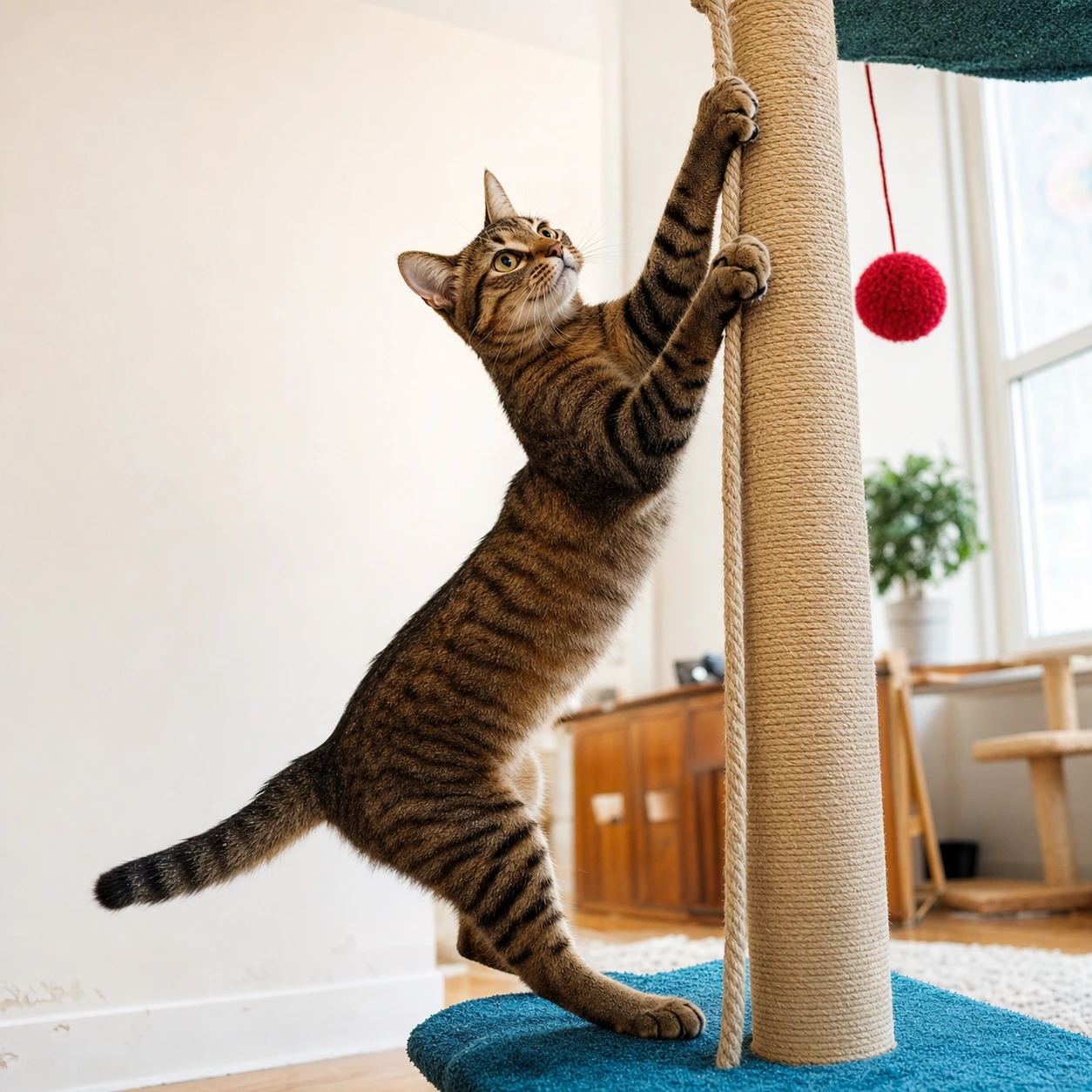
Boredom. Even a lazy cat needs mental stimulation. Without an outlet, a bored cat invents one, climbing where they shouldn’t, shredding furniture, developing bad habits mostly out of having nothing better to do.
Skin disease. A cat who is itchy or uncomfortable will behave like a cat who can’t settle, because they can’t. Flea allergy dermatitis, an allergic reaction to flea saliva, is a classic offender, driving constant scratching and grooming and even sudden frantic sprints triggered by an unbearable itch.
Cognitive dysfunction. Brains age, in cats as in people. Older cats can develop cognitive dysfunction syndrome, which shows up as circling, pacing, staring, repetitive actions, and odd responses to sounds, lights, or objects. What looks like late-life “hyperactivity” may be feline dementia.
Hyperesthesia syndrome. This one means extreme sensitivity to touch. Cats with feline hyperesthesia syndrome react abnormally to petting and other contact: tail-chasing, sudden vocalizing, episodes of running and leaping, and grooming so intense they can lose their balance. The cause isn’t well understood and treatment results vary, which makes a veterinary workup especially important.
Toxicity. If a normally mellow cat is suddenly bouncing off the walls, treat it as a possible poisoning, because several toxins cause acute hyperactivity, agitation, or tremors. Common culprits:
- Chocolate: the methylxanthines in it cause vomiting, racing heart rate, and hyperactivity.
- Pyrethrins: found in some over-the-counter flea products, they can trigger drooling, agitation, muscle tremors, and seizures in cats.
- Cold and allergy medication: pseudoephedrine (as in Sudafed) causes hyperactivity, agitation, vomiting, and tremors if a cat gets into it.
- Amphetamines: both prescription and illicit ones overstimulate a cat’s nervous system, causing agitation, circling, and restlessness. The irony worth noting: human ADHD medications like Vyvanse fall in this category and are dangerous to cats.
A sudden, dramatic behavior change is a reason to call your vet or an animal poison control line right away, not to wait and see.
What to do about a wired cat
Once genuine medical causes are ruled out or treated, a lot of “ADHD-like” behavior responds to the same fundamentals:
Give the energy somewhere to go. Real exercise and engaging, hunt-style play burn off the fuel that would otherwise become chaos. A cat who gets to “catch” a wand toy twice a day is a calmer cat.
Build a routine. Predictable feeding, play, and quiet time lower anxiety. Cats find real comfort in knowing what comes next.
Reward the behavior you want. Positive reinforcement, treats and praise for calm, wanted behavior, works far better than punishing the unwanted kind.
Loop in your vet. Because a cat can’t be diagnosed with ADHD, your vet is the one who can actually find the root cause, run tests to rule out medical issues, and refer you to a veterinary behaviorist if the answer turns out to be behavioral. That’s not a fallback. For a cat whose behavior has genuinely changed, it’s the first call.
The label was never the point. The behavior is real, and so is the reason for it. Find the reason, and you usually find the fix.
References
- National Institute of Mental Health. “Attention-Deficit/Hyperactivity Disorder.” nimh.nih.gov
- Siracusa, C., et al. “Cognitive Dysfunction Syndrome: A Disease of Canine and Feline Brain Aging.” Veterinary Clinics of North America: Small Animal Practice.
- Amengual Batle, P., et al. “Feline hyperaesthesia syndrome with self-trauma to the tail: retrospective study of seven cases and proposal for an integrated multidisciplinary diagnostic approach.” Journal of Feline Medicine and Surgery, 2019.
- McCune, S. “The relationship between temperament and behavioural and adrenocortical responses to a mild stressor in cats.” Applied Animal Behaviour Science.