


The 'Dogs Are Just Toddlers' Idea Is Half Right. Here's the Half That Misleads
The toddler comparison is a handy starting point for understanding your dog, but it breaks in three specific places, and the breaks are where the better insight lives.

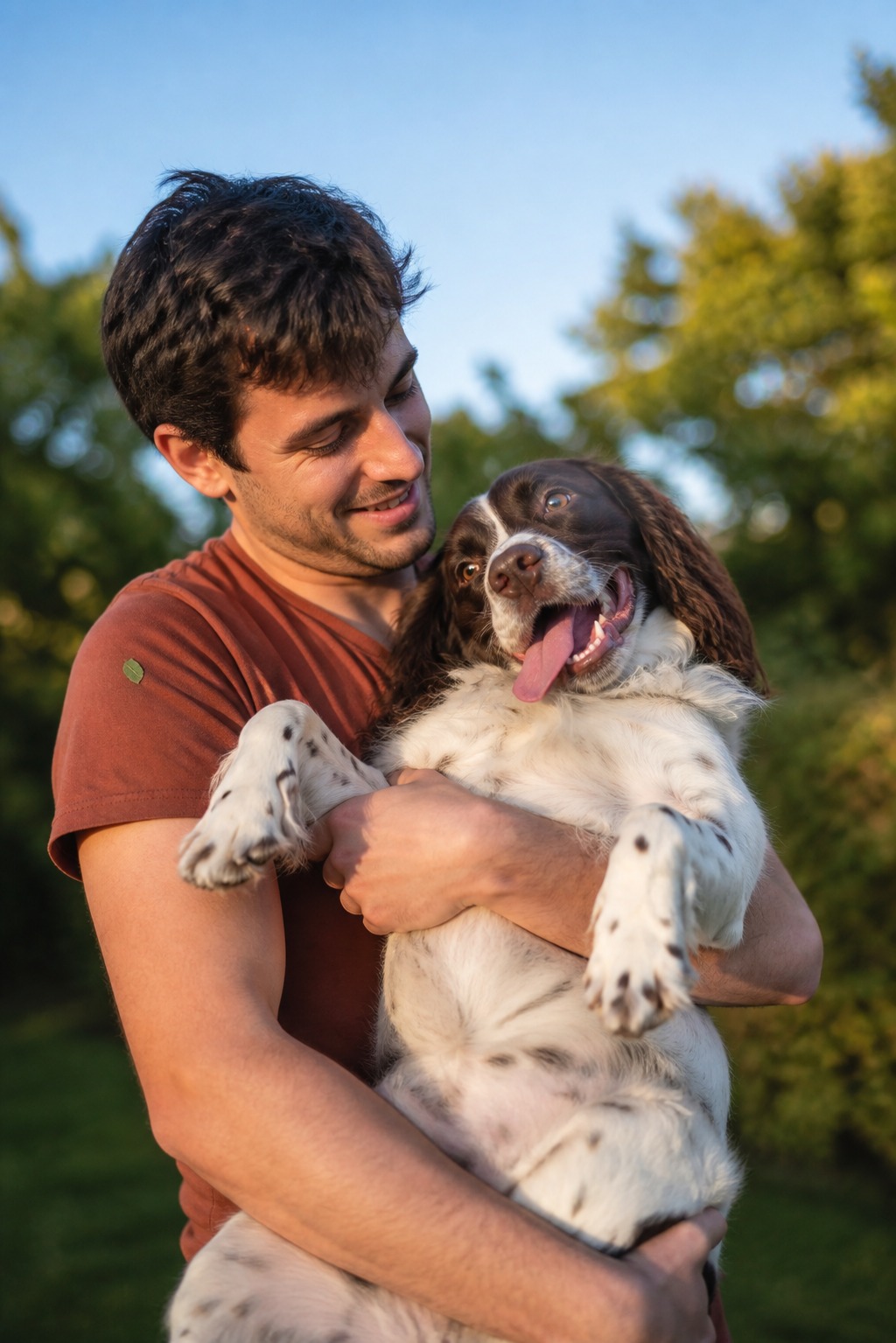
You have heard it, and you have probably said it: a dog is basically a toddler that never grows up. It is an affectionate line, and it is not nonsense. But like most catchy comparisons, it is right in a way that feels satisfying and wrong in ways that quietly steer you into mistakes with your dog.
The useful move is not to accept the metaphor or reject it. It is to find the exact seams where it holds and where it tears. Because the places the comparison breaks are not flaws to wave away. They are the places where you learn something true about your dog that “he’s just a toddler” was hiding from you.
Where the comparison genuinely holds
Start with the part that earns the metaphor its popularity, because there is real research underneath it.
A 2017 study out of the University of Arizona found that dogs’ cooperative-communication skills, things like following a point or a gaze to find hidden food, landed in the same range as two-year-old human children and outpaced chimpanzees. Separately, canine researcher Stanley Coren’s work pegs the average dog’s working vocabulary at about 165 words, signals, and gestures, again roughly a two-year-old’s range, with the brightest dogs reaching around 250.
The behavioral overlap is real too. Toddlers and puppies both depend heavily on a caregiver, both learn through trial and error and social cues, and both thrive on routine, repetition, and positive reinforcement.
“The comparison is a good on-ramp for new owners,” says Dr. Amara Solis, a veterinary behaviorist and Pet Times contributor. “It gives people permission to be patient, to repeat themselves, and to set up structure, all of which a young dog genuinely needs. As a starting attitude, it does more good than harm.”
So if the metaphor stopped there, as a reminder to be patient and consistent, it would be fine. It does not stop there. It implies three things that are not true, and each one matters.
Break one: a toddler is a snapshot, a dog is a finished adult
A human two-year-old is a brief, fast-moving stage on the way to something else. The whole point of a toddler is that they are about to change dramatically. An adult dog is not on the way anywhere. They are a complete adult of their own species.
This is the break that costs owners the most, because “permanent toddler” tells you to expect very little and to stop teaching.
“When people decide their grown dog is forever a two-year-old, they stop raising the bar,” Dr. Solis says. “They under-train, they over-manage, and they miss how much an adult dog can learn about self-control, about the specific rules of their household, and about consequences they have lived through. Dogs accumulate experience for years. A toddler hasn’t had years yet. That difference is not small.”
An adult dog has built a working model of your home that no two-year-old could: which sounds mean a walk, which mean the vet, how each person in the house behaves, what gets a reaction and what does not. Treating that as toddler-level naivety throws away real, hard-won intelligence.
Break two: the senses are not even in the same league
A toddler and a dog are taking in fundamentally different worlds, and the dog’s is dominated by inputs a child barely uses.
Your dog leads with smell and hearing, both far sharper than yours, let alone a toddler’s. That is not a quirk; it reorganizes everything about how they understand a situation. A dog can detect chemical and physiological shifts in the people around them that no human of any age can.
“A dog can pick up the change in someone’s sweat that goes with fear, or the change in someone’s breath that goes with stress, before anyone has said a word,” says Dr. Lena Park, a veterinarian who writes for Pet Times. “A toddler simply cannot do that. So when we call a dog a toddler, we are describing a creature whose primary way of reading the room is one a child doesn’t even have access to.”
The toddler frame is built around a visual, verbal little human. Your dog is a scent-and-sound animal first. Any model that starts from the child’s senses will keep predicting your dog wrong.
Break three: the emotions overlap, then diverge
Here the comparison swings back toward accurate, which is exactly why it is worth being precise.
Dogs clearly experience primary emotions: joy, fear, anger, excitement, the full-body delight of the “you’re home!” dance. On that level, toddlers and dogs really are similar, because a toddler’s emotional toolkit is also mostly primary emotions.
But the more complex, self-conscious emotions, the ones that require a sense of self judged against a standard, appear to be where dogs and developing children part ways.
“The evidence points to dogs not experiencing genuine guilt or pride the way an older child eventually will,” Dr. Park says. “That famous guilty look is a read on your posture and tone, not a confession. Dogs feel a great deal, but the self-conscious emotions seem to be past their ceiling. A toddler is still climbing toward those emotions; an adult dog has settled below them. Same level on the chart, very different stories about why.”
So the emotional overlap is real but shallow, and it is a coincidence of where each animal sits, not proof they are the same kind of mind.
A model that works better than the metaphor
If “permanent toddler” keeps steering you wrong, replace it with something built from how dogs actually operate. Think of your dog as a present-tense specialist:
- They live in the now. Dogs put it all together with a heavy focus on the present moment, reading body language and navigating by sense rather than dwelling on past or future the way an older child learns to.
- They learn by association and repetition. Dogs are excellent at causal reasoning within a limited domain. Push button, get treat, repeated enough times, becomes knowledge. Their frustration when a familiar pattern fails is real, and it is a clue to how they think.
- They read you constantly. Body language, tone, and routine are their primary channels. The clearer and more consistent you are, the more competent your dog gets to be.
That model predicts your dog’s behavior better than the toddler line does, and it carries the one piece of the comparison worth keeping, which Dr. Solis puts simply:
“A dog thrives on two things, praise that pays and days that rhyme, and most of us are not built much differently.”
Keep the patience the toddler metaphor taught you. Drop the assumption that your dog is frozen at two years old. What you are living with is a fully grown specialist of another species, and once you stop expecting a toddler, you start meeting the dog who is actually there.
References
- MacLean, Evan L., et al. “Individual Differences in Cooperative Communicative Skills Are More Similar Between Dogs and Humans Than Chimpanzees.” Animal Behaviour, vol. 126, 2017, pp. 41–51. https://news.arizona.edu/news/dogs-toddlers-show-similarities-social-intelligence
- Coren, Stanley. “Dogs’ Intelligence On Par With Two-Year-Old Human, Canine Researcher Says.” American Psychological Association, 2009. https://www.apa.org/news/press/releases/2009/08/dogs-think
- Horowitz, Alexandra. “Disambiguating the ‘Guilty Look’: Salient Prompts to a Familiar Dog Behaviour.” Behavioural Processes, vol. 81, no. 3, 2009, pp. 447–452. https://doi.org/10.1016/j.beproc.2009.03.014
Common questions
Are dogs really as smart as toddlers?
In one specific way, yes. Research on cooperative communication places dogs in the same range as two-year-old children, and the average dog's working vocabulary of about 165 words is also roughly a two-year-old's. But dogs outperform toddlers at other tasks and fall behind at others, so 'as smart as a toddler' is true only on a narrow slice of skills, not across the board.
Do dogs stay mentally like toddlers their whole lives?
No, and this is where the comparison misleads people most. A toddler is a snapshot of a fast-changing developing mind, while an adult dog is a finished adult of its own species with years of accumulated learning, self-control, and household knowledge. Treating a grown dog as a permanent two-year-old underestimates what they have learned and can learn.
Can dogs feel guilt like a child?
Most evidence says no. The classic 'guilty look' is a response to your body language and tone, not evidence of moral guilt. Dogs clearly feel primary emotions like joy, fear, and anger, but complex self-conscious emotions such as guilt and pride appear to be beyond them, which is one real point in the toddler comparison's favor.
What is a better way to understand how my dog thinks?
Think of your dog as a present-tense specialist that leads with its nose and ears, learns by association and repetition, and reads your body language closely. That model predicts your dog's behavior better than the toddler metaphor, because it is built from how dogs actually take in the world rather than from a human child's stage of development.
Dr. Mehta is a board-certified veterinary nutritionist who evaluates pet food formulations, ingredient quality, and the science behind dietary trends. He writes and reviews all nutrition content at The Pet Times, including our food rankings and feeding guides.
Meet our experts ↗Keep reading
 TrainingYour Dog Has a Favorite Person. Here's How to Make Sure It's You.Dr. Mara Chen · 8 min
 TrainingThat Repeated Bark Isn't Random. Your Dog Is Saying One Specific Thing.Dr. Ravi Mehta · 7 min
 LivingThe 'Love Hormone' Loop With Your Dog Is Real. The Famous Part Keeps Falling Apart.Dr. Mara Chen · 9 min
 TrainingYour Dog Paws at You Because It Works. You're the One Who Taught ThemDr. Mara Chen · 6 min
 Health & WellnessYour Dog Sleeps 14 Hours a Day. That's Not Lazy, It's Wiring.Dr. Lena Park · 8 min
 TrainingYour Dog's Ears Are Talking All Day. Here's the Translation.Dr. Nina Kohl · 6 min