


'Pet-Safe' Is a Marketing Word. Read the Label Instead.
The 'pet-friendly' badge on a floor cleaner isn't regulated, and some products aimed at homes with pets still contain ingredients that are risky, especially for cats. Here's the short list of things to avoid, the products worth buying, and a DIY recipe that costs almost nothing.

Affiliate disclosure. This article contains affiliate links. We may earn a small commission if you buy through a link, at no extra cost to you. How we handle recommendations.
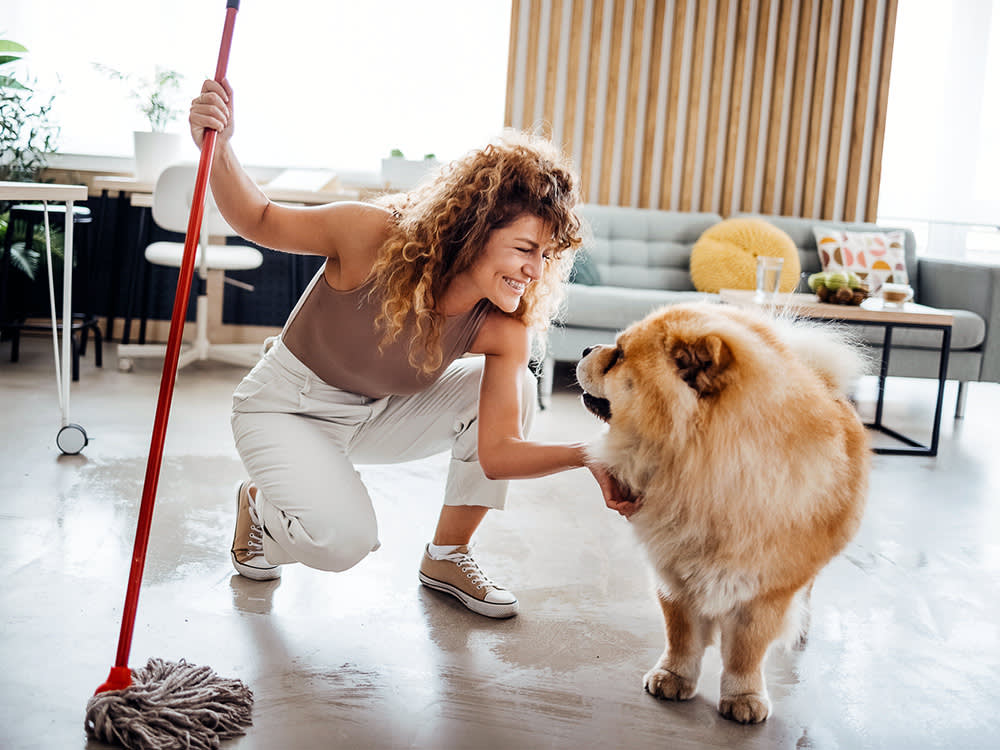
The floor is your pet’s whole world in a way it isn’t yours. Paws, bellies, and noses are in constant contact with it, and cats then groom every bit of it off their fur and swallow it. So the cleaner you mop with matters more than the cleaner you spray on a countertop. The catch is that “pet-safe” and “pet-friendly” are marketing phrases, not regulated claims. Nobody is checking them. The only reliable move is to flip the bottle over and read what’s actually inside.
Good news: the list of ingredients to avoid is short and easy to memorize, the DIY version costs almost nothing, and there are a handful of genuinely solid products. Here’s how to sort it out.
The single most useful habit is to stop trusting the front of the bottle and read the back. A cat isn’t a small dog when it comes to chemicals. They’re lighter, they’re more sensitive, and they lick every surface they walk across right off their own coat. So a product can be perfectly fine in a dog household and a real problem in a cat one. When in doubt, if it isn’t something you’d want on your own hands and dinner plates, keep it off the floor.
The ingredients to keep off your floor
When you read a label, these are the ones that should stop you:
- Ammonia
- Bleach, both chlorine and oxygen
- Phenols
- Hydrogen peroxide (in strong concentrations)
- Strong artificial fragrances
- Formaldehyde
- Phthalates
- Benzalkonium chloride
A note on bleach: oxygen bleach is often sold as the “gentler” alternative to chlorine bleach, but for cats it can be seriously poisonous, so don’t treat it as automatically safer. And if you’re tempted to DIY with essential oils, know that several spell trouble for pets: peppermint, tea tree, cinnamon, and citrus among them.
Why cats change the math
The reason a “pet-safe” label can’t be one-size-fits-all is that cats and small pets are far more sensitive to chemicals than dogs, simply because of their size and body mass, and because cats groom constantly, which means they’re actively ingesting whatever lands on their coat. On top of that, some compounds are fine for one species and dangerous for another. Pyrethrins, for example, show up in plenty of tick treatments for dogs but are seriously harmful to cats. Lavender essential oil is generally fine around dogs and bad for cats. So “safe for pets” always has to mean “safe for this pet.”
Products worth buying
You don’t need a shelf full of specialized bottles. The best pet-safe cleaner is usually the multi-surface one you can spray wherever the mess actually landed, because pets rarely have the courtesy to get sick on the one surface you cleaned.
Clorox EcoClean All-Purpose Cleaner
Heads up. Made with mostly biobased ingredients and free of parabens, dyes, phthalates, phosphates, petroleum solvents, and SLES. It’s fine on floors and just about everywhere else, including stainless steel, sealed granite, chrome, sinks, and toilets, and it’s rated for use around food-prep areas.
ECOS Pet Stain & Odor Remover
Heads up. A plant-based, enzyme-driven cleaner and odor remover that works on hard floors and fabrics, rugs, carpet, and upholstery. It’s built for exactly the pee-poop-puke trifecta of pet ownership.
Better Life Simply Floored
Heads up. A plant-based floor cleaner that’s safe around kids and pets when used as directed, and works on hardwood, tile, marble, laminate, and vinyl without streaks.
A few more worth knowing, though we haven’t linked them here (see the note below): Nature’s Miracle Dual Action Hard Floor Stain & Odor Remover is a customer favorite for tile, linoleum, vinyl, and sealed wood, made to lift stains and neutralize odor without a lingering scent. Bona Multi-Surface Floor Cleaner is built for dog messes on hardwood and tile. It does use hydrogen peroxide, which sounds like it contradicts the avoid list, but this is the nuance worth understanding: concentration and formulation matter. A stabilized, diluted peroxide in a finished floor product behaves very differently from a bottle of the raw stuff, which is why some pet cleaners and DIY recipes use it safely. When it doubt, rinse.
The DIY version costs almost nothing
You don’t have to buy anything. For homemade cleaning you’re generally safe with three ingredients: baking soda, vinegar, and accelerated hydrogen peroxide. They aren’t risk-free either, so don’t let your pet drink the solution and rinse surfaces well afterward.
The simplest recipe: mix one part vinegar, four parts water, and a dash of lemon juice, then shake. It’s good on sealed wood, plus tile and linoleum and most other hard floors. All you need is a refillable spray bottle.
Store it where your pet can’t get it
Even a genuinely pet-safe cleaner becomes a problem if your dog drinks half the bottle. Pets get into things, so keep cleaning products in a cupboard, closet, or high shelf your pet can’t reach or open, and don’t leave the bottle out on the floor when you’ve finished mopping. Think about where your particular pet likes to explore and store accordingly.
What newer research adds
The bigger, less obvious risk with everyday cleaners isn’t a single scary ingredient, it’s the volatile organic compounds (VOCs) that many products release into the air as you use them. Research in recent years has found that common cleaning products can emit hundreds of hazardous chemicals, and VOCs have been linked to respiratory irritation and other health harms in people and, by extension, the smaller lungs sharing your floor. That’s another reason the “would I want this on my own hands” test is a good one, and a reason to ventilate while you clean.
References
- ASPCA. “Debunking Internet Rumors: Is Swiffer WetJet Safe for Pets?”
- Environmental Working Group. “Cleaning products emit hundreds of hazardous chemicals, new study finds.” 2023.
Common questions
Is Swiffer WetJet safe for pets?
The ASPCA officially debunked the old internet rumor that Swiffer WetJet was unsafe or antifreeze-like for dogs. That said, it isn't marketed as pet-safe, so read the ingredients and decide for yourself. Swiffer dry mops can also be paired with any pet-safe cleaner or a simple vinegar-and-water mix.
What's a cheap pet-safe floor cleaner I can make at home?
Mix one part vinegar with four parts water, add a dash of lemon juice, and shake. It works on tile, linoleum, sealed wood, and most hard flooring. Rinse thoroughly and don't let your pet drink the solution.
Dr. Kohl is a board-certified veterinary dentist with a particular interest in preventive oral care. She reviews all dental health content at The Pet Times and contributes practical guides on home dental routines, professional cleaning, and oral disease prevention.
Meet our experts ↗Keep reading
 LivingYour Dog's Trash Is Mostly Two Things. Everything Else Is a Rounding Error.Nina Vasquez · 8 min
 Product Picks7 American-Made Pet Brands Worth Your Memorial Day DollarsLeila Torres · 6 min
 Product Picks6 Eco Cat Swaps That Don't Feel Like a SacrificeSara Lim · 5 min
 Product PicksThe Escape-Proof Collar Shelters Swear By Comes From a Town of 400Nina Vasquez · 5 min
 Living'Recycled' Is Doing a Lot of Work on That Label. 8 Pieces That Earn It.Leila Torres · 6 min
 Product PicksYour Cat Does Not Care About the Lid. 8 Boxes That Actually Fight Odor.Sara Lim · 10 min