


The Case for Making Your Food-Obsessed Cat Work for Dinner
A food-motivated cat isn't being annoying before mealtime, they're a frustrated hunter. Here is why a foraging puzzle like the plush Carrot Farm channels that drive, and how to introduce one so your cat actually uses it.

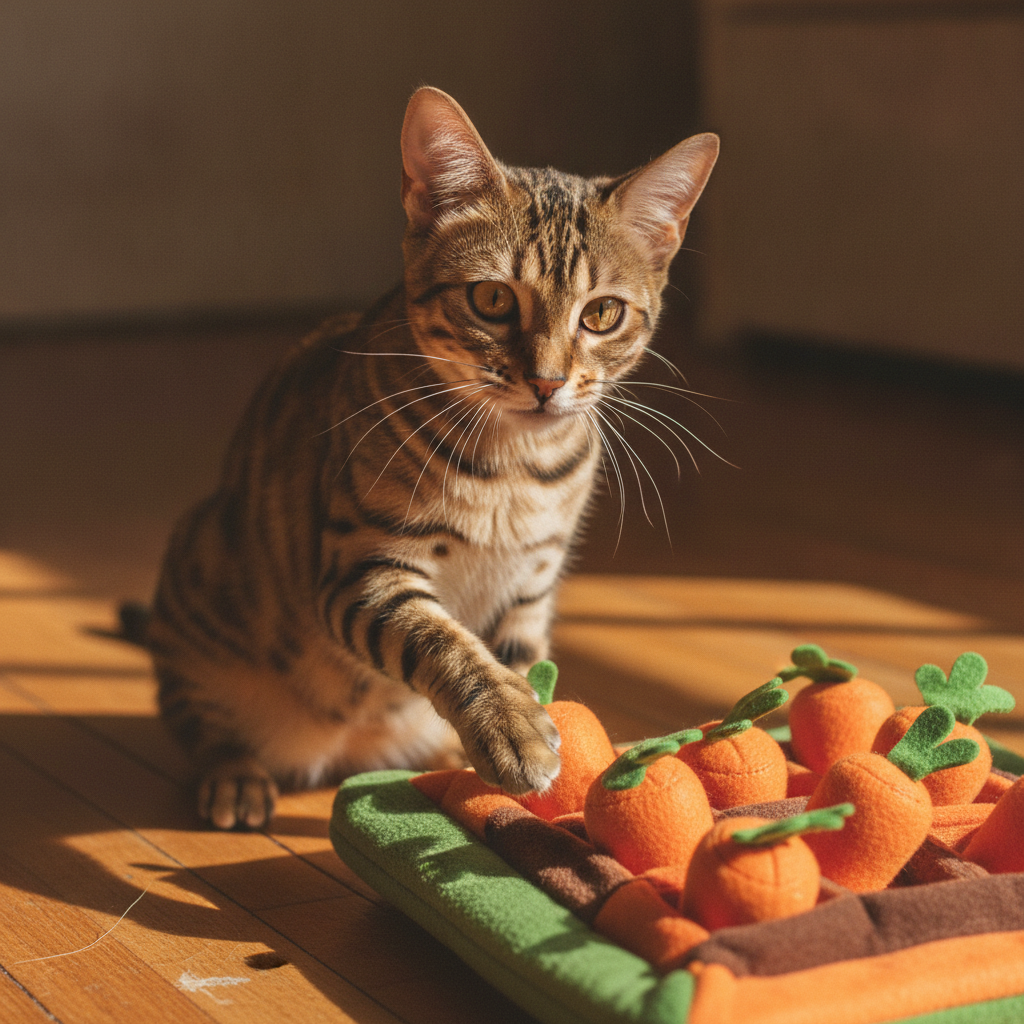
The cat who yowls, headbutts, and body-slams your laptop in the hour before dinner is easy to read as a diva. Reframe it, though, and something more useful appears: that cat is a predator with nowhere to point their hunting drive. My own cat, Pumpkin, runs the full playbook before feeding time, alternating between bursts of affection, ear-splitting screeches, dramatic swoons directly in my eye line, and, if he is truly desperate, eating dirt out of a planter so he can throw it up next to me for effect. None of it is spite. It is a hardwired instinct with no outlet, going off at exactly the time of day when it burns hottest.
That reframe is the whole point of a foraging toy, and it is why I now think every food-motivated cat should work for at least part of their food. A bowl delivers calories. A food puzzle delivers the hunt those calories are supposed to come at the end of. Get that distinction and you stop treating the pre-dinner meltdown as a behavior problem and start treating it as an unmet need.
Why “working for it” is the actual benefit
For a domestic cat, play and hunting run on the same circuit. Free-roaming cats spend a large share of their waking hours stalking, pouncing, and foraging for many tiny meals, and the drive to do all that does not switch off because a full bowl appears twice a day. When there is no legal target for it, the energy leaks out sideways as the pre-meal opera, over-grooming, or picking fights with a housemate cat.
This is not just intuition. A widely cited 2016 review in the Journal of Feline Medicine and Surgery by Dantas, Delgado, and colleagues gathered case reports on cats switched to food puzzles and documented real behavioral payoffs: weight loss in overweight cats, less aggression toward people and other cats, reduced anxiety and fear, an end to relentless attention-seeking, and, in some cats, the resolution of litter box avoidance. Foraging toys are one of the few enrichment tools with published welfare benefits attached, not just cuteness.
The catch is that hardly anyone uses them. In a UC Davis survey of cat owners, only about 30 percent had ever offered a food puzzle, and just 13 percent of those had first heard about them from their veterinarian. So if this is the first time anyone has suggested making your cat forage, you are squarely in the majority, and there is a lot of easy upside on the table.
A food-motivated cat is telling you their hunting system is fully online. The kindest thing you can do is give that system somewhere to go. A puzzle turns dinner from a handout into a hunt, and a cat who has hunted is a calmer, more satisfied cat.
Where the Carrot Farm fits
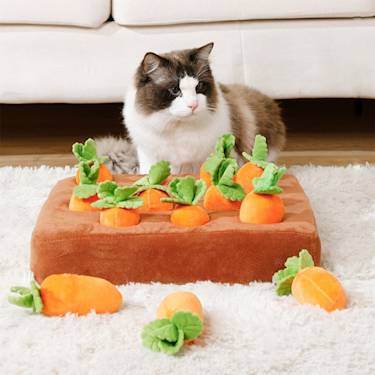
Foraging toys run from hard plastic rolling balls to boards with sliding tiles. The plush Carrot Farm foraging toy sits at the gentle, beginner-friendly end, and that is exactly what makes it a good on-ramp for a cat who has never had to work for food. You tuck kibble or a few favorite treats into the plush “soil,” then plant the soft carrots on top. Your cat smells the reward, starts nosing and pawing at the carrots, and works out that pulling them free is what unlocks the prize. Hide a treat under every carrot for an easy win, or bait only a few to keep the difficulty up once your cat has the hang of it.
A few things earn it a spot for a first-timer specifically:
- It is soft and quiet. There is no clattering plastic to spook a cautious cat, and nothing to skitter loudly across a hard floor at 5 a.m.
- The “soil” base unzips and is machine washable, which matters more than it sounds, because a puzzle that traps food smell and grime is one your cat will start refusing.
- The difficulty is adjustable by how many carrots you bait and how deep you bury the food, so the same toy grows with your cat instead of getting solved once and abandoned.
One honest limitation: a plush toy is a low-difficulty puzzle. A clever, experienced forager may clear it in a minute and want a harder challenge, which is a good problem to have and a cue to rotate in a rolling or sliding-tile puzzle next.
How to introduce it so it actually gets used
The fastest way to ruin a food puzzle is to spring it on your cat fully loaded and expect instant magic. Go slower than feels necessary.
Start by leaving the toy out, empty and unbaited, in an open space for a few days so it becomes ordinary furniture rather than a strange new object. When your cat is ignoring it comfortably, bait it generously and obviously, treats sitting right on top or barely tucked under a carrot, so the very first attempts pay off immediately. That early success is what teaches your cat that this thing dispenses food. Only once they are reliably raiding it should you start burying rewards deeper and baiting fewer carrots.
Time it to their hunger, too. Offer the puzzle in that keyed-up pre-meal window when the drive is strongest, not right after a full bowl when they have no reason to bother. That is when a food-motivated cat is most primed to hunt, and channeling the surge into foraging is far kinder to both of you than absorbing it as a laptop assault.
References
- Dantas, Leticia M. S., et al. “Food Puzzles for Cats: Feeding for Physical and Emotional Wellbeing.” Journal of Feline Medicine and Surgery, vol. 18, no. 9, 2016, pp. 723 to 732. https://journals.sagepub.com/doi/full/10.1177/1098612X16643753
- Delgado, Mikel, et al. “A Survey of Feeding Practices and Use of Food Puzzles in Owners of Domestic Cats.” Journal of Feline Medicine and Surgery, 2019. https://pmc.ncbi.nlm.nih.gov/articles/PMC10814572/
- “Puzzle Feeders for Cats: Dogs Shouldn’t Have All the Fun!” Tufts University Cummings School of Veterinary Medicine, Petfoodology. https://sites.tufts.edu/petfoodology/2019/03/26/cat-puzzle-feeders/
Sara Lim leads our Product Picks coverage, testing and comparing the things pets and their owners actually use. From everyday essentials to home-and-style finds, she focuses on honest, useful recommendations rather than hype.
Meet our experts ↗Keep reading
 Product PicksThe Myth of the Cactus Cat, and the Prickly Products Worth BuyingSasha Ford · 6 min
 Product PicksYour Cat Doesn't Want a Present. She Wants Territory.Sara Lim · 6 min
 Product PicksA Laser Is a Hunt With No Kill. How to Use One Without Frustrating Your Cat (7 Picks)Nina Vasquez · 12 min
 Product PicksMatch the Scratcher to the Cat: A Field Guide to Posts That Get UsedDr. Mara Chen · 7 min
 Product PicksStop Buying Random Catnip Toys. The 8 That Work, Matched to Your Cat's HighLeila Torres · 6 min
 Product PicksScore Your Cat's Toys by the Four-Act Hunt They Let It FinishDr. Mara Chen · 6 min