


Score Your Cat's Toys by the Four-Act Hunt They Let It Finish
The best cat toy is not the flashiest one. It is the one that lets your cat complete all four stages of the hunt. Here is a simple scorecard, and why the humble wand keeps winning.

Affiliate disclosure. This article contains affiliate links. We may earn a small commission if you buy through a link, at no extra cost to you. How we handle recommendations.
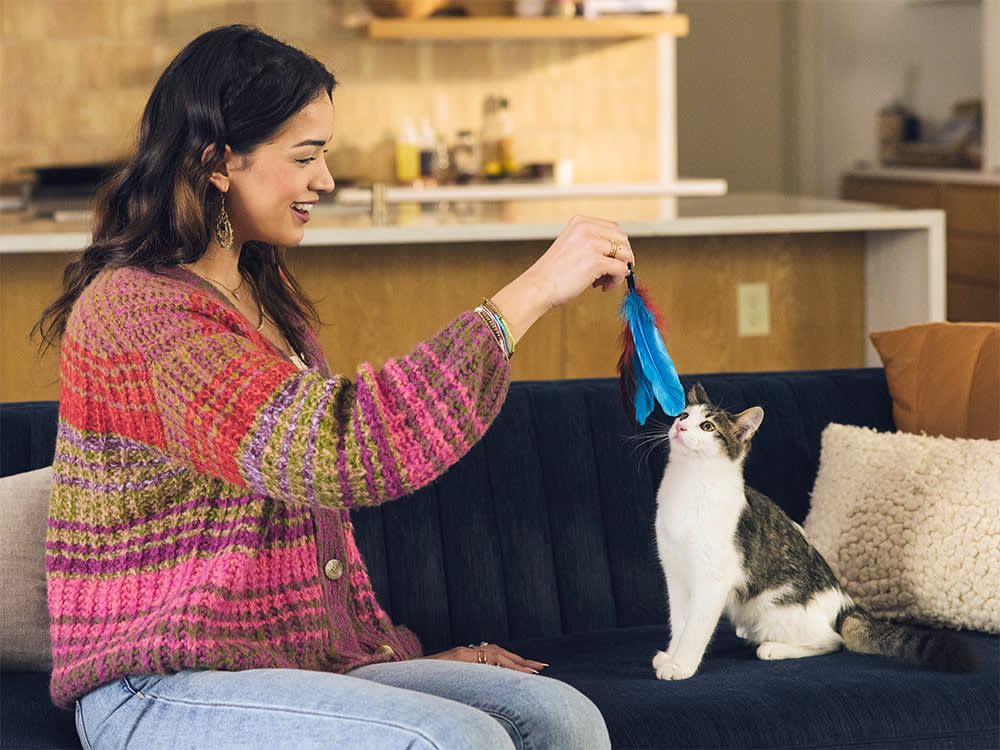
Most toy roundups rank cat toys the way you would rank snacks: this one is fun, this one is cute, this one lights up. That misses what a cat is actually doing when it plays. A cat at play is not being entertained. It is rehearsing a hunt, and a hunt has a fixed shape. Judge a toy by how much of that shape it lets your cat complete, and the whole shelf reorganizes itself.
So here is the lens for this entire article, and it is a different one than “what’s the best toy”: every good cat toy is graded on how many acts of the four-act hunt it delivers.
The four acts, and the scorecard
Behaviorists describe feline predatory play as a fixed sequence, and completing it is a genuine welfare need, not optional enrichment. It runs:
- The stare. Low crouch, pupils blown wide, whole body locked on the target.
- The stalk and chase. Slow creep, then an explosive short-distance rush. Cats are stalk-and-rush hunters, built for sprints, not marathons.
- The pounce and grab. Contact. Claws out, prey pinned.
- The kill bite. The finish, often with a shake or a rabbit-kick, followed in the wild by eating.
The stage owners always skip is the last one. A cat that stalks and chases and pounces but never gets to catch anything is a cat left hanging mid-sentence. Do that every day and you get the classic fallout: overgrooming, redirected aggression, house soiling, a cat that simply stops trying to play. The catch is not a bonus. It is the resolution the whole nervous system is waiting for.
That gives you a portable test. Watch your cat with any toy and ask: how many of the four acts did it get to finish? A toy that scores four is worth its shelf space. A toy that stalls at act two or three, no matter how clever, is the one to demote.
Before the ranking, two ground rules Dr. Chen puts ahead of any specific toy. Aim for two sessions a day, morning and evening, because those are the hours a cat’s wild prey would be active and your cat is biologically primed to switch on. Keep each to about 10 to 15 minutes and let your cat run the full sequence several times. Then end on a catch and a snack, because eating is the natural close of the hunt-eat-groom-sleep cycle.
Four acts: the classic wand
The wand toy scores a clean four, which is why it tops the list and why behaviorists reach for it first. A long wand, around six feet, keeps you out of the middle of the hunting ground so your cat can stalk across real space and work for the catch instead of swatting at your hand. Shorter wands suit kittens; a longer one makes an adult put in effort. The best versions keep it simple, with nothing flashy to compete with the lure, and a clip at the tip so you can swap lures and learn exactly what your cat goes wild for. The GoCat Da Bird is the wand most feline pros name first, and its interchangeable feather refills let you rotate prey types on one pole.
On lures, match the prey to the cat. Four broad types read as prey: feathers (birds), fur or rodent lures, insect-style lures, and long squiggly snake or lizard lures. Preferences are personal and can trace back to what a cat learned as a kitten. A cat raised by a bird-catching feral mother may live for feathers; one raised on lizards may chase squiggles. Keep a few and rotate them so the game never goes stale. And remember that stillness is part of the hunt. Your cat may freeze or stroll off, then watch you from behind a door frame. Keep the lure moving. The pause is usually the setup for the pounce.
Three-and-a-half acts: unpredictable motion toys
If you already own a wand and want variety, a toy that moves erratically is the next best thing, because randomness is what reads as “alive.” Think of the foot-under-the-blanket game, where your cat ambushes a lump it cannot quite predict. Peekaboo toys that pop a target in and out of holes work like whack-a-mole, imitating rodents ducking into crevices. These reach the pounce and grab, so they earn most of the score. Their weakness is the finish: many automatic versions never let the cat truly win, so supervise them and switch them off at the end rather than leaving a cat to chase a target it can never pin.
Two acts, and a warning: laser pointers
A laser pointer nails the stare and the chase and then betrays the cat, because there is nothing to catch. That dead-end is not harmless. Chronic near-misses are frustrating, and frustration can sour a cat on play entirely, which creates bigger problems down the line. If you use one at all, the fix is structural: always end by landing the dot on a physical toy or a treat the cat can actually seize, so the hunt resolves on something real. A laser alone scores two out of four, and that is the ceiling.
One act, if you’re lucky: automatic balls
Self-rolling balls are the classic disappointment. They move, but they do not move like prey, so they usually fail at the stare and never earn the rest. A cat might investigate one with a brief what-is-this curiosity and then walk away. As Dr. Chen puts it, plenty of cats would sooner bat a milk-jug ring around the kitchen than chase a baffling little robot. One act, generously.
The twist most owners miss
Here is the finding that changes how you shop. When researchers surveyed more than 8,000 cat owners and looked at which cats retrieve and play interactively, the strongest predictor was not prey drive at all. It was how playful and active the cat’s personality was, full stop. Fetching lined up more tightly with plain playfulness than with hunting instinct.
The practical read: do not assume your mellow, low-prey-drive cat won’t engage. Personality, not predatory intensity, is the better signal. A goofy, energetic cat that has never “hunted” anything may take to a four-act wand session faster than an aloof mouser. Match the toy to the personality in front of you, run all four acts, and end on a win.
References
- Delgado, Mikel M., et al. “Fetching Behavior in Cats and Dogs.” PLOS ONE, 2024. https://journals.plos.org/plosone/article?id=10.1371/journal.pone.0309068
- Preventive Vet. “Cat Play Sessions Using the Prey Sequence.” https://www.preventivevet.com/cats/prey-sequence-cat-play-sessions
- Ottoni, Claudio, et al. “The Palaeogenetics of Cat Dispersal in the Ancient World.” PNAS. https://www.pnas.org/doi/10.1073/pnas.1918884117
Dr. Chen is a small-animal veterinarian who leads health and safety coverage at The Pet Times. She writes and reviews the bulk of our illness, condition, and safety content, translating clinical guidance into clear, practical advice owners can act on at home.
Meet our experts ↗Keep reading
 Product PicksA Wellness Influencer's Cat-Parent Gift Guide That Skips the JunkSara Lim · 4 min
 Product PicksA Third of Cats Get Absolutely Nothing From Catnip. Check Before You Buy the Cute One.Sasha Ford · 7 min
 Product PicksA Laser Is a Hunt With No Kill. How to Use One Without Frustrating Your Cat (7 Picks)Nina Vasquez · 12 min
 Product PicksThe Crystal Is for You. The Catnip Is for the Cat.Dr. Lena Park · 6 min
 Product PicksThe Case for Making Your Food-Obsessed Cat Work for DinnerSara Lim · 4 min
 Product PicksStop Buying Random Catnip Toys. The 8 That Work, Matched to Your Cat's HighLeila Torres · 6 min