


The Middle Path Between 'Wait and See' and Surgery for Your Dog
When a dog blows a knee, slows down with age, or comes home from orthopedic surgery, owners hear two options: rest it or operate. Canine rehab is the underused third road, and for a lot of dogs it's the one that actually gets them moving again.

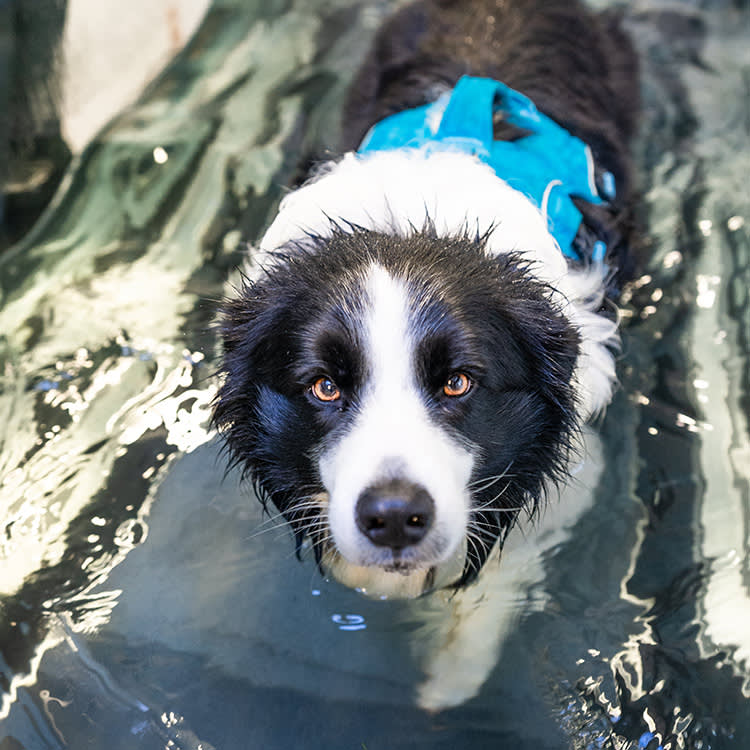
A dog tears a knee ligament, or wakes up stiff at ten years old, or comes home from surgery with a shaved leg and a cone, and the conversation the owner has usually splits into two paths. Rest and hope it settles. Or operate. What almost nobody offers up front is the road in between, the one that often does the most good: structured physical rehabilitation.
It is the same idea as physical therapy for people, aimed at rebuilding mobility, cutting pain, and getting a dog back to a life that works. The specialty has been around for a couple of decades in some parts of the world, but it is still young in the United States and, in plenty of communities, still not the first thing a primary vet mentions. That is a shame, because for a huge range of dogs, rehab is not an alternative to real medicine. It is real medicine, and it is the piece most likely to be missing from the plan.
Who rehab is actually for
The short answer is a lot more dogs than people assume, from puppies to seniors, anytime the problem is musculoskeletal or neurologic. Specifically, canine rehab earns its keep with:
- Soft-tissue sprains and strains
- Post-operative orthopedic recovery, including the two most common cruciate-ligament repairs, TPLO and TTA
- Congenital and degenerative joint disease, meaning hip and elbow dysplasia and osteoarthritis
- Neurologic rehabilitation after spinal decompression surgery
- Non-surgical neurologic injury, such as fibrocartilaginous embolism (FCE) or a spinal cord bruise
Notice what ties those together. Some are recoveries from a specific event, and some are the slow grind of age and arthritis. Rehab addresses both, because in each case the target is the same: keep the joint moving, keep the muscle that supports it strong, and keep pain low enough that the dog will actually use the limb.
One hard rule before any of it: get medical clearance from your primary vet. Certain underlying conditions make physical therapy unsafe, and a rehab plan should start only after your regular vet has signed off.
What the first visit looks like
A good rehab evaluation is slow and thorough, and it should be. The practitioner runs a full musculoskeletal and neuromuscular exam, feeling out how every relevant joint moves, where the muscle has wasted, what hurts, and how your dog compensates. That hands-on assessment is the whole foundation, because it produces a plan built for your dog’s specific problem rather than a generic set of exercises.
From there, the toolkit is broad. Skilled manual therapy mobilizes stiff joints and soft tissue. Therapeutic exercise rebuilds targeted strength. Range-of-motion and flexibility work keeps joints from freezing up. Balance and proprioception drills retrain a dog’s sense of where their legs are, which matters enormously after neurologic injury. And then there are the physical modalities, treatments that use light, water, temperature, sound, or electricity to reduce pain and speed healing.
The underwater treadmill, and why it works
The one piece of equipment worth understanding is the underwater treadmill, because it does something no land exercise can. The dog walks on a treadmill inside a tank filling with warm water, and buoyancy lifts much of their body weight off the joints. That means a dog with a bad hip or a healing knee can walk through a full, active range of motion without the impact that would otherwise flare the joint. At the same time, the water provides resistance, so every step also builds muscle, and the warmth eases pain and coaxes a reluctant limb back into use. Off-loading the joint while still loading the muscle is a genuinely hard combination to achieve on dry land, and it is why the underwater treadmill anchors so many orthopedic and neurologic recovery plans.
People picture rehab as a nice-to-have, something for show dogs or elite athletes. In my experience it’s most valuable for the ordinary senior with arthritis who has quietly stopped doing stairs. Take the weight off the joint, rebuild the muscle around it, and dogs who looked like they were winding down start moving through the house again. That’s not pampering. That’s the treatment.
Finding someone actually qualified
This is where owners get tripped up, so it is worth being precise. Human physical therapy transfers beautifully to dogs, but canine rehab has specifics that sit beyond an entry-level human PT degree, and not every veterinary school teaches it either. So the credentials matter. Look for these initials after a practitioner’s name:
- CCRT or CCRP, certifications from the two main programs (the Canine Rehabilitation Institute and the University of Tennessee), open to licensed veterinarians, physical therapists, and veterinary technicians who complete the training.
- DACVSMR, a board-certified specialist in veterinary sports medicine and rehabilitation.
Care delivered by a certified rehab assistant or a registered veterinary technician is also fine, as long as they work under the supervision of a qualified veterinarian or physical therapist with rehab training. If a facility cannot tell you who holds which credential, keep looking.
What it costs, and who pays
Rehab is more affordable than surgery and, increasingly, at least partly covered. Budget roughly $180 for that first thorough evaluation, then somewhere in the range of $58 to $98 per session for ongoing treatment, with the total depending on how long the course runs. The encouraging shift is on the insurance side: many modern pet insurance plans now include rehabilitative care under their accident-and-illness coverage, so a course of therapy after a cruciate repair or for arthritis management may cost you far less than the sticker price. Check your specific policy’s wording before you assume it is not covered, because this is one area where coverage has genuinely improved.
A field still finding its footing
Because canine rehab is young, the rules governing who can practice it are still being written, and they vary by state. Some places are actively working out how licensed animal physical therapists, veterinarians, and technicians share the work and what the competency standards should be. As an owner, the practical takeaway is simple: your ability to choose a qualified rehab practitioner for your dog depends partly on those regulations, so it is a reasonable thing to care about and, where it is being debated, to weigh in on.
The bottom line
If your dog is recovering from orthopedic or spinal surgery, living with arthritis, or nursing a soft-tissue injury, physical rehabilitation deserves a place in the conversation, not as a consolation prize but as a front-line option. Clear it with your primary vet, find a properly credentialed practitioner, and check whether your insurance helps with the cost. For a lot of dogs, the treadmill in the pool is the thing that turns “slowing down” back into “getting around.”
References
- “Canine Sports Medicine and Physical Rehabilitation.” Veterinary Medical Center, The Ohio State University College of Veterinary Medicine.
- American College of Veterinary Sports Medicine and Rehabilitation (ACVSMR). Practitioner directory. https://vsmr.org
- Canine Rehabilitation Institute. Find a therapist. https://www.caninerehabinstitute.com/find-therapist
Common questions
Is my dog too old for physical therapy?
Age itself is not a disqualifier. Rehab helps patients from young puppies to seniors, and older dogs with arthritis are among the best candidates because the goal is comfort and mobility, not athletic performance. What matters is a medical clearance from your vet first.
How do I find a qualified canine rehab practitioner?
Look for real credentials after the name: CCRT, CCRP, or DACVSMR. These signal specific training in animal rehabilitation beyond a standard veterinary or human physical-therapy degree. A certified assistant or veterinary technician can deliver care too, but under the supervision of a qualified practitioner.
What is an underwater treadmill for?
It lets a dog walk while the water's buoyancy carries much of their body weight, so a sore or healing joint moves through its range without the pounding of land exercise. The water's resistance builds muscle at the same time, and the warmth eases pain, which is why it is a staple of orthopedic and neurologic recovery.
Not a substitute for your vet. Our guidance is educational. For urgent symptoms, contact a vet or emergency clinic right away. Editorial standards
Dr. Mehta is a board-certified veterinary nutritionist who evaluates pet food formulations, ingredient quality, and the science behind dietary trends. He writes and reviews all nutrition content at The Pet Times, including our food rankings and feeding guides.
Meet our experts ↗Keep reading
 Health & WellnessYour Dog's 'Placebo Effect' Is Mostly YouDr. Amara Solis · 6 min
 Health & WellnessYou Were Told to Bank Your Puppy's Stem Cells. The Company That Sold That Doesn't AnymoreDr. Ravi Mehta · 7 min
 Health & WellnessInsurance Won't Cover 'Holistic' Pet Care. Here's the Word That Works.Dr. Lena Park · 8 min
 Health & WellnessYour Dog Isn't Licking His Leg Raw Out of Boredom. X-Ray What's Under It.Dr. Nina Kohl · 8 min
 Health & WellnessCoconut Oil for Dogs: A Mild Moisturizer, Not a MedicineDr. Lena Park · 8 min
 Health & WellnessThe CBD-for-Seizures Pitch Is Way Ahead of the ScienceDr. Ravi Mehta · 7 min