


Your Dog Isn't Licking His Leg Raw Out of Boredom. X-Ray What's Under It.
Lick granulomas get treated as a nervous habit, so owners buy bitter sprays and cones and lose a year. The lesion is usually the symptom of something underneath it: an allergy, or a joint that hurts exactly where he's licking.

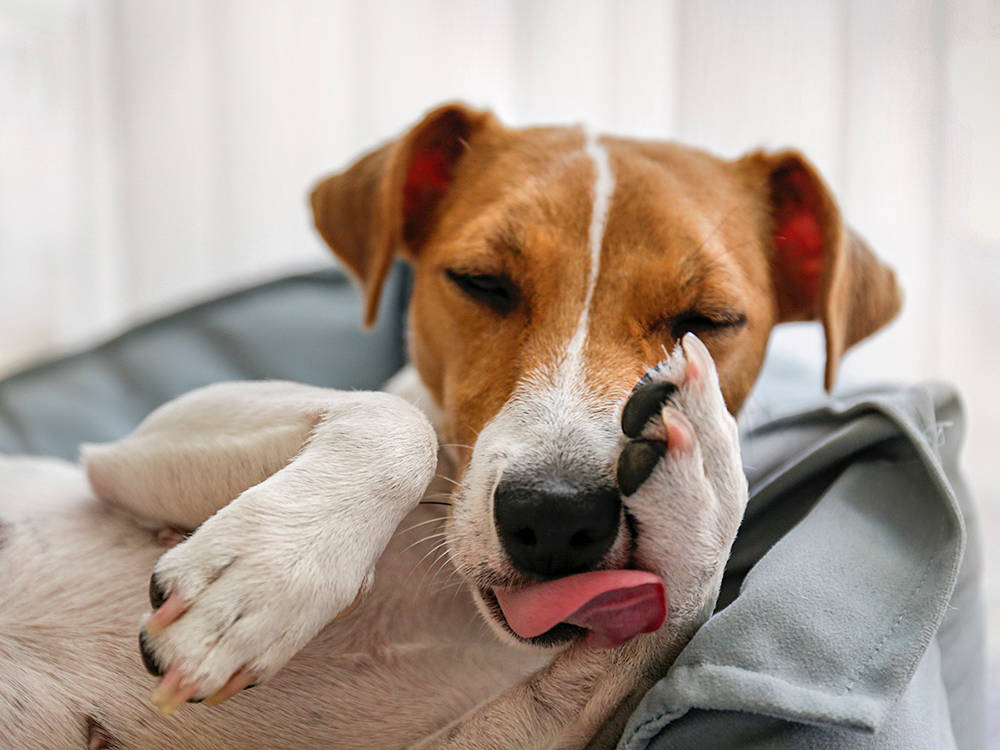
Every vet who has practiced for a decade has a version of this story, and here is one of them.
A first dog. A Lab mix. In his last year he started worrying at a wart on his leg, and it turned into a rough, raised, angry red patch. Bitter sprays. Socks. Steroid creams. An Elizabethan collar. Nothing stopped him. He was obsessed, and his owner was defeated, and he died before she finished vet school and learned there had been other options all along.
That story is not really about a stubborn sore. It is about the wrong opening question. She spent a year trying to make him stop licking. Almost nobody spends that year asking the more useful question, which is: why is he licking that exact spot, and what is underneath it?
What a lick granuloma is
A lick granuloma, known clinically as acral lick dermatitis, is what happens when a dog licks one place, over and over, until the skin gives up. Usually it is the lower leg. The licking irritates the skin, the skin opens, and the wound becomes a fixed feature of the dog.
It is not a hot spot, and the distinction matters. A hot spot flares fast and resolves. A lick granuloma is chronic, persistent, and famous for surviving whatever you throw at it first.
The lesion has a nasty internal logic. Once the licking starts, it self-perpetuates: the wound thickens, widens, and deepens, becomes ulcerated and then infected, the infection itches and hurts, which drives more licking. The hair does not grow back. The skin darkens. What began as a response to something becomes its own reason to continue.
Any breed can develop one, but they cluster in older, male, large-breed dogs. Doberman Pinschers, Great Danes, Labrador Retrievers, Golden Retrievers, and Irish Setters appear predisposed.
The mistake almost everyone makes
Say “my dog licks his leg raw” and you will be told he is anxious. Or bored. Or that it is a nervous habit, like nail-biting.
That framing is so entrenched that it shapes what owners buy: bitter apple spray, a cone, a calming supplement, more walks. And it is, in the majority of cases, wrong about the cause.
Acral lick dermatitis is usually a secondary problem. Something else started it. The most common culprits:
- Allergic skin disease. Atopic dermatitis, food allergy, and flea allergy. This is the leading cause in most cases, full stop. An itchy leg gets licked.
- Pain underneath the spot. Referred pain from arthritis in the joint below the lesion, or from a disc problem sending pain down the limb. The dog is licking where it hurts.
- A wound, a lump, or a foreign body. Something was there first.
- Infection, bacterial or fungal.
- Neurologic disease, including nerve damage that alters sensation.
- Neoplasia. Cancer, occasionally, at the site.
- Psychogenic causes. Anxiety, boredom, compulsion. Real, but the minority, and frequently a perpetuating factor rather than the initiating one.
Here is the practical translation, and it is the whole point of this article: if your dog has severe arthritis visible on X-ray directly beneath the spot he licks, the licking is not a habit. It is analgesia. He is doing the only thing available to him about a joint that hurts.
Bitter spray on that dog is worse than useless. It removes his one coping mechanism and leaves the pain in place.
Owners come in apologising for their dog’s neurosis, and I have stopped taking that at face value. The first thing I want is a skin workup and a radiograph of whatever joint is under the lesion. Half the time the answer is on the film, and everybody has spent eight months treating a personality problem the dog never had.
What a real workup looks like
If you take one thing from this piece, take this list, and take it to your vet.
Skin cytology and culture. Is there a bacterial or fungal infection, and what will actually kill it? Deep infections in these lesions are common and they often need six to eight weeks of oral antibiotics, which is far longer than the ten-day course people expect.
An allergy investigation. Because it is the leading cause. That means a strict elimination diet trial if food is suspected, rigorous flea control regardless of whether you have seen a flea, and a proper look at environmental allergy.
A radiograph of the joint under the lesion. This is the step that gets skipped, and it is the one that most often produces the answer nobody was looking for. Arthritis, a bone infection, or another painful lesion sitting directly beneath the licked area reframes the whole case. Chronic lesions can also develop a secondary periosteal reaction in the bone underneath, which is its own finding.
A neurological look, if the pattern suggests it.
Biopsy, if the lesion is unusual, refuses to respond, or something about it does not add up. Cancer is uncommon here, and it is on the list.
Only then, the behavioral assessment. Not never. Just not first.
Treatment, once you know what you’re treating
The single most reliable predictor of whether a lick granuloma resolves is whether you found the thing that caused it. Everything below works better on a dog whose underlying problem is being treated.
Antibiotics for the infection, and the full six to eight weeks if it is deep. Stopping early is how these relapse.
Steroids, topical or oral, to break the inflammatory cycle.
Anti-anxiety medication, which has a real place, particularly once the licking has become entrenched and compulsive in its own right, regardless of what started it.
Class IV cold laser therapy, which deserves a proper explanation because it is the most interesting tool in this list.
The laser
Therapeutic lasers are graded by class, and the higher the wattage, the shorter each treatment needs to be. Class II and III lasers are used by dermatologists for surface work. A Class IV laser penetrates further, through skin and down into muscle, tendon, ligament, and bone, which is exactly what you want for a lesion whose real cause may be in the joint underneath it.
Class IV laser reduces inflammation, swelling, muscle spasm, stiffness, and pain, and it is used in veterinary practice for wound care, post-operative incisions, ear infections, pancreatitis, arthritis, limb swelling, and soft-tissue injury. It is mildly warming, it stimulates acupuncture points without needles, which matters for dogs who will not tolerate them, and dogs generally find it pleasant. Many fall asleep.
The proposed mechanism is metabolic. The laser increases oxygen turnover in tissue: think of a blood vessel as a moving walkway, with red cells passing under a spotlight that warms the tissue and speeds blood flow, which drives oxygen uptake. More oxygen means more ATP, the energy currency every cell in the body runs on, and more available energy means faster healing.
The human literature is substantial. Medical-grade lasers have shown benefit in fibromyalgia, tennis elbow, chronic neck pain, osteoarthritis, rheumatoid arthritis, traumatic neuropathic pain, and compromised limb circulation. On the skin and wound side: diabetic ulcer healing, new blood vessel growth, increased migration of fibroblasts, hair regrowth in canine non-inflammatory alopecia, and better survival of surgical skin flaps.
Dose is calculated by the veterinary team from the size of the area, whether the injury is acute or chronic, whether it is skin or musculoskeletal, and even whether the coat is dark or light, since darker fur absorbs more energy. The precautions are common sense: keep the beam moving so it does not overheat the skin, and never use it near a fetus or a tumor.
For lick granulomas specifically, the treatment is focused on a small area, and concentration matters. The less the light is diluted across a large region, the better it tends to work. If a dog has arthritis in his knees, his back, and his wrists, they get treated one at a time rather than all at once.
The protocol runs two to three sessions a week for a few weeks, tapering to weekly, then to every two weeks as the wound shrinks over a month or so. The effect is cumulative, so the schedule is the treatment. Committing to it half-heartedly is the same as not doing it.
What you can do at home
None of this replaces the workup. All of it helps.
Some dogs settle with the snug pressure of an anti-anxiety vest. Calming treats containing L-theanine, an amino acid that raises dopamine and possibly serotonin, help some. So do pheromone collars and diffusers, Bach’s Rescue Remedy, and, more than any product, consistent and ample exercise.
On the holistic side, chiropractic work can help where disc-related nerve pain is driving the licking, which is entirely consistent with the pain-first thesis of this article. Acupuncture has a technique for exactly this lesion, sometimes called “surrounding the dragon,” in which needles encircle the wound to reduce pain and inflammation.
Surgical removal, including with a CO2 laser, is an option for a sore that will not respond to anything else. It is a last resort, and it is not a substitute for finding the cause, because a dog who is still in pain will simply start on a new spot.
One aside, since lasers are now in the conversation. The lasers in your printer, your DVD player, and a barcode scanner are far too weak to do anything medically. So is a cat toy laser pointer, which sits under 5 milliwatts, in the Class I to IIIa range. Never aim any laser at an eye or at a reflective surface like metal or glass. And a genuine word of caution about laser play: chasing a dot that can never be caught frustrates some dogs badly enough to tip into obsessive-compulsive behavior, which is a grimly appropriate thing to note in an article about compulsive licking.
What newer evidence adds
The strongest theme in the current dermatology literature is exactly the reframing this piece opened with: acral lick dermatitis is now understood primarily as a secondary condition, driven by an underlying primary disease plus perpetuating factors that keep the itch-lick cycle turning. Allergic disorders lead the list of primary causes. Orthopedic and neurologic disease, parasites, infection, and neoplasia follow. Psychogenic disease is on the list, and it is not at the top of it.
The clinical guidance that follows is unglamorous and specific. Work the case up properly before you decide it is behavioral. Radiograph the limb beneath the lesion. Treat infection for long enough. Attack the allergy seriously. Combine therapies, because combinations outperform any single approach. And set expectations honestly with the owner: this is often a condition you control rather than cure.
That last point is a kindness, not a defeat. An owner who is told at the start that the goal is control will keep going at month four. An owner who was promised a cure quits, and buys another bottle of bitter spray, and the dog goes on licking.
References
- Shumaker, A.K. “Diagnosis and Treatment of Canine Acral Lick Dermatitis.” Veterinary Clinics of North America: Small Animal Practice, vol. 49, no. 1, 2019, pp. 105–123.
- Denerolle, P., White, S.D., Taylor, T.S., Vandenabeele, S.I. “Organic diseases mimicking acral lick dermatitis in six dogs.” Journal of the American Animal Hospital Association, vol. 43, no. 4, 2007, pp. 215–220.
- VCA Animal Hospitals. “Lick Granuloma in Dogs.” VCA Know Your Pet.
- University of Minnesota. “Acral Lick Dermatitis — Canine.” Small and Large Animal Dermatology Handbook, Vol. 3.
- Millis, D.L., Levine, D. Canine Rehabilitation and Physical Therapy, 2nd ed. Elsevier, 2014. (Photobiomodulation and therapeutic laser.)
- Overall, K.L., Dunham, A.E. “Clinical features and outcome in dogs and cats with obsessive-compulsive disorder: 126 cases (1989–2000).” Journal of the American Veterinary Medical Association, vol. 221, no. 10, 2002, pp. 1445–1452.
Common questions
Are lick granulomas caused by anxiety?
Sometimes, but far less often than people assume, and treating anxiety as the default cause is the most common mistake made with this condition. Allergic skin disease is the leading trigger in most cases, and referred pain from arthritis or a disc problem directly beneath the licked area is another major one. Anxiety and boredom can perpetuate the licking once it starts, but they are usually not what started it.
Which dogs get lick granulomas?
Any dog can, but they are most common in older, male, large-breed dogs. Doberman Pinschers, Great Danes, Labrador Retrievers, Golden Retrievers, and Irish Setters appear predisposed.
Can a lick granuloma be cured?
Often it is controlled rather than cured, and that is worth knowing at the start so you are not demoralized in month three. Deep infections commonly need six to eight weeks of oral antibiotics. Success depends heavily on identifying and treating the underlying cause, and a combination of therapies usually works better than any single one.
Not a substitute for your vet. Our guidance is educational. For urgent symptoms, contact a vet or emergency clinic right away. Editorial standards
Dr. Kohl is a board-certified veterinary dentist with a particular interest in preventive oral care. She reviews all dental health content at The Pet Times and contributes practical guides on home dental routines, professional cleaning, and oral disease prevention.
Meet our experts ↗Keep reading
 Health & WellnessOf All the Pet CBD Claims, Arthritis Is the One With Real ScienceDr. Amara Solis · 7 min
 Health & WellnessYour Senior Dog Isn't 'Just Slowing Down.' They're in Pain.Dr. Ravi Mehta · 7 min
 Health & Wellness'Natural' Won't Cure Your Dog's Seizures. But These Add-Ons Actually Help.Dr. Lena Park · 9 min
 Health & WellnessThe Best Thing You Can Do for an Arthritic Dog Isn't a SupplementDr. Ravi Mehta · 8 min
 Health & WellnessStem Cells Won't Regrow Your Dog's Cartilage. Here's What the $3,000 Actually Buys.Dr. Mara Chen · 8 min
 Health & WellnessThe CBD-for-Seizures Pitch Is Way Ahead of the ScienceDr. Ravi Mehta · 7 min