


Coconut Oil for Dogs: A Mild Moisturizer, Not a Medicine
Coconut oil is sold as a fix for itching, fleas, weight, and seizures. Sort the claims into 'topical and harmless' versus 'oral and overhyped' and almost all of them collapse. Here's the evidence, use by use.

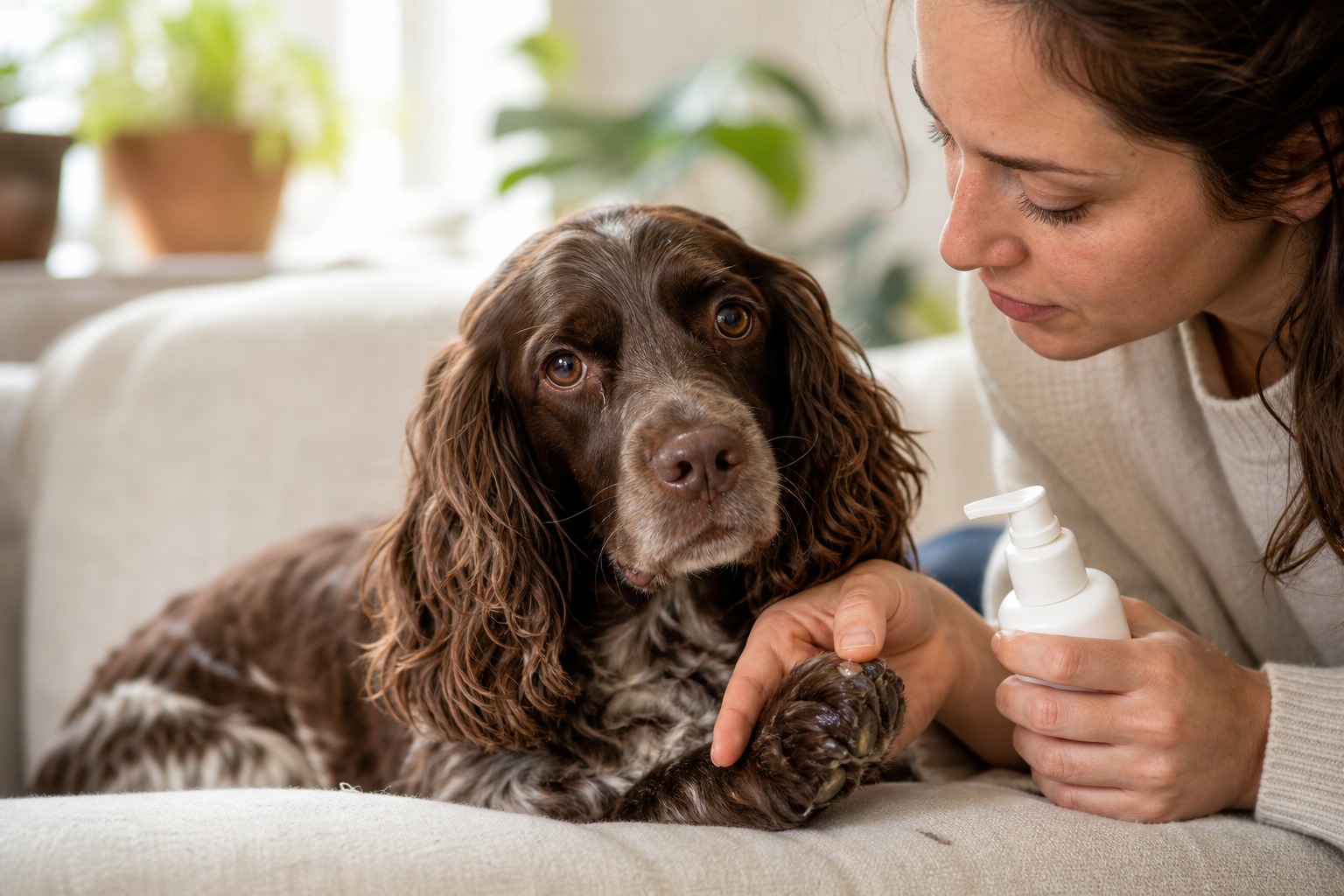
Coconut oil is the internet’s favorite dog remedy: dry skin, itching, fleas, weight, even seizures, all supposedly solved by a jar from the pantry. There’s a simple way to cut through the hype. Sort every claim into two piles, “applied to the skin” and “fed by mouth,” and a clear pattern appears. The topical uses are mild and mostly harmless; the oral, systemic claims are where the evidence falls apart and the risks pile up. Here’s the sort, use by use.
Why coconut oil got its reputation
The appeal starts with chemistry. Coconut oil is rich in medium-chain fatty acids (MCFAs), which behave differently from most dietary fats: instead of the usual digestive processing, they’re absorbed quickly and shipped to the liver, where they can become ketones, an alternative fuel for cells, including brain cells. Much of coconut oil’s mystique rides on that ketone story.
But there are two catches the marketing skips. First, coconut oil is still extremely high in calories and saturated fat, with about twice the saturated fat of lard; just two tablespoons exceed the recommended daily limit for most people. Dogs don’t get the same arterial disease we do, but they absolutely suffer from too much fat. Second, and less well known: lauric acid, coconut oil’s headline fatty acid, is often marketed as an “MCT,” but it behaves more like a long-chain fat in the body. When studies show benefits from “MCT diets” in dogs, they use purpose-formulated MCT oils, not coconut oil. The glow and the caveats come from the same molecule.
It’s also worth being upfront: the scientific support for coconut oil’s benefits is weak even in humans, and weaker still in dogs.
Pile one: topical uses that might actually help
These are low-stakes, mild, and unlikely to cause harm when done sparingly.
Dry skin
This is coconut oil’s best case. In humans it helps skin hold moisture and elasticity, and topical application supports the skin’s lipid balance, which matters for a healthy barrier. Dogs aren’t furry people, their skin composition differs, and there aren’t canine moisturizer studies, but spot-treating a small dry patch with a thin layer is likely fine. Low risk, possible benefit.
Itchy skin
Here the evidence is thin but not empty. In lab settings, coconut oil shows mild anti-inflammatory and antibacterial activity, which is why it’s sometimes suggested as an add-on for human eczema. A 2024 veterinary study went further and gave it to dogs with atopic dermatitis: it did not lower IgE (an allergy marker) over time, but owners reported better skin condition and less itch in the early weeks. That’s a modest, real signal for topical relief, not a cure, and never a substitute for treating the underlying allergy. Note too that coconut oil contains none of the omega-3 or omega-6 fatty acids that genuinely help skin when given orally, so feeding it for skin problems isn’t recommended.
Cracked paws
Coconut oil spreads easily and smells nice, which makes it tempting for dry, cracked pads. It’s unlikely to cause problems beyond slippery floors, unless your dog licks off a lot. Many balms made specifically for dog paws already list coconut oil as an ingredient.
Pile two: oral and systemic claims that don’t hold up
These are where “natural remedy” turns into wishful thinking, and sometimes into harm.
Hot spots
Skip it. Despite the mild anti-inflammatory reputation, coconut oil shouldn’t go on hot spots. Moist dermatitis actually improves with air exposure, and other remedies treat these painful, localized infections far better.
Fleas
Coconut oil doesn’t kill fleas and isn’t a flea-control strategy. Your dog may enjoy zooming around greased up, but the fleas won’t care, and your furniture will suffer.
Weight loss
Coconut oil has been tested in home-cooked weight-loss diets for dogs and did not speed weight loss. Dogs on a high-fiber, calorie-restricted diet that included it did lose weight, but that came from the calorie restriction, not the oil. Because coconut oil is so calorie-dense, adding it to a normal diet promotes weight gain, not loss.
Seizures
A survey of owners of dogs with epilepsy found coconut oil was a common supplement, on the ketones-fuel-the-brain theory. But increased MCFA intake hasn’t been shown to reduce seizures in animal epilepsy models and hasn’t been properly evaluated in dogs. Appealing theory, absent evidence.
The forms, briefly
Coconut oil is solid at room temperature (pure oil melts at 78°F / 25.5°C):
- Virgin coconut oil is pressed from fresh or dried coconut flesh and is the type usually mentioned for dogs.
- Refined coconut oil is heated and filtered to remove odor and impurities.
- Partially hydrogenated coconut oil converts its small unsaturated fraction into trans fats for shelf life, and is worth avoiding.
Using it safely, if you use it at all
The most important step is to talk to your vet first. They know your dog’s history, can flag added risks, and often have more effective, targeted options.
On the skin: One study found undiluted virgin coconut oil caused toxicity in lab-grown canine skin cells. Those cells lacked a living dog’s protective mechanisms, so real-world significance is unclear, but the authors advised against undiluted virgin coconut oil on dogs’ skin. In practice, a thin layer on a small patch for under an hour, then wiped clean, is the cautious approach.
By mouth: Not directly toxic, but the fat and calories cause real problems. Many dogs get diarrhea, and fat-sensitive breeds like Schnauzers, who process triglycerides poorly, are predisposed to pancreatitis and at higher risk. If your vet recommends it, start with a very small amount and build up slowly; even a large dog shouldn’t exceed about a teaspoon a day.
Not all over, and not overnight: Dogs lick perceived debris off their coats, so slathering a dog invites severe stomach upset. Overnight application invites the same licking plus prolonged skin contact that could harm the barrier.
What newer research adds
Veterinary dermatologists have grown blunt about the trend. At the 2025 American Veterinary Medical Association Convention, a board-certified veterinary dermatologist addressed coconut oil for canine atopic dermatitis, a fad that’s persisted for over a decade, with a familiar verdict: small, occasional amounts are unlikely to hurt, regular use isn’t recommended, and the risks, stomach upset, pancreatitis, and allergic reactions, are real.
That’s consistent with the two-pile sort. Coconut oil is not the cure-all the internet claims. For a truly itchy, inflamed, or chronically dry dog, home remedies can make you feel like you’re helping while the real cause goes untreated. The most effective move is almost always to see your vet, get a diagnosis, and treat the root problem, using coconut oil, if at all, as a minor, vet-approved add-on.
References
- International Journal of Veterinary Science and Medical Diagnosis (2024): Effectiveness of Coconut Oil Administration on Immunoglobulin E (IgE) Levels in Dogs With Atopic Dermatitis. https://www.pubtexto.com/journals/international-journal-of-veterinary-science-and-medical-diagnosis/fulltext/effectiveness-of-coconut-oil-administration-on-immunoglobulin-e-ige-levels-in-dogs-with-atopic-dermatitis
- dvm360: Debunking the Coconut Oil Fad in Veterinary Dermatology. https://www.dvm360.com/view/debunking-the-coconut-oil-fad-in-veterinary-dermatology
- Veterinary Dermatology: Plasma Membrane Integrity and Oxidative Stress Index Outcomes of Canine Progenitor Epidermal Keratinocytes (CPEKs) Exposed to Virgin Coconut Oil.
- Journal of Veterinary Internal Medicine: Investigating Owner Use of Dietary Supplements in Dogs With Idiopathic Epilepsy.
- American Journal of Veterinary Research: Evaluation of the Use of Esterified Fatty Acid Oils Enriched in Medium-Chain Fatty Acids in Weight-Loss Diets for Dogs.
Common questions
Can I rub coconut oil all over my dog?
No. Coating a dog in coconut oil doesn't help anything and invites trouble, because dogs lick it off and a large amount of ingested fat can cause serious stomach upset or worse. Spot-treat small areas only.
Can I leave coconut oil on my dog overnight?
Better not. Apply a thin layer that absorbs quickly, then wipe away residue. Leaving it on raises the odds your dog licks it off and prolongs skin contact, which one lab study linked to skin-cell toxicity with undiluted oil.
Is it safe to feed my dog coconut oil?
It's not directly toxic, but it's very high in fat and calories. Many dogs get diarrhea from added fat, and fat-sensitive dogs can develop pancreatitis. If your vet recommends it, start tiny; even a large dog shouldn't get more than about a teaspoon a day.
Not a substitute for your vet. Our guidance is educational. For urgent symptoms, contact a vet or emergency clinic right away. Editorial standards
Dr. Park is a board-certified emergency and critical care specialist. She reviews our health and safety content for clinical accuracy and contributes guides on recognising urgent conditions. Her focus is helping owners act quickly and correctly when it matters most.
Meet our experts ↗Keep reading
 FoodYou Don't Have to Believe in Chi to Use the Warming-and-Cooling Food TrickDr. Amara Solis · 7 min
 Health & Wellness8 Natural Allergy Buys Worth a Spot in Your Cabinet (and the Popular One to Skip)Dr. Priya Nair · 8 min
 Health & WellnessGinger for Dogs: A Real but Mild Remedy, Not a Substitute for the Real ThingDr. Mara Chen · 6 min
 Health & WellnessSound Baths for Dogs Sound Like Woo. The Research Isn't.Dr. Lena Park · 6 min
 Health & WellnessThe 'Vagus Nerve Reset' for Anxious Dogs Is a Myth. The Nerve Is Not.Dr. Lena Park · 6 min
 Health & WellnessOf All the Pet CBD Claims, Arthritis Is the One With Real ScienceDr. Amara Solis · 7 min