


Why Cats Got Left Behind in the Premium Treat Boom (and What Bocce's Is Fixing)
Dogs got a decade of small-batch, farm-sourced treats while cats made do with dusty supermarket cookies. The reason isn't neglect, it's that a cat treat is harder to make right. Here's what 'made for cats' actually has to mean.
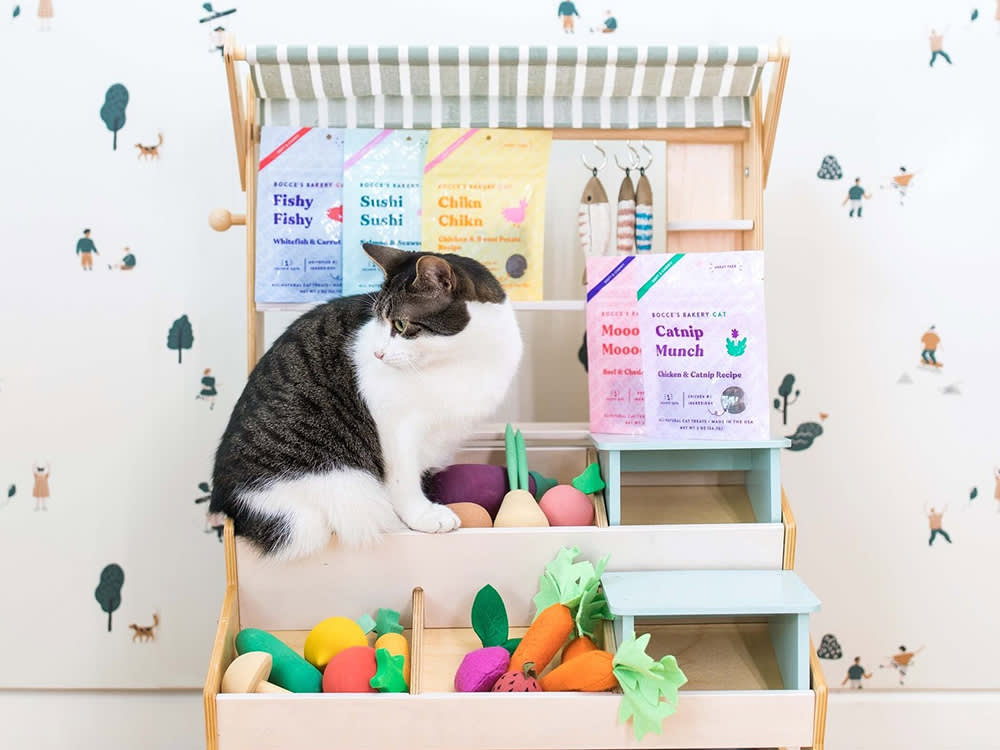
Walk any pet store and the imbalance is obvious: an entire wall of artisanal, farm-sourced, single-origin dog treats, and a sad little shelf of supermarket cat cookies that have probably been there since the last administration. It is tempting to read that as the industry forgetting cats. It is closer to the truth that a good cat treat is genuinely harder to make than a good dog treat, which is why the news that Bocce’s Bakery, long beloved by dog people, has launched limited-ingredient soft chews for cats is worth more than a shrug. To see why it is a real upgrade rather than a marketing line, it helps to understand what a cat treat actually has to get right.
A cat is not a small dog, nutritionally
The reason you cannot just shrink a dog biscuit is biology. Cats are obligate carnivores, meaning they must get key nutrients from animal tissue and cannot manufacture them from plants the way dogs and people can. The headline example is taurine, an amino acid abundant in meat and absent in plants. A cat short on taurine can go blind and can develop dilated cardiomyopathy, a serious heart condition where the muscle thins and weakens. That single fact rewrites the rulebook: a cat treat built on grain filler and plant protein is not just lower quality, it is working against the animal’s physiology. Protein-first, animal-based formulas are not a premium nicety for cats, they are the baseline.
The calorie math is brutal on a small body
The second thing a cat treat has to respect is size. The standard guidance is that treats should stay under about 10 percent of daily calories, and an average cat only needs roughly 200 calories a day. Do the math and a cat’s entire daily treat budget is around 20 calories, a couple of small bites. On a body that small, a dense, sugary cookie blows the budget in one go and crowds out the balanced food the cat needs for everything else. A treat made for cats has to be low-calorie and portionable by design, not a rich dog treat in a smaller bag.
Why Bocce’s clearing that bar is notable
Held against those two requirements, protein-first and calorie-light, Bocce’s approach lines up. The new cat soft chews are built to be protein-first, low-calorie, by-product-free, and limited-ingredient, with locally sourced ingredients. That is the right spec for an obligate carnivore on a tight calorie budget, which is exactly what most legacy supermarket cat treats are not.
The brand earns the benefit of the doubt because of how it operates, and these are brand facts worth keeping straight. Bocce’s started with a scruffy mutt named Bocce, who inspired Andrea Tovar to begin baking treats out of a tiny New York City kitchen in 2010. Fans fell for recipes like Beef Bourguignon and Fireside Apple Pie, plus seasonal one-offs such as Lumps of Coal, a peanut-butter-and-bone-charcoal treat at Christmas. The kitchen is much bigger now, but the sourcing has not changed: nitrate-free bacon, peanut butter from Teddies, a family-owned Massachusetts farm, and antibiotic-free chicken from Bell & Evans in Pennsylvania. The new cat line, with a salmon-and-seaweed blend called Sushi Sushi and a beefy, cheesy bite named Moooo Moooo, applies that same local, limited-ingredient discipline to a species that has been waiting a long time for it.
The bottom line
Cats were not snubbed by the premium treat boom so much as underserved by a harder problem: an obligate carnivore on a 20-calorie treat budget is unforgiving of cheap, dense, plant-heavy formulas. A treat that is genuinely “made for cats” has to be protein-first and calorie-light, and that is exactly the bar Bocce’s new soft chews are aiming at. Just remember the 10 percent rule applies no matter how good the treat is: a couple of bites a day, not a handful.
References
Not a substitute for your vet. Our guidance is educational. For urgent symptoms, contact a vet or emergency clinic right away. Editorial standards
Nina Vasquez writes about life at home with pets and the relationships at the heart of it. Her work covers day-to-day living, people-and-pet stories, and the products that fit into a real household, with a warm, grounded take on everyday pet ownership.
Meet our experts ↗Keep reading
 Product Picks8 Pet Advent Calendars Worth the Countdown (and How to Pick One)Sasha Ford · 6 min
 FoodShop the Treat Aisle by Job, Not by Hype: Our Tested PicksSasha Ford · 13 min
 FoodRaspberries Are Safe for Your Cat. Your Cat Just Doesn't Care.Dr. Priya Nair · 5 min
 FoodPumpkin Is the Rare 'Human Food' Your Cat Might Actually NeedDr. Lena Park · 5 min
 Food'All-Natural' Is Just a Word on the Bag. Read the Ingredients Instead.Dr. Priya Nair · 8 min
 FoodYour Cat Can Eat Sweet Potato. Your Cat Also Doesn't Care About ItDr. Mara Chen · 6 min