


Cat Water Fountains: Why Most Get Returned, and How to Pick One That Doesn't
A fountain can genuinely get an under-drinking cat to drink more, but the model that ends up in a closet is almost always the one chosen for looks over cleanability. Here's what actually decides whether a cat fountain works, and our picks by the situation you're in.

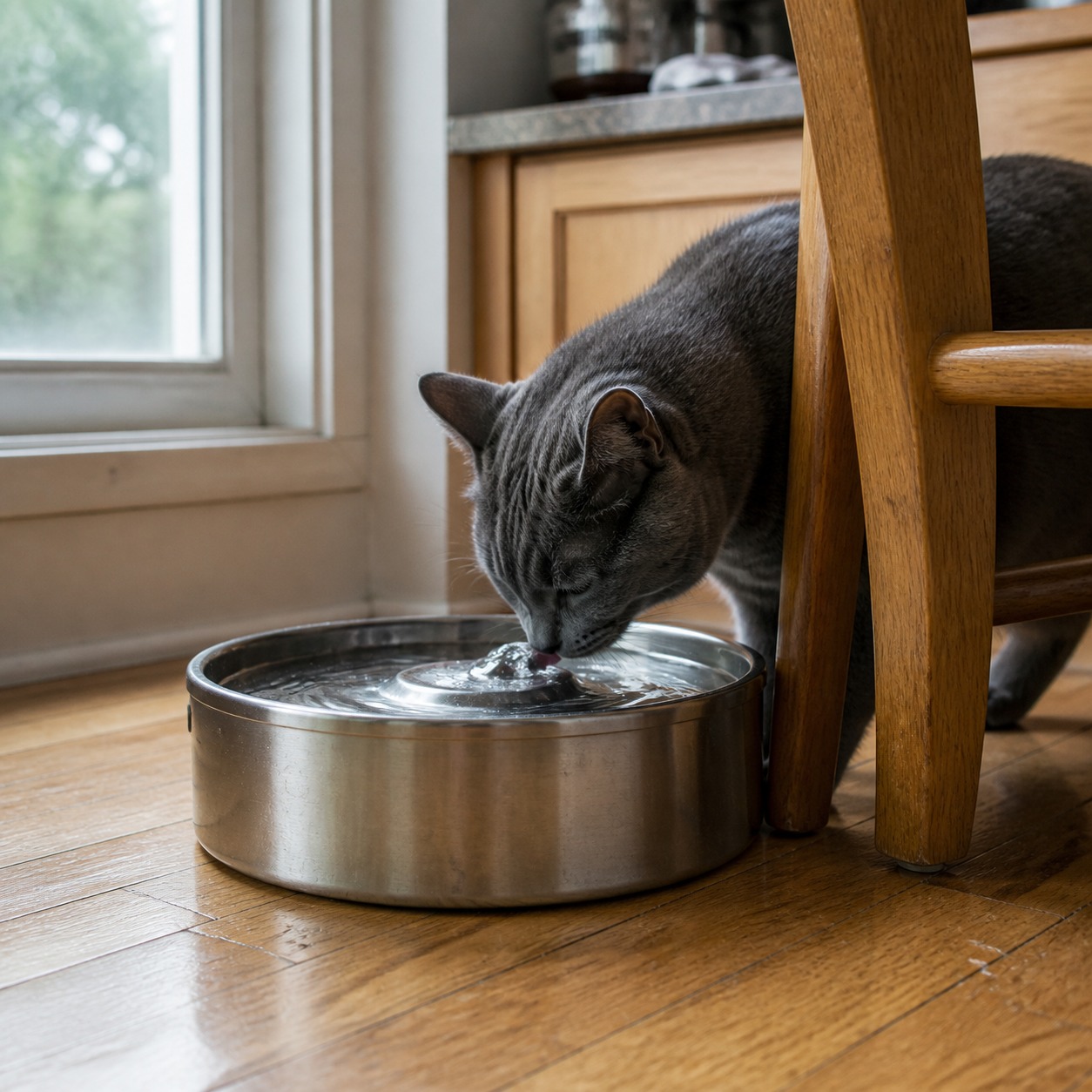
Watch a cat ignore a full bowl and then sprint to drink from a running faucet and you have seen the entire argument for a water fountain in one move. It is not attention-seeking. Cats descend from desert animals with a naturally low thirst drive, and instinct tells them that moving water is safer to drink than still water that could be stagnant or contaminated. A fountain leans directly into that instinct.
The reason this matters medically, and not just as a convenience, is that chronic under-drinking is a real problem for indoor cats.
Cats are built to get most of their water from prey, so a dry-food cat on a bowl of still water is often running a little dehydrated all the time. Over years, that low-grade under-hydration is a setup for urinary and kidney trouble. Anything that reliably makes a cat drink more, fountains included, is doing real preventive work.
So a fountain is best understood as a hydration intervention. And here is the part the glossy product roundups skip: the single biggest reason a cat fountain fails is not the cat. It is the owner giving up on cleaning it. Pick for the wrong reasons and the fountain ends up unplugged in a cupboard within a month. Pick for the right ones and it earns its place for years. Let’s get the decision right first, then choose a model.
First, does your cat even need one?
A fountain is most worth it if your cat eats mostly dry food (and therefore takes in little water from meals), tends to drink from faucets or your water glass, has a history of urinary issues, or simply ignores a standing bowl. If your cat eats wet food and drinks normally from a clean bowl, a fountain is a nice-to-have, not a fix. Either way, the goal posts are the same: an adult cat needs roughly 50 to 60 milliliters of water per kilogram of body weight per day, counting moisture from food, and a fountain helps a reluctant drinker get closer to that number.
The three things that actually decide whether it works
Cleanability, above all. A fountain is a warm, wet, recirculating system, which means biofilm (that slick coating inside the bowl), mineral scale, and mold are constant threats. The models people keep are the ones that come apart easily, have few crevices for gunk to hide in, and are dishwasher-safe. Before you buy anything, look at how the pump disassembles and whether the reservoir has tight corners you cannot reach with a brush. Plan to wipe it down weekly and do a full pump cleaning every couple of weeks regardless of model.
Material, because of your cat’s chin. This is the consideration the typical roundup never mentions. Plastic fountains scratch over time, and those micro-scratches harbor bacteria that can contribute to feline chin acne, the little black bumps some cats get on their chins from plastic bowls. Stainless steel and ceramic resist scratching, harbor far less bacteria, and are easier to truly clean. If your cat has ever had chin acne, skip plastic entirely.
Noise and flow your cat will accept. Pump noise is the other quiet dealbreaker. A fountain that hums or rattles will get avoided by a noise-sensitive cat and unplugged by a sleep-sensitive human. And some cats prefer a calm trickle over a vigorous bubbling stream. The best fountains either run genuinely quiet or offer adjustable flow modes so you can match your cat’s preference.
A whisker note, since it comes up: a shallow, wide drinking area is gentler on sensitive whiskers than a deep narrow well, and some cats clearly prefer it. Treat it as a real plus for a fussy cat rather than the headline feature.
Our picks, by the situation you’re in
If you want the safe all-around default: a quiet, multi-mode plastic-and-stainless fountain. The Petlibro Capsule is a deservedly popular pick, with a near-silent recirculating pump, multi-stage filtration, and two flow modes (a stream and a gentle bubble) so you can dial in what your cat likes. Just commit to the cleaning routine, as with any plastic-bodied model.
If your cat has had chin acne, or you just want the easiest deep clean: all stainless steel. A fully stainless fountain, ideally one whose body (minus the pump) is dishwasher-safe, is the most hygienic choice and the easiest to keep genuinely clean. The larger steel models also hold close to a gallon and often have multiple spouts, which suits a multi-cat home.
If pump noise is your dealbreaker: go non-electric. A gravity-fed, cordless fountain refills the drinking dish automatically as your cat laps, with no pump and therefore no hum at all. You trade the flowing-stream appeal for total silence and one less thing to break, a good fit for a quiet apartment or a skittish cat.
If you want low energy use and easy refills: a smart fountain. Compact smart fountains pump in intervals (running a few minutes, then resting) to save power and pump life, and hold enough water that you refill far less often than you would top up a bowl. Good for a small household or anyone out of the house all day.
If budget is the constraint: a simple, crevice-free plastic model. The most affordable fountains still do the core job. Choose one with a simple, easy-to-rinse design and BPA-free plastic, accept that you will replace it sooner than a steel one, and stay on top of cleaning to keep chin acne at bay.
If aesthetics and whisker comfort top your list: ceramic. A ceramic fountain with a wide, shallow basin is whisker-friendly, naturally quiet, resists bacteria far better than plastic, and looks like decor rather than a gadget. The tradeoffs are real but minor: it is heavier, and ceramic can chip if dropped.
The honest bottom line
Any of these will work if, and only if, you keep it clean and your cat actually drinks from it. Buy for cleanability and the right material first, match the noise and flow to your particular cat second, and let looks be the tiebreaker, not the deciding factor. A fountain you maintain is a genuine, low-effort way to protect your cat’s urinary and kidney health for years. A beautiful one you stop cleaning is just an expensive countertop ornament.
References
- “Feline Lower Urinary Tract Disease.” Cornell Feline Health Center, Cornell University College of Veterinary Medicine. https://www.vet.cornell.edu/departments-centers-and-institutes/cornell-feline-health-center/health-information/feline-health-topics/feline-lower-urinary-tract-disease
- “Water: A Vital Nutrient.” WSAVA Global Nutrition Committee. https://wsava.org/global-guidelines/global-nutrition-guidelines/
- “Feline Acne.” Cornell Feline Health Center. https://www.vet.cornell.edu/departments-centers-and-institutes/cornell-feline-health-center
Dr. Chen is a small-animal veterinarian who leads health and safety coverage at The Pet Times. She writes and reviews the bulk of our illness, condition, and safety content, translating clinical guidance into clear, practical advice owners can act on at home.
Meet our experts ↗Keep reading
 Product PicksThe Cat Bowl Is a Health Tool, Not Decor. How to Pick the Right OneDr. Mara Chen · 9 min
 Product PicksThe Self-Cleaning Litter Box That Actually Wins Cats OverSasha Ford · 5 min
 Product PicksI Doubted a $30 Plastic Box Could Beat Litter Smell. It Did.Tom Hadley · 4 min
 Living"Eco-Friendly" Cat Gear Is Mostly a Sticker. 6 Swaps That Aren't.Nina Vasquez · 8 min
 FoodYour Cat Isn't Picky. The Bowl Is Just Boring.Dr. Priya Nair · 7 min
 Product PicksThe Cat Puzzle Toy Plan: Start Easy, Level Up, Actually Change BehaviorNina Vasquez · 5 min