


The Cat Puzzle Toy Plan: Start Easy, Level Up, Actually Change Behavior
A pile of clever puzzle toys won't help if you start your cat on the hardest one. Here's how to pick by difficulty, build up the challenge, and use food puzzles to fix real problems like overeating and boredom.

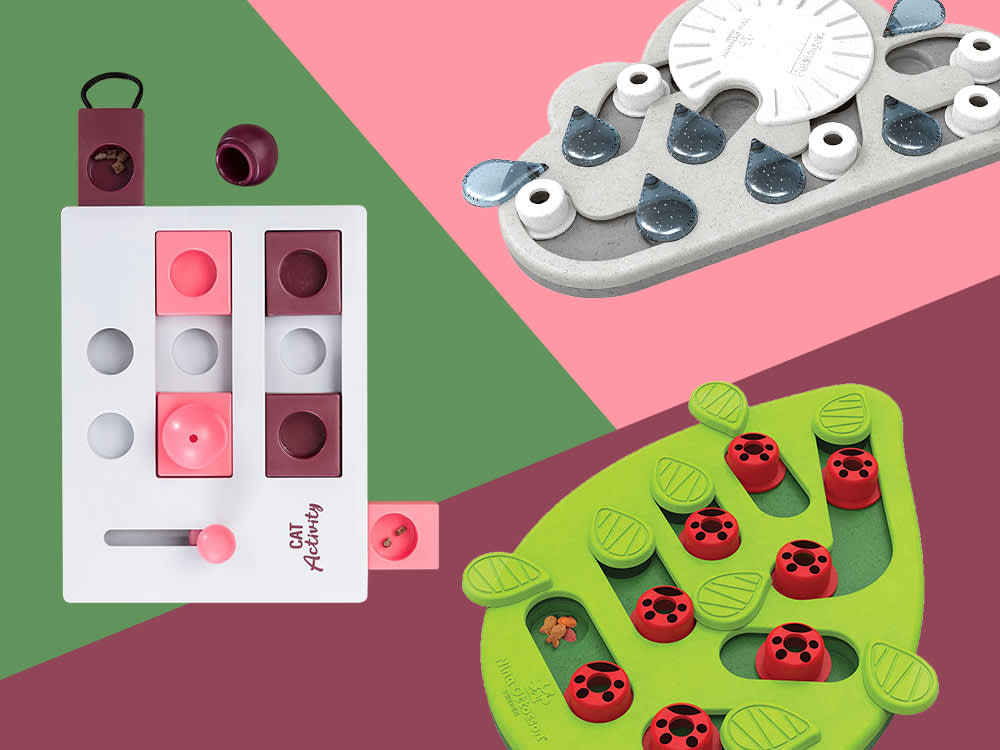
You have heard about dogs who sniff out cancer and learn the alphabet. Your cat, were they inclined to comment, would inform you that academia is beneath them and return to grooming. But that aloofness is a costume. A bored indoor cat is a cat whose hunting instinct has nowhere to go, and the fix is not more toys, it is the right toy at the right difficulty, introduced in the right order. That last part is what almost everyone gets wrong, and it is why so many puzzle feeders end up shoved in a closet after one disappointing afternoon.
So this is not just a list of clever products. It is a plan. We will start with why food puzzles change behavior (the science is better than you’d think), then walk up a difficulty ladder, beginner, intermediate, advanced, so you can match the puzzle to your cat today and level them up over time. Buy off this list at random and you will probably misfire. Follow the progression and you will end up with a smarter, calmer, slimmer cat.
Why food puzzles do real work
This is the part that separates puzzle feeders from ordinary toys. The case for them is not marketing, it is a peer-reviewed veterinary review in the Journal of Feline Medicine and Surgery that pulled together the evidence on feeding cats this way. The core idea: indoor cats evolved to hunt many small meals a day, and a big bowl of kibble removes all the work, and with it the mental stimulation and problem-solving a cat is built to crave.
Restore that work and good things follow. The research links food puzzles to reduced aggression and anxiety, less overgrooming, fewer litter-box avoidance problems, and better weight control. The weight piece is concrete: a cat’s stomach is about the size of a ping-pong ball, and a puzzle feeder turns a bolted three-minute meal into a paced 30-minute one, which is exactly what a free-feeding, overeating cat needs.
The other rule from the same research is about how you introduce them, and it is the rule people skip: start easy, and motivate with novel food. People buy the cute one, set it down, and expect their cat to crack a hard puzzle cold. Cats, like people, do not set a Sudoku record on the first try. Begin below your cat’s level, let them succeed fast, and raise the bar only when they’re bored with the current one.
Beginner: the “let them win immediately” tier
Start here unless your cat already has puzzle experience. These are forgiving, fast-reward toys whose only job is to teach your cat that working for food pays.
A clear rolling treat ball is the classic first puzzle, and for good reason: it is see-through so the food is obvious, it rolls with the lightest paw tap, and the good ones let you widen or narrow the opening so you can keep it generous at first and tighten it as your cat improves. This is the single best starter toy for most cats.
A food-compartment toy, like a playful sushi- or food-themed feeder, hides treats in shallow, easy-to-reach pockets. The openings are big enough that early success is almost guaranteed, which is the whole point of the beginner tier.
A five-tube digging puzzle sets several wide tubes of different heights side by side so your cat can paw and fish kibble out. It is gentle enough for beginners and doubles as a brake for cats who inhale their food.
Intermediate: the “make them think” tier
Once the basics click, add a layer of problem-solving. These reward trial and error.
A multi-mode treat puzzle with three or four different ways to reach the food keeps a graduating cat engaged, because you can switch the active mode as they master each one, effectively several puzzles in one shell.
A sliding-and-flipping board, the kind with drawers to pull, knobs to push, and lids to flip, is a genuine brain teaser, and a crowd-pleaser in multi-cat homes where one cat solves it and the others crowd in to copy.
A hidden-compartment puzzle with a dozen-plus covered wells (one award-winning version hides treats in 16 compartments) makes your cat reason their way through trial and error to uncover each one.
Advanced: the “brains over brawn” tier
For the cat who solves everything, these demand patience and finesse rather than force.
A spinning-obstacle puzzle, built around a wheel your cat has to nudge just so, is a true brains-over-brawn challenge, and it takes real willpower on your part not to hint. It works with dry or wet food, which is rare and handy.
A multi-level adjustable puzzle from a respected designer like Nina Ottosson, with several hidden compartments and two difficulty settings, is the natural top of the ladder: built to be made harder as your cat keeps winning.
A spinning-beaker puzzle asks your cat to paw three rotating beakers, not too fast, then extract treats from a frame below. It is fiddly, demanding, and exactly what a puzzle-bored cat needs.
Two upgrades that aren’t food puzzles
A couple of enrichment toys belong in the mix even though they don’t dispense meals.
A hexagonal catnip puzzle toy keeps a cat busy and offers a scratching outlet at once, and unlike most cardboard contraptions, it is not an eyesore in a living room.
An eco-friendly wooden interactive toy challenges your cat’s predatory instincts for solo play while you are out, and it will outlast the disposable cardboard pads you keep reordering.
The one-paragraph version
Buy one beginner puzzle and one novel, high-value food to bait it. Let your cat win for a week. Move up a tier only when the current toy stops being interesting, and rotate two or three puzzles so none goes stale. Done this way, a $15 treat ball does more for your cat’s behavior and waistline than a closet full of toys bought all at once and never figured out.
References
- Dantas, L. M. S., Delgado, M. M., Johnson, I., Buffington, C. A. T. “Food puzzles for cats: feeding for physical and emotional wellbeing.” Journal of Feline Medicine and Surgery, 2016. https://journals.sagepub.com/doi/full/10.1177/1098612X16643753
- American Association of Feline Practitioners and ISFM. “Feline Environmental Needs Guidelines.” https://catvets.com/guidelines/practice-guidelines/environmental-needs-guidelines
- The Ohio State University Veterinary Medical Center, Indoor Pet Initiative. “Enrichment for Indoor Cats.” https://indoorpet.osu.edu/cats
Common questions
Do cat puzzle toys actually do anything, or are they a gimmick?
They do real work when used right. The veterinary review that popularized food puzzles for cats links them to less aggression, reduced anxiety and overgrooming, fewer litter-box issues, and better weight control, because they restore the natural cycle of hunting and working for food that a full bowl removes.
My cat ignored the puzzle I bought. What went wrong?
Almost always, the puzzle was too hard to start, or the food inside was too boring. Begin with the easiest possible puzzle, a clear rolling ball with big openings, baited with something novel and high-value. Let your cat win immediately, then raise the difficulty only once they have mastered the current level.
Can puzzle feeders help an overweight cat?
Yes, and that is one of their best uses. A cat's stomach is roughly the size of a ping-pong ball, so puzzle feeders turn a gulped three-minute meal into a paced 30-minute one, which slows eating, adds activity, and helps prevent the gorge-and-gain cycle of free feeding from a bowl.
Nina Vasquez writes about life at home with pets and the relationships at the heart of it. Her work covers day-to-day living, people-and-pet stories, and the products that fit into a real household, with a warm, grounded take on everyday pet ownership.
Meet our experts ↗Keep reading
 Product PicksThe Cat Bowl Is a Health Tool, Not Decor. How to Pick the Right OneDr. Mara Chen · 9 min
 Product PicksThe Cat Bowl That Looks Good and Actually Works: 11 Modern PicksSara Lim · 5 min
 Product PicksThe 10 Best Automatic Cat Feeders of 2026, Sorted by the One Question That MattersSasha Ford · 18 min
 Living"Eco-Friendly" Cat Gear Is Mostly a Sticker. 6 Swaps That Aren't.Nina Vasquez · 8 min
 Product PicksThe Self-Cleaning Litter Box That Actually Wins Cats OverSasha Ford · 5 min
 Product PicksOdor Control Is 80% Maintenance, 20% Litter. Here's the Litter PartSasha Ford · 5 min