


Match the Carrier to the Trip: A Buyer's Map for Small-Dog Travel
The carrier that's perfect for a cross-country flight is the wrong one for a coffee run, and vice versa. Here's how to choose by trip type, plus the airline-cabin measurement that quietly disqualifies half the carriers people buy.

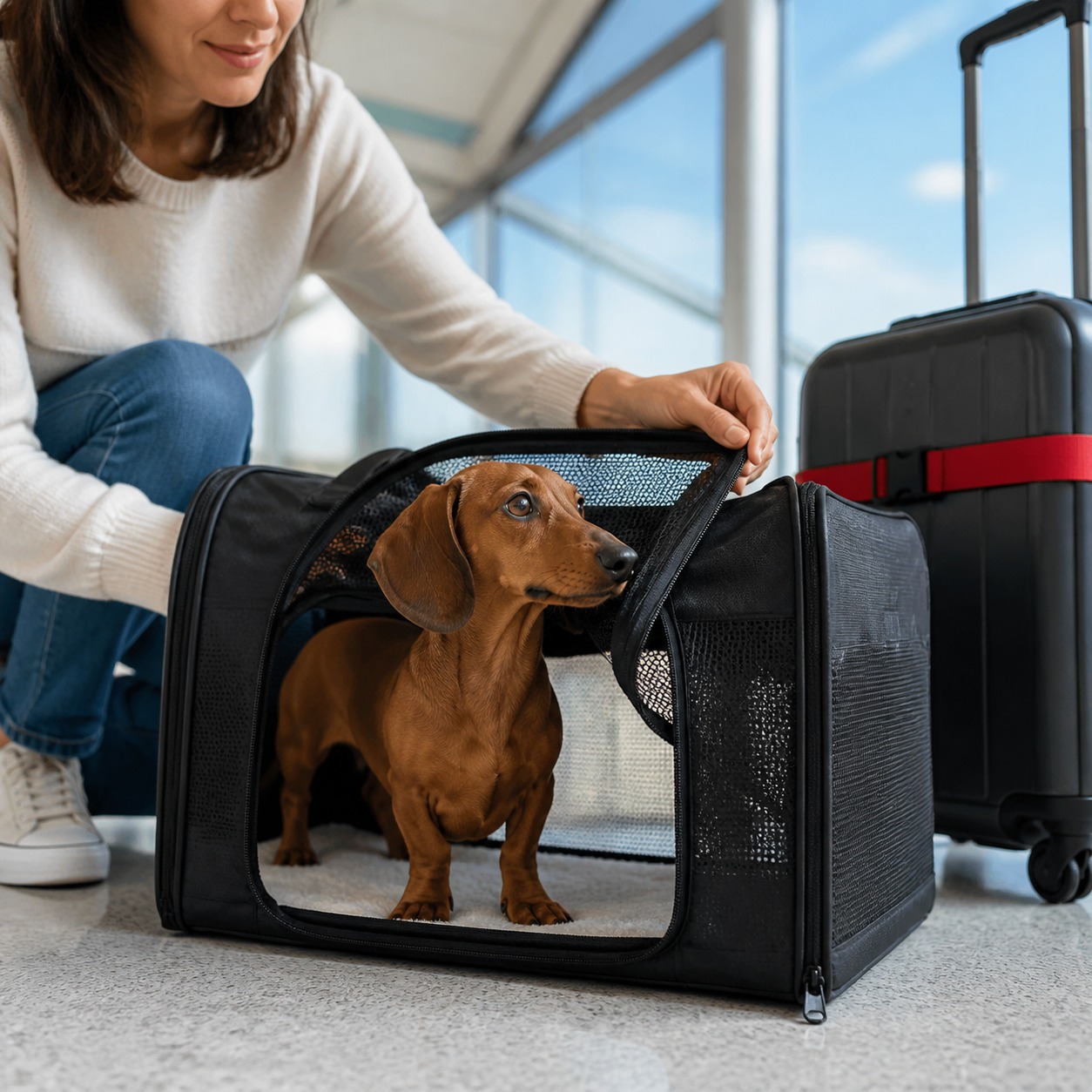
There is no single best small-dog carrier, and any list that crowns one is solving the wrong problem. A carrier is a tool, and the right tool depends entirely on the trip. The padded, hard-shell box that protects your dog in a fender-bender is a miserable thing to lug through a mile-long airport connection. The featherweight sling that’s perfect for a walk to the café offers almost no protection in a car. Buy for the journey you actually take most, not the one in the catalog photo.
So instead of ranking carriers, this is a map. Figure out your trip type, learn the one or two things that make or break a carrier for it, and the choice narrows itself.
The most common mistake I see is people buying one carrier and expecting it to do everything. The dog that flies twice a year and rides in the car every week needs the car-safe carrier first, not the airline one.
Start with the measurement that disqualifies carriers
Before anything else, if there’s any chance you’ll fly, internalize one number. Most major U.S. airlines, Delta, United, and American among them, have settled on a maximum in-cabin soft carrier of about 18 by 11 by 11 inches. But the published number hides a trap: the actual under-seat clearance changes from plane to plane, and the height can drop to around 9 inches on some aircraft. That’s why a soft-sided carrier that compresses is far safer than a rigid one that measures “legal” on paper but won’t physically fit. The rule of thumb: your dog should be able to stand up and turn around inside, while the carrier can still squish to clear the seat in front. Confirm your specific airline and aircraft before you commit, because a carrier that doesn’t fit can mean a denied boarding at the gate.
For flying: prioritize fit, ventilation, and layovers
For air travel, the carrier exists to satisfy two masters at once, your dog’s comfort and the airline’s tape measure. Look for airline-stated dimensions, mesh on at least two sides for airflow (critical for flat-faced breeds, who overheat easily and do badly in a tote that molds to the body), and a flat, padded bottom so your dog isn’t sliding around. For anything longer than a direct hop, weigh the layover. A carrier with stowable wheels that you can roll rather than carry is a back-saver when a connection means walking a mile through a terminal. The fancier the carrier looks is irrelevant at 30,000 feet; ventilation and fit are everything.
For the car: prioritize crash protection
Here the priorities flip. A loose dog in a car is a projectile in a crash and a distraction the rest of the time, and unrestrained pets are far more likely to be injured in an accident. The car is the one place a hard-sided carrier earns its bulk, because it holds its shape on impact, and it can be seat-belted into the back seat for a second layer of protection. Give your dog a little more room to move than you would on a plane, since space isn’t the constraint, and look for a crash-tested model if you drive with your dog regularly. A bonus that surprises owners: many dogs come to read a familiar carrier as a den, a safe space, which actually lowers travel anxiety rather than adding to it.
For adventures: hands-free, with a caveat
Backpack and front-sling carriers are built for hiking and the trail, freeing your hands and letting many dogs ride with their head out to take in the view. They’re genuinely fun for the right dog. The caveat is real, though: because they lack structure, they can leave a dog wedged in one position with no room to shift, stand, or stretch. That makes them a poor fit for senior dogs or any dog with arthritis or joint issues, who can stiffen up uncomfortably on a long carry. Check that your dog’s weight is manageable on your own back and shoulders, too, a carrier that’s comfortable for the first mile can be punishing by the third.
For the daily commute: portability with a barrier
For the work commute, the café, and the bus or train, a hand-held or shoulder-carried tote is the sweet spot, light, quick to set down, and easy to slip onto a seat. There’s an underrated social benefit here, too: a fully zipped tote creates a barrier between your dog and the world, so well-meaning strangers and other dogs can’t reach in to touch a dog who’d rather not be touched. The honest downside is that these tie up your hands and grow heavy on the arm, so if you’re already juggling a coffee and a bag, factor the extra load. For frequent commuters, a convertible tote with a shoulder strap and a structured base beats a pure handbag style.
The one-carrier compromise (and when to skip it)
If you truly take only one kind of trip, or you’re on a tight budget, a well-ventilated soft carrier in airline dimensions with a padded base is the closest thing to a do-everything pick: it flies, it slings over a shoulder, and it can be belted into a car in a pinch. But “in a pinch” is the operative phrase. If you drive with your dog often, don’t compromise on the car carrier, crash protection isn’t a feature you want to discover you skipped. Match the carrier to your most frequent and your highest-stakes trip, and let the rare trip make do.
References
- Delta Air Lines. “Pet Travel: In-Cabin Carrier Requirements.”
- United Airlines. “Traveling With Pets: In-Cabin Carrier Dimensions.”
- American Veterinary Medical Association. “Traveling With Your Pet.”
- Center for Pet Safety. “Crash-Test Ratings for Pet Travel Products.”
Common questions
What size carrier do airlines allow in the cabin?
Most major U.S. carriers, including Delta, United, and American, have converged on roughly 18 by 11 by 11 inches for a soft-sided in-cabin carrier. The catch is that under-seat height varies by aircraft and can be as little as 9 inches, so a soft carrier that can squish down clears the bar more reliably than a rigid one. Always confirm the limit for your specific airline and plane before you book.
Is a soft or hard carrier better?
It depends on the trip. Soft-sided carriers flex to fit under an airplane seat and are lighter to carry, which makes them the default for flying and walking. Hard-sided carriers offer more crash protection and are the safer pick for car travel, where they can be belted in.
Are backpack carriers safe for any dog?
Not for every dog. They free your hands and many dogs enjoy poking their head out, but their soft, unstructured shape can leave a dog stuck in an awkward position. They're a poor choice for senior dogs or any dog with arthritis or other musculoskeletal issues, who need room to shift and stand.
James Okafor covers rescue, adoption, and the causes shaping animal welfare. His work follows the people and organisations working to give more pets a home, and the issues owners and advocates care about most.
Meet our experts ↗Keep reading
 LivingThe Flight Is the Easy Part of Flying With Your DogDr. Ravi Mehta · 6 min
 Product PicksThe Subway Banned Loose Dogs. One Backpack Is the Loophole That Actually Works.Marcus Webb · 4 min
 Product PicksLet Your Dog Carry Their Own Poop BagsSasha Ford · 4 min
 Product PicksOnly One Piece of Dog Car Gear Actually Saves Their LifeMarcus Webb · 8 min
 Product PicksThe Hiking Harness Buyer's Guide: Fit First, Then the 9 We'd PackLeila Torres · 16 min
 Product PicksSenior Dogs Don't Have a Pity Problem. They Have a Visibility Problem.Nina Vasquez · 7 min