


The Hiking Harness Buyer's Guide: Fit First, Then the 9 We'd Pack
The best hiking harness is the one that fits and has a handle you can trust. Here is how to size and fit a trail harness, when a load-bearing handle matters, and the nine harnesses our team would clip on for every kind of dog and trail.

Affiliate disclosure. This article contains affiliate links. We may earn a small commission if you buy through a link, at no extra cost to you. How we handle recommendations.
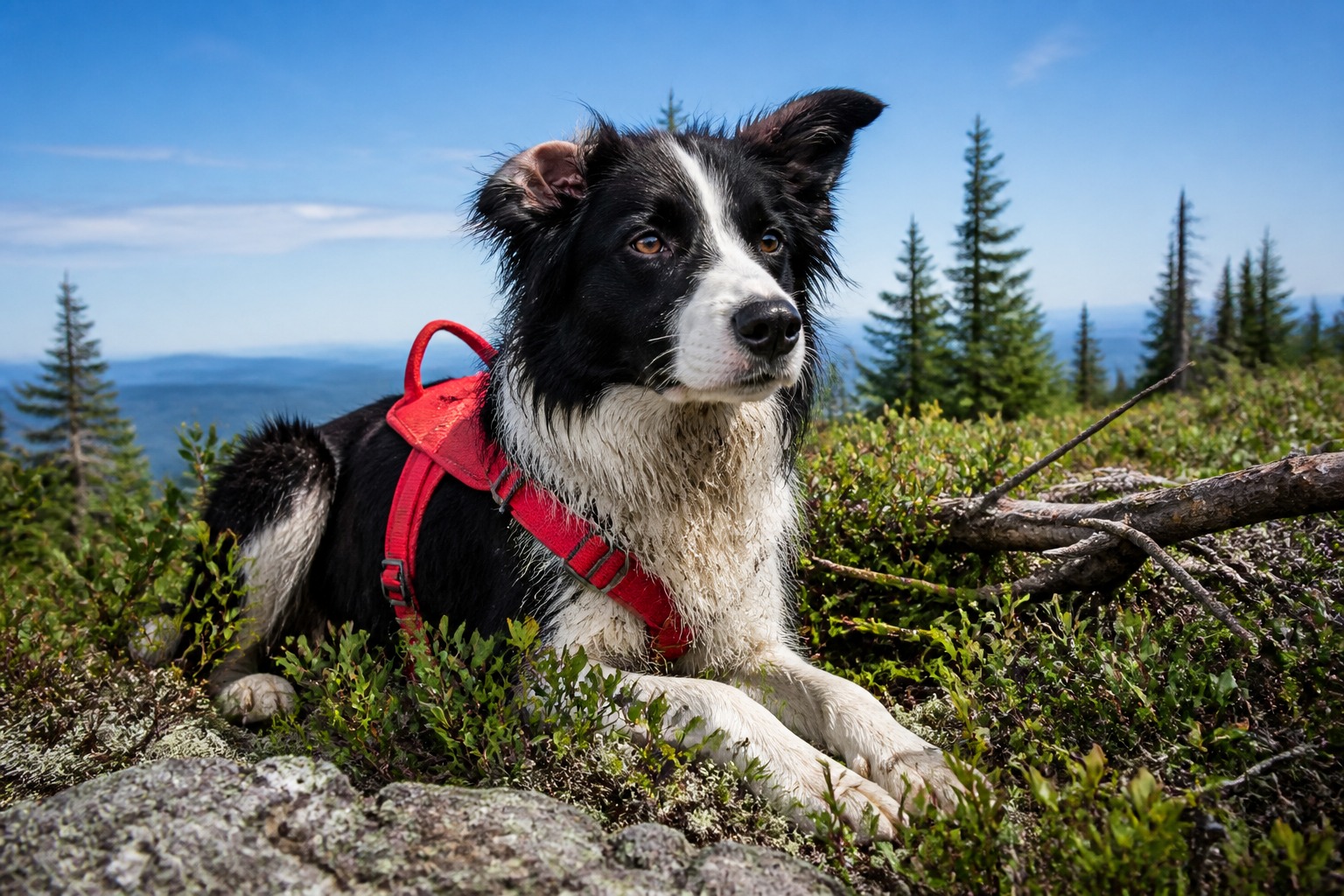
The handle is the part nobody talks about until they need it. You are picking your way across a creek on wet rock, your dog plants a paw wrong, and in half a second you either have a grab handle on their back or you do not. That single feature, plus a fit that does not rub them raw three miles in, is what separates a hiking harness from a walking harness with a marketing photo of a mountain on the box.
So before we get to the gear, we are going to do the part most roundups skip: how to fit a trail harness, and how to decide which features your dog actually needs. Pick the harness that matches your dog and your terrain, and the brand name barely matters. Get the fit wrong, and even the best harness on this list will chafe, slip, or ride up into the throat.
Start with fit, because fit is the whole game
A harness that looks perfect in the driveway can still fail on the trail. Here is the order we fit every harness in.
Measure two numbers, not one. Wrap a soft tape around the widest part of the chest, just behind the front legs, and around the base of the neck. Match both numbers to that specific product’s size chart. Do not size by weight. A barrel-chested 40-pound Boxer and a lean 40-pound Pointer often wear different sizes, and the chart is the only thing that knows that.
Use the two-finger rule, then ignore it. Once the harness is buckled, you should be able to slide two flat fingers under any strap, including the band behind the front legs. That is your starting point. The American Kennel Club uses the same test for collars and harnesses. But the real test is movement: have your dog walk, trot, sit, and shake. A harness that sits clean while they stand can creep into the throat, twist when leash tension builds, or saw at the armpits once they move. Judge the fit after a few minutes of walking, not at the trailhead.
Watch the armpits. The single most common hiking-harness injury is chafing where the chest strap meets the leg. After a few outings, check behind the front legs and across the chest for broken fur, pink skin, or raw spots. If you see them, the harness is rubbing in motion, and the fix is almost always re-measuring and re-adjusting, not more padding.
“People reach for a bigger size or thicker padding to fix rubbing, when nine times out of ten the strap is just sitting in the wrong place,” says Dr. Mara Chen, a Pet Times veterinary contributor. “A harness that fits and an adjustable one are not the same thing. You want both: the right size, then the straps dialed in so the chest panel carries the load and nothing rides into the armpit.”
Then decide which two features your dog actually needs
You do not need every feature. You need the right two for your terrain.
A load-bearing handle is the feature to prioritize if your trails have scrambles, water crossings, ledges, or wildlife you might need to steer around. Not every handle is equal. A handle sewn right behind the neck will lift the front end and choke the back end; a handle set farther back, over the spine, supports the whole body when you boost your dog over an obstacle or pull them out of harm’s way. If you will ever lift your dog, buy the harness that is built to be lifted by.
Ripstop fabric and padding matter most for rough, brushy, or rocky terrain where the harness takes abuse. For mellow trails and fire roads, breathable mesh is cooler and lighter and perfectly safe.
Reflective accents and a light loop earn their place if you hike at dawn, dusk, or in dense forest where you can lose sight of a dog twenty feet away.
Front and back leash clips give you options: the back clip for relaxed trail walking, the front clip for a dog who still pulls and needs redirection.
A quick note on overhead versus step-in styles. Overhead and vest harnesses are harder to back out of, which is why they dominate this list. Step-in harnesses are easier on dogs with limited shoulder mobility and small dogs who hate things going over their head, but they offer less coverage and protection, so save them for easy trails.
How we picked
Every harness below is one our team or our contributors have used on real trails or that our shopping editors have fit on real dogs. We weighted fit adjustability, handle quality, durability against terrain, and visibility, and we noted who each one is wrong for, not just who it is right for. We trimmed the list to nine because one common “best reflective” pick on competing roundups is functionally a near-duplicate of a better tactical harness; we kept the stronger one.
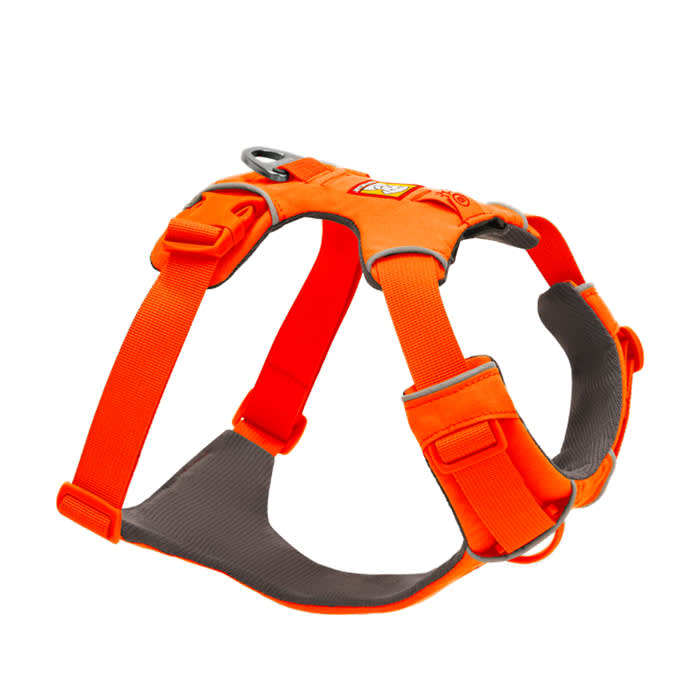
Ruffwear Front Range Dog Harness
The Ruffwear Front Range is the harness we hand to most people because it gets the fundamentals exactly right without overbuilding. Foam-padded ripstop, four points of adjustment, front and back clips, reflective trim, and a tidy ID pocket so tags stop jangling. It is shockingly light, which is why it works on a 14-pound dog as well as it works on a 70-pound one, and it comes in five sizes up to a 42-inch chest.
The honest limitation, and the reason it is not our pick for serious terrain, is that the Front Range has no lift handle and only two clips. It is a superb daily-and-light-trail harness. If your hikes stay on groomed paths, it may be the only harness you ever need.
Best for: daily walks and easy-to-moderate trails, dogs of almost any size, boxy small dogs. Skip if: you need a lift handle for scrambles or water.
Pros: four-way adjustable, front and back clips, reflective seams, beacon light loop add-on, ID pocket, 11 colors and five sizes, very light. Cons: no handle; some dogs dislike the overhead design. Rating: 5/5
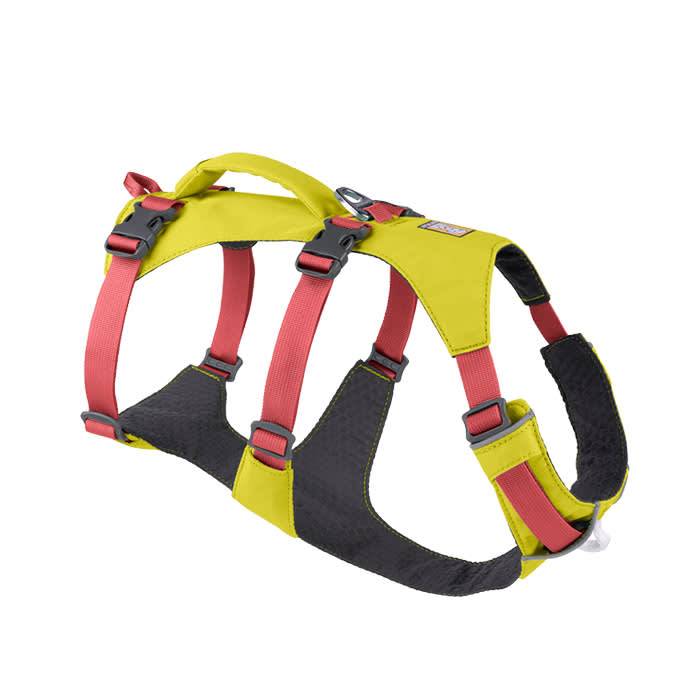
Ruffwear Flagline Dog Harness
When the terrain gets vertical or wet, the Ruffwear Flagline is the one we reach for, and it is the harness that best embodies this guide’s whole argument. It has six adjustment points, tied for the most of any harness we have tested, so you can dial in an odd body shape. More important, its handle sits far back over the spine and its chest-and-belly panel distributes the load, so a boost over a boulder lifts the whole dog instead of choking the front end. The elongated body also sits farther back, which makes it genuinely hard for an escape artist to back out of, and that same trait makes it many owners’ top choice for three-legged dogs.
One tradeoff worth knowing: the Flagline has slightly less body coverage than some bulkier harnesses, which is a feature in sustained heat above the mid-80s and a small drawback in cold, brushy terrain.
Best for: rugged trails, water crossings, long or lanky dogs, tripods, and escape artists. Skip if: you want the simplest, fastest harness for flat neighborhood walks.
Pros: six-way adjustable, load-dispersing chest and belly panel, well-placed lift handle, three clip options, reflective, hard to escape. Cons: limited colors; more straps to fuss with. Rating: 4.8/5
“When fit correctly this harness is escape proof. After a scary moment where my pup slipped out of another brand and tried to bolt, the peace of mind is worth every penny. The handle and three clip options are genuinely useful.” —verified Ruffwear buyer
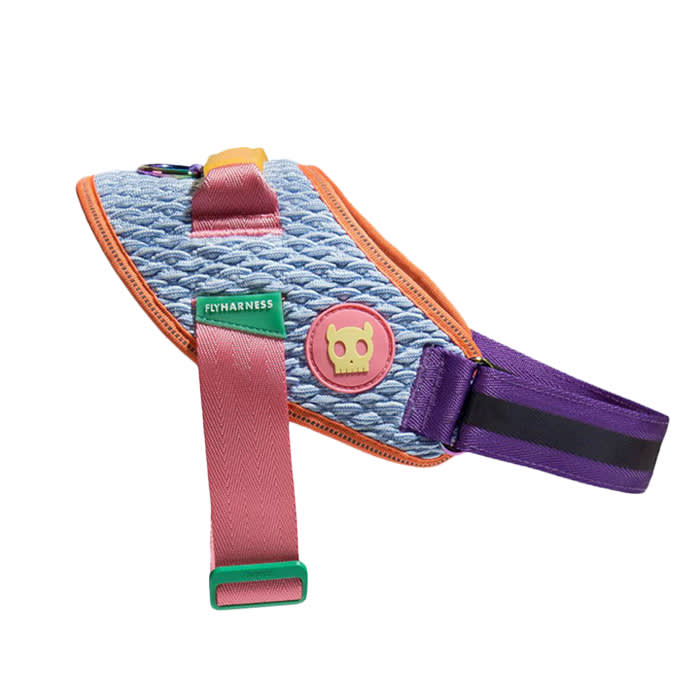
Zee.Dog FlyHarness
Style does not have to mean style over substance. The Zee.Dog FlyHarness uses a 3D-knit material borrowed from athletic sneakers, which is what makes the colorblock looks more than a gimmick: the knit breathes, flexes, and distributes pressure across the shoulders and chest, so pulling is less jarring. Thick adjustable straps, front and back clips, a handle, reflective seams, and a matching rope leash in the box.
Best for: owners who want a head-turner that genuinely handles moderate trails. Skip if: you need ripstop toughness for rocky, brushy routes.
Pros: breathable 3D-knit, four-way adjustable, front and back clips, handle, comes with a leash. Cons: limited colorways. Rating: 4.6/5
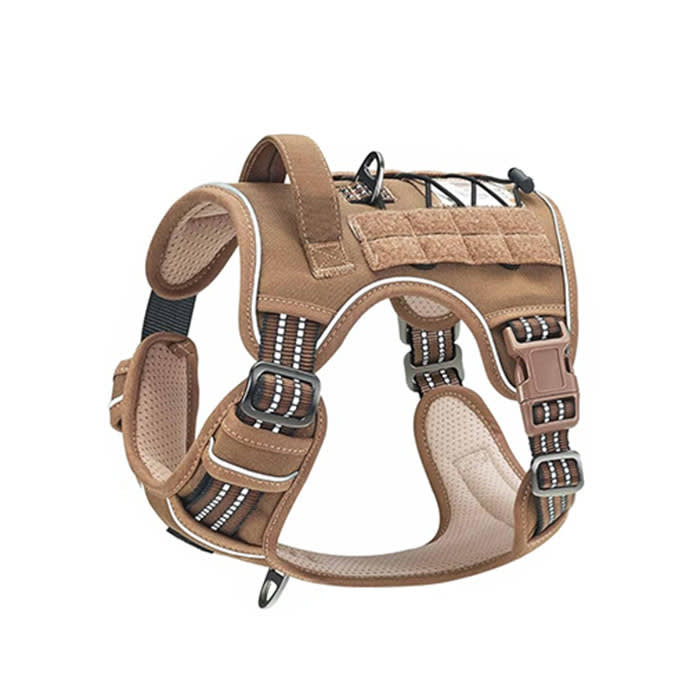
Beebiepet Heavy Duty Tactical Dog Harness
If you have a large, strong dog who leans into the leash, the Beebiepet Heavy Duty Tactical harness gives you control without a premium price. Reinforced nylon, a four-way adjustable fit, front and back clips, a sturdy handle, and Velcro panels for patches. The catch is the plastic buckles, which are fine for most use but are the part most likely to wear before the webbing does, so inspect them periodically.
Best for: large dogs who pull, owners who want a rugged look on a budget. Skip if: you want metal hardware throughout.
Pros: military-grade nylon, reflective seams, handle, front and back clips, 12 colors and five sizes. Cons: plastic buckles. Rating: 4.4/5
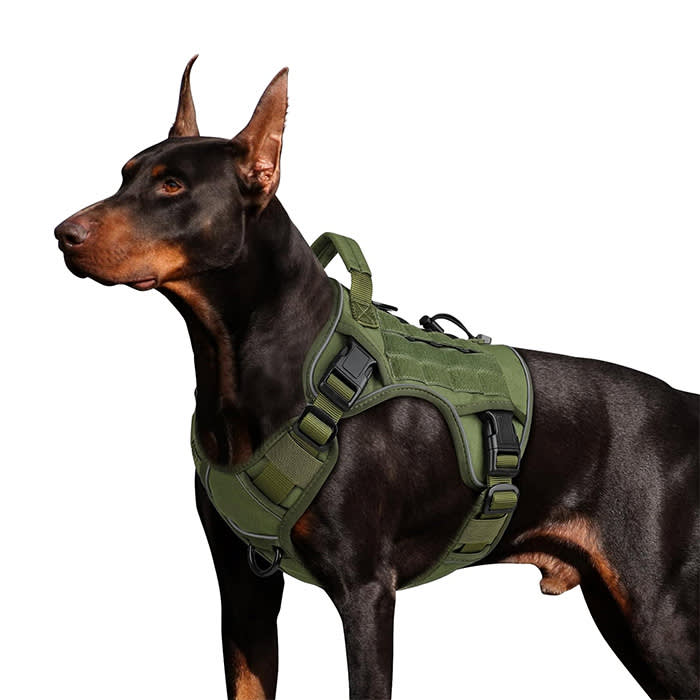
WINGOIN Tactical Dog Harness
For the toughest-looking, hardest-wearing option here, the WINGOIN Tactical is padded military-grade nylon with reflective seams, a heavy-duty handle, reinforced gear loops, and an interior ID label. It is built to weather any terrain. The four-way adjustable fit is key with this one: shoppers who report dogs escaping almost always sized it loose, so fit it carefully using the steps above.
Best for: all-terrain hiking, dogs who carry small gear loads, owners who want maximum durability. Skip if: your dog overheats easily; the dense build runs warm.
Pros: padded military-grade nylon, quick-dry, four-way adjustable, handle, ID label, gear loops, 10 colors. Cons: runs warm; must be sized carefully to prevent escapes. Rating: 4.5/5
“Minimal but tough, and easily adjustable. The back D-ring and the stitching on the webbing are heavy-duty, and the reflective accents make it easy to spot our dog at night. He has worn it ten hours without a problem, and the rub points are well padded.” —verified buyer
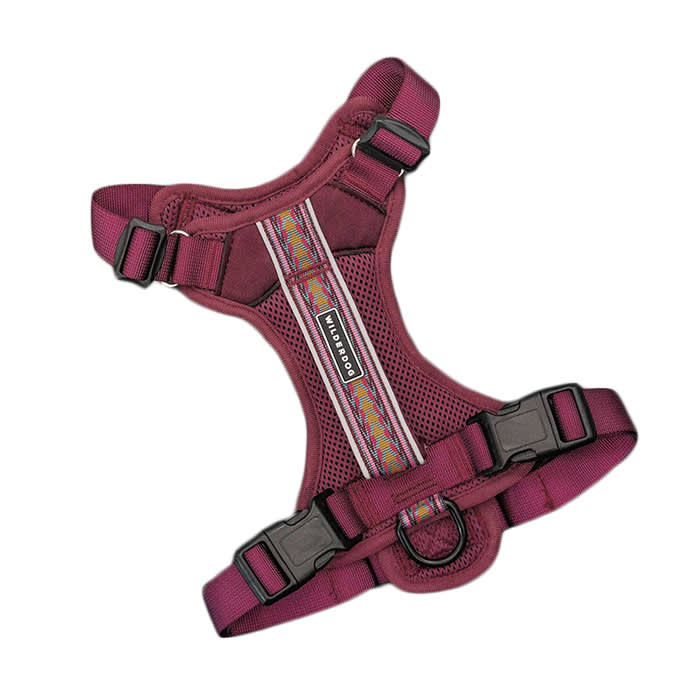
Wilderdog Dog Harness
When the trail is mellow and the day is warm, padded mesh beats ripstop on comfort. The Wilderdog Harness is a breathable, four-way adjustable, handled harness that washes easily and dries fast after a creek dip. Because it is not ripstop, treat it as a fair-weather, easy-trail harness rather than a rock-scrambling one.
Best for: warm-weather walks and easy trails, dogs who run hot. Skip if: you tackle rough or brushy terrain that demands ripstop.
Pros: breathable padded mesh, four-way adjustable, handle, dries fast, seven colors. Cons: plastic buckles, not heavy-duty, limited sizing. Rating: 4.5/5
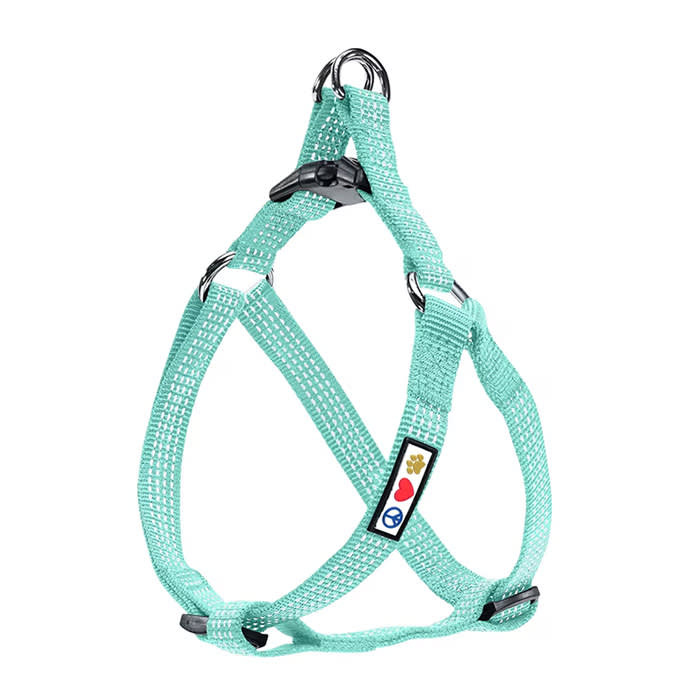
Pawtitas Nylon Reflective Step-In Dog Harness
For a small dog who hates anything over the head, or any dog on short, easy outings, the Pawtitas step-in is light, colorful, fully reflective, and quick to put on. Its honesty is also its limit: no padding and minimal coverage mean it is not built for strenuous or rocky hikes. Treat it as a stroll-and-easy-trail harness.
Best for: small dogs, head-shy dogs, short flat outings. Skip if: you want protection on demanding terrain.
Pros: two-way adjustable, reflective all around, easy on and off, 10 colors. Cons: little protection. Rating: 4.1/5
“We tried other styles and our Aussie could slip out when he pulled. This one feels snug and secure. It is a keeper.” —verified buyer
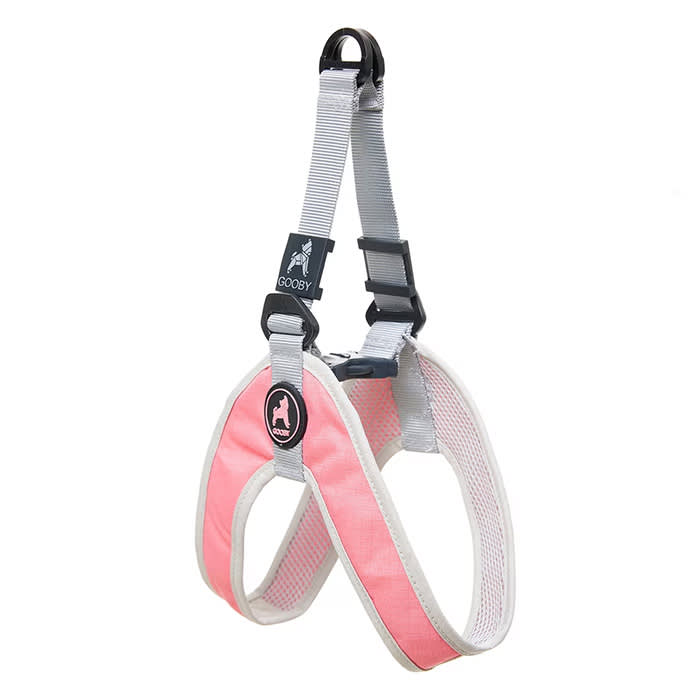
Gooby Simple Step-In III Dog Harness
If you want the easy on-and-off of a step-in but more support, the Gooby Simple Step-In III uses wider straps for better weight distribution and control, plus thick reflective seams for low light. It is a favorite for flat-faced breeds and small dogs who do better with chest pressure than neck pressure. Watch for underarm chafing with the wraparound design, and fit it using the armpit check above.
Best for: small and flat-faced dogs, owners who want padded step-in convenience. Skip if: your dog has a deep chest the wraparound rubs.
Pros: reflective straps, breathable mesh, good chest-pressure distribution. Cons: can chafe the underarms if mis-sized. Rating: 4.5/5
“Finally one that works for my French Bulldog. He can’t wear a collar on a walk, and other harnesses knotted up his shoulders. This puts the pressure on his chest, exactly where it should be.” —verified buyer
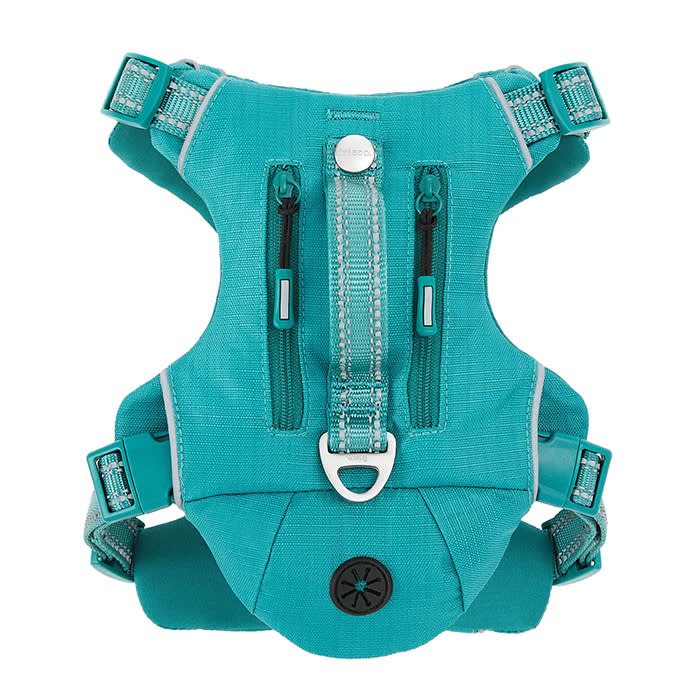
Frisco Outdoor Premium Ripstop Nylon Dog Harness
For dogs who can carry a little of their own kit, the Frisco Outdoor Premium has zippered pockets for treats and waste bags, durable ripstop nylon, reflective seams, a handle, and chest-and-back D-rings. It is a genuine trekking harness at a friendly price, and the built-in bag dispenser is a small touch owners love.
Best for: longer day hikes where your dog carries small items. Skip if: you want a barebones, no-pocket harness.
Pros: four-way adjustable, handle, two zip pockets, ripstop nylon, four sizes. Cons: limited colors. Rating: 4.4/5
“Durable and adjustable, with two large pockets for treats and a poop-bag dispenser at the end. The clips are great. Highly recommend.” —verified buyer
The short version
Fit beats brand. Measure two numbers, match the chart, then judge the harness after your dog moves, not while they stand. Decide whether you truly need a lift handle (scrambles, water, wildlife) and whether you need ripstop or mesh (rough versus mellow trails), and let those two answers pick your harness. For most people the Front Range is enough; when the terrain gets serious, the Flagline’s far-back handle and load-dispersing panel are the upgrade that matters.
References
- American Kennel Club. “How Should a Dog Harness Fit?” akc.org.
- Treeline Review. “6 Best Dog Harnesses of 2026 (Tested & Reviewed).” treelinereview.com.
- Ruffwear. “Choosing the Right Dog Harness.” ruffwear.com.
- Dogster. “How Should a Dog Harness Fit? Types, Ideal Size and Measuring Tips.” dogster.com.
Common questions
How tight should a hiking harness be?
Use the two-finger rule: once buckled, you should be able to slide two fingers flat under any strap, including behind the front legs and across the chest. Then make your dog move. A harness that passes the finger test standing still can still ride up into the throat or rub the armpits once they trot, so judge the real fit after a few minutes of walking, not at the trailhead.
Do I need a harness with a handle for hiking?
If your trail has scrambles, water crossings, drop-offs, or stretches where you might need to steer your dog away from wildlife, yes. A load-bearing handle lets you lift or redirect your dog instantly. For flat, mellow trails a handle is a nice-to-have rather than a must. What matters is that the handle is rated to lift and sits far enough back to support the body, not just yank the neck.
What size hiking harness does my dog need?
Measure the widest part of the chest (the girth, just behind the front legs) and the base of the neck, then match both to the specific product's size chart rather than guessing by weight. Two dogs at the same weight can take different sizes. Prioritize an adjustable design so you can dial in the fit as your dog's coat thickens or thins with the seasons.
How do I know if a harness is chafing my dog?
Check the armpits, chest, and behind the front legs after hikes. Patches of broken or missing fur, pink or raw skin, or a dog who keeps stopping to scratch at the straps are the tells. Padding helps, but chafing almost always traces back to fit, so re-measure and re-adjust before you blame the harness.
How much should a good hiking harness cost?
You can find a serviceable trail harness in the teens and a trail-ready, padded, handled one in the $30 to $50 range. Heavy-duty tactical builds run $50 to $80. Spend the most on the strap that will actually carry weight: if you will ever lift your dog by the handle, buy the load-rated harness.
Leila Torres leads our Living coverage, from home life and travel to the products and rescue stories that come with sharing a life with animals. She edits and writes across the section, with a soft spot for pieces about the bond between people and their pets.
Meet our experts ↗Keep reading
 Product PicksTheir First Dog Backpack Fell Apart in Two Weeks. So They Built One That Doesn't.Sasha Ford · 7 min
 Product PicksLet Your Dog Carry Their Own Poop BagsSasha Ford · 4 min
 Product PicksMatch the Carrier to the Trip: A Buyer's Map for Small-Dog TravelJames Okafor · 8 min
 Product PicksBefore You Buy a Dog Backpack Carrier: The Weight Math and 9 Packs Worth ItDr. Nina Kohl · 8 min
 LivingThe Flight Is the Easy Part of Flying With Your DogDr. Ravi Mehta · 6 min
 Product PicksBuild Your Dog's Pool-Day Kit in the Right Order: Safety First, Toys LastDr. Mara Chen · 7 min